• About

Stevemayne's Blog

~ Spending time on my family tree

Stevemayne's Blog

Category Archives: Opinion

Dealing With The Government

13 Friday Oct 2023

Posted by Steve Mayne in Opinion

≈ Leave a comment

Tags

Government, pension

Or “Struggling With The Feds”

I’ve had occasion to deal with Service Canada, or the Feds, just recently, and as ever it’s been like wading through treacle. It’s not difficult, and the people are really nice, it’s just the processes are labyrinthine in nature and glacial in progress.

I’ve been trying to apply for my Canada Pension Plan (CPP) payouts for a while now. One thing the Feds are quite good at is running a good online system, but not on this occasion. Each time I went into their website and logged on successfully, the system told me that the CPP applications system wasn’t available. I tried it on various browsers, in various operating systems, but each time I hit “Error 500, System Unavailable”.

Eventually, I got around to visiting my local Service Canada office to see what was going on. The very nice people there scratched their heads for a few minutes then, after a delve into their computers, said what no one wants to hear, “You’re not on the system”. Bugger, I thought.

This was all a bit perplexing, though, as I had logged into the Government system using my Insurance number, and been recognised. I had in the past applied for and received Employment Insurance benefits from the very same people that handle the CPP. What on earth was going on? Then came the next thing you never want to hear, “You’ll need to apply using a paper application form”. Bugger (again), I thought.

They gave me a sheaf of papers and said I could fill the form in there, but it required more information than I had to hand (actually my banking details, the same details they had used to pay my other benefits). I was on the point of giving up, at least in the Service Canada office, when the nice lady came over and gave me another sheaf of forms, this time for Old Age Security (OAS, a benefit automatically payable to oldies like me, which is supposed to happen without input from me). “You’re not on the system” she said, “So you’d best fill this in as well”. Bugger, I thought, for the third time.

Of course, the second form asked for all of the same information that the first for asked for; God forbid that “the system” could pull details that were identical from one application to another.

I did say to the nice lady that I must be on the system because I’d used it a few times, but all she could say was “Different systems”.

Then it dawned on me why I couldn’t apply online. The system wasn’t unavailable in general, just to me. Ah, you live and learn.

So, I brought the forms home, filled them in, and returned the completed articles to the nice people at Service Canada. Of course, processing paper applications takes far longer than the online application, so I guess I shall have to wait.

The ironic thing is that both my CPP and OAS payments are going to be miniscule. But, I’ve paid into both schemes, so I want my return, but what a lot of unnecessary work.

Of course, I’m really not complaining. It’s great to live in a country that has such good Government sponsored schemes that are not at the mercy of commercial interests, and “the market”. I just wish the processes were a wee bit more swept up.
Highways and Byways

13 Friday Oct 2023

Posted by Steve Mayne in Opinion

≈ Leave a comment

Tags

Driving, School Bus, Work

Or “You Want Me To Drive This Bus Where?”

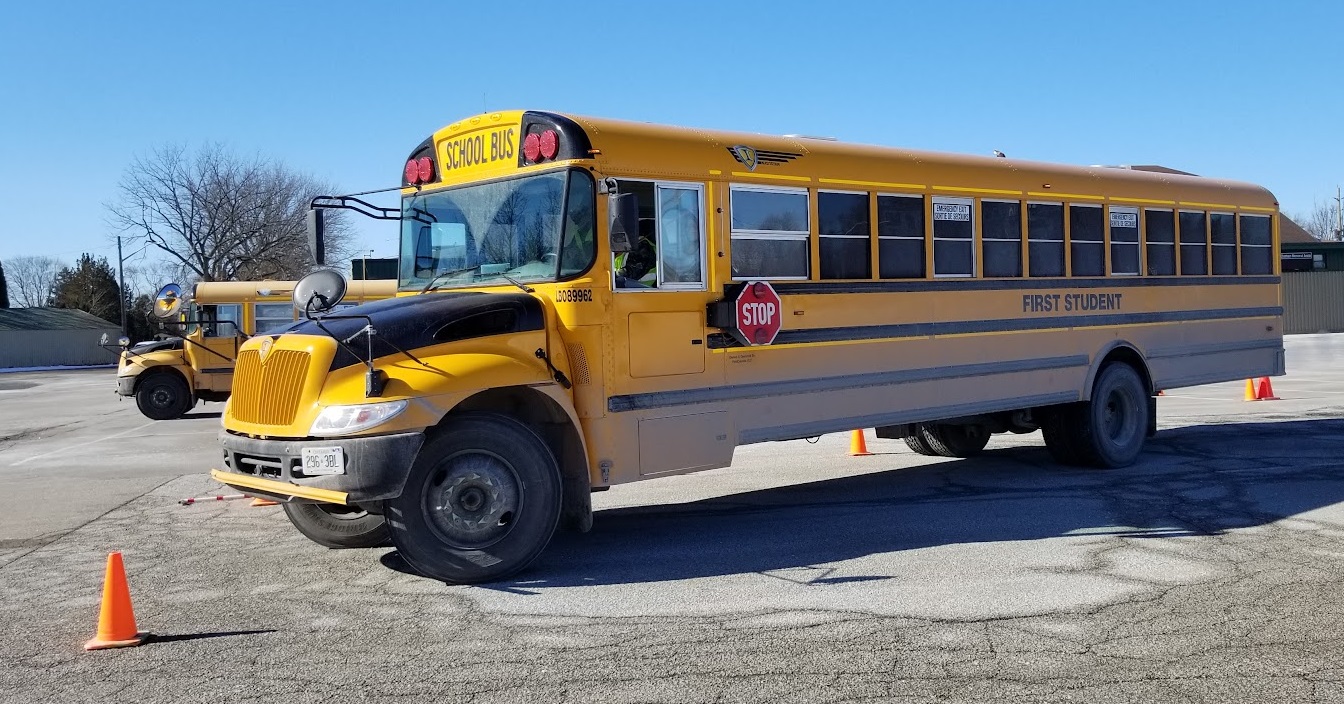
When I rebooted this blog, I promised some school bus tales, so here goes.

Training to drive the bus wasn’t too difficult, despite the obvious differences between it and a car. Off-road training and on-road training, as well as many hours in the classroom, had me set up to pass the Ontario B Class licence tests without too many issues. Of course, all that training really didn’t prepare me for the bulk of the challenges to come. There were students to consider, schools, and the thousands of little roads in and around the school district, most of which I’d never heard of.

On my first day driving a bus route, I did have the benefit of an experienced driver come with me. It was a dark and very cold January morning that I headed out to Townline Road, a gravel track out towards Lake St. Clair. I had my map (not easy to read in the dark), but I had never been this far west of the City, and had hardly driven a bus in the dark at all, so it was all very challenging. Add to the mix that my fingers were frozen (buy some decent gloves, I thought) and the fact that I was pretty nervous, and it all added up to a tough start. I do still remember picking up my first student, though, and she was still smiling when we got to school so I must have been doing something right.

The next day I was on my own, and my route timings were terrible. Being new, I did everything slowly, and ended being late to school for the first run, then late for the second run’s start, and even later to that school. In the afternoon, the drivers waiting at my second run school were radioing to find out where I was, so late was I. It wasn’t that I got lost or anything, but until you get into the routine of it, and get to know your route, it all seems to take way too long.

With the added distraction of the students, mostly well behaved I will admit, I let some of that training I worked so hard at, go by the board, and worked on speeding up some of the processes, like loading and unloading. It was a case of concentrate on a few things then, when you’ve mastered them, work on a few of the other things. It took me a while to remember to check that tail swing on the corners, because I was so busy with the other stuff.

But it started to come together. I bought some better gloves, a light for my maps, and even some variable-focus lens glasses as reading the maps wearing my fixed focus glasses was difficult. I also started to find out about the locale. I had no idea just how far the school district extended, and for the longest time I was driving out on country roads that I really hadn’t known existed. Things were not helped by the fact that I couldn’t learn a specific route because as a new boy, I was put onto covering other people’s runs, so I had new maps and new places to drive all the time. Fortunately, map reading, and finding my way around, comes easily to me, so it wasn’t too long before a run out to Duart, or to Florence (relatively remote farming communities, both), were becoming a lot easier. Indeed, the Dispatcher had me doing different routes almost daily as I was both effective at covering them, and I was keen to learn and to take them on.

The first few weeks were also complicated by the Canadian winter, with ice and snow to deal with, and such cold that I hadn’t experienced before. The buses were heated, of course, but the for the first twenty-five minutes or so, it was like driving a freezer. More than once I had to stop the bus to hack ice off the windows, the mirrors and even the Stop sign. That said, as my abilities and knowledge improved, so did the weather, and by June and the summer vacation, I had the school district down, my route timings were where they should be and I had never been lost, nor had even the slightest of collisions, which wasn’t too shabby for a newcomer. Dealing with the students was another issue, though, and I tended to leave them to their own devices, especially as I had different routes most days. The little ones were noisy, the middle schoolers at the French language schools were difficult (not because they spoke French, they didn’t while they were on the bus, but it was more to do with a perceived entitlement, I think), and it took me a lot longer to get to grips with having to cope with kids running around the bus, and to drive the darned thing at the same time. I quickly came to appreciate the high school students as generally, if left alone, they just kept themselves to themselves.

I had a couple of wobbles when driving, at least early on. Getting called in to work very early (a consequence of my being overly helpful, I think) on a dark and snowy morning and having to drive out to Ridgetown in an old and rickety bus, had me questioning why I was doing this, because the pay was definitely not stellar given the effort required. A couple of times when students were being very difficult also had me thinking that it wasn’t worth the hassle, at least given the poor compensation. Then on other days, particularly when the mornings were lighter and the weather was warmer, it did seem like a pretty good job. Like the time I had some high schoolers from Wallaceburg laughing like drains and leading me on a circuitous round around Sombra, trading on my unfamiliarity with the place, having me drop them at their homes rather than their actual stops, all because I was struggling with the map. You lose some, you win some.

Even in those early days, though, I was getting the warning signs that the company I was working for were operating on a shoe string. Not that the buses were dangerous, or too many operational corners were being cut, but there was definite lack of investment, in equipment and drivers, that didn’t bode well for the future.

That’s for another day, though.

Family Tree

08 Sunday Oct 2023

Posted by Steve Mayne in Opinion

≈ Leave a comment

Tags

Cemeteries, Family Tree, History

Or: “How Big Does This Thing Get?”

I’ve been dabbling with my Family Tree, both my dad’s and my mum’s sides, for a while now, but only really took a serious interest when I was contacted by another member of my family doing the same thing. It was an unexpected contact, too, because it came from the United States, and I had always believed that both branches of my family were firmly rooted in the UK. My cousin on my dad’s side (4th, and once removed), for that was who it was, added an extra line atop my findings and all of a sudden I discovered an entire branch of the family in the US, and another in South Africa. Canada features in there as well, although not quite so directly. I had fondly thought that they’d never found their way out of Yorkshire.

I use Ancestry, expensive though it is, as my tool for compiling the tree. The links to various sources are almost instant, and are mostly correct. My relative count this year went from around a hundred to over a thousand, although the direct lines count for far fewer, of course. I’ve traced my dad’s family not only out of Yorkshire, before the bolder relations headed overseas, but to Exeter in Devon (UK), where my mother’s family come from, which is so much of a co-incidence. The oldest birthday for a traced relative is one Thomas Mayne, born around 1650, in Surrey, England. I haven’t been able to go so far back on my mum’s side, but there’s time for more research.

It’s quite exciting to delve into where the family has been. I vaguely remember my dad saying something about a relation coming from Silverton in Devon, but I dismissed it on the assumption that Yorkshire was the family base. He was right, though, and there is indeed a link to Silverton (now part of Exeter). I wish I’d not been so quick to ignore that hint. The bulk of the Maynes were in Victorian Leeds, many in the boot and shoe trade. They were poor and lived in some pretty squalid back to back houses in Leeds, and many died very young. Addresses are listed in census and burial records, but I could never find them on modern maps, especially since Leeds has gone through a few major urban renewals over the past one hundred years. That was until I discovered the National Library of Scotland’s online historic maps, and all of a sudden the streets that had long been swept away, reappeared and could be superimposed on modern maps. Schole’s Yard, Thomas’ Yard, and the rest, suddenly became real.

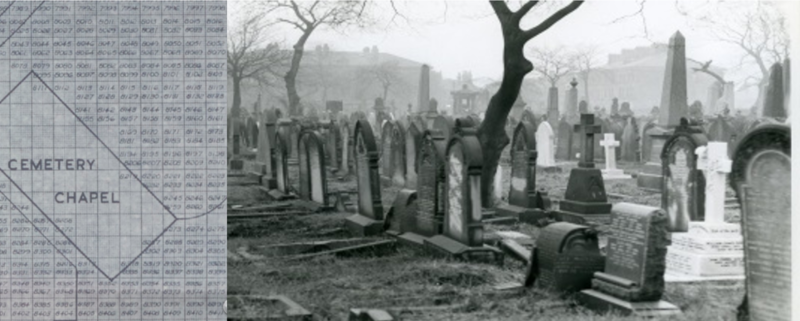
I also discovered the Leeds University project that has digitised the nearly 70,000 burials in the old Burmantofts Cemetery, now part of the University campus. I have found some detailed, and quite sad, records of my family there, like my Grandad’s three very young siblings who didn’t even make it to two years old. They weren’t visible through Ancestry either, probably because their births were not recorded, but the burial records are clear and accurate.

Finding out about the American branch of the family was fun, and I find that the city of Huntington in Indiana is where many of them made a name for themselves, and are buried in various local cemeteries there. There’s even a Mayne street. That’s only a few hour’s drive from me now, so next year I will head over there to explore.

The South African branch was successful, although the original Mayne who landed in Durban in 1849 came back to Leeds and died there after his wife died in South Africa. The bulk of their children stayed, though, and while most were farmers, some became involved with the DeBeer’s diamond mining operation and fairly made their fortunes. Curiously, one who certainly did well married into English money and spent her adult life at various smart addresses in London, including a big house on Portman Square. She died in Kensington, in the shadow of the Palace, and now rests with many of her family in Brompton Cemetery in London. The number of times I have been past that place and have known nothing of her.

Tracing your family can be all consuming, and you really have to keep a lid on things so you don’t fall into too many rabbit holes. I have joined forces with some other family members who are building trees like me, and we’re compiling quite a picture. I’m headed off to Leeds in a few weeks time to do a bit of family tree research, and to find a few of those graves so carefully catalogued over the years. I was born in Leeds, but have never really been back (except to get a cheap breakfast in IKEA), so it’ll be a voyage of discovery I think. I’ll also be in London, so I guess the Portman Square connection should be checked up on as well.

It’s all good fun, but beware if you’re limited on time, those family rabbit holes are everywhere.

Camping In The Rain

07 Saturday Oct 2023

Posted by Steve Mayne in Opinion

≈ Leave a comment

Tags

Airstream, Camping, Flood, Rain, Toyota

Or “Ark/Airstream”

We do like our camping, and in September 2021 we headed out to Science Hill Golf Course, close to St. Mary’s in Southern Ontario. We’re not golfers, but the place has a nice campground in rolling countryside, and it’s fairly quiet there, as well as being well located for doing some walking or exploring.

You can’t tell what the weather’s going to be like when you book, and when we arrived, the owner said that he thought we were in for some poor weather, despite it being quite nice at the time. He said we could camp on any free site and while I was about to pick one a little apart from some of the other trailers, I did note that the ground looked a little soggy, so I sought out slightly higher ground. How prophetic that turned out to be.

Our first night was wet, and got wetter. We’re not unused to rain, but after a slightly rainy start to the following day, thing went seriously downhill. It rained and rained and rained. I took the limping dog out a couple of times for her exercise, but she was sick and didn’t enjoy either the exercise or the rain (it turned out that this was to be her last but one camping trip as we had to have her put to sleep a few weeks later). We didn’t go out at all, just stayed in and watched the rain. It was hard to think that it would get any worse, but it did.

The rain became worse, the wind picked up and we were fairly rocking through the evening, and not in a good way. I’d left the short street side awning out to stop water ingress through the cooker exhaust vent (which turned out to be cracked), but the wind whipped at it and snapped it partly shut, thankfully with no damage.

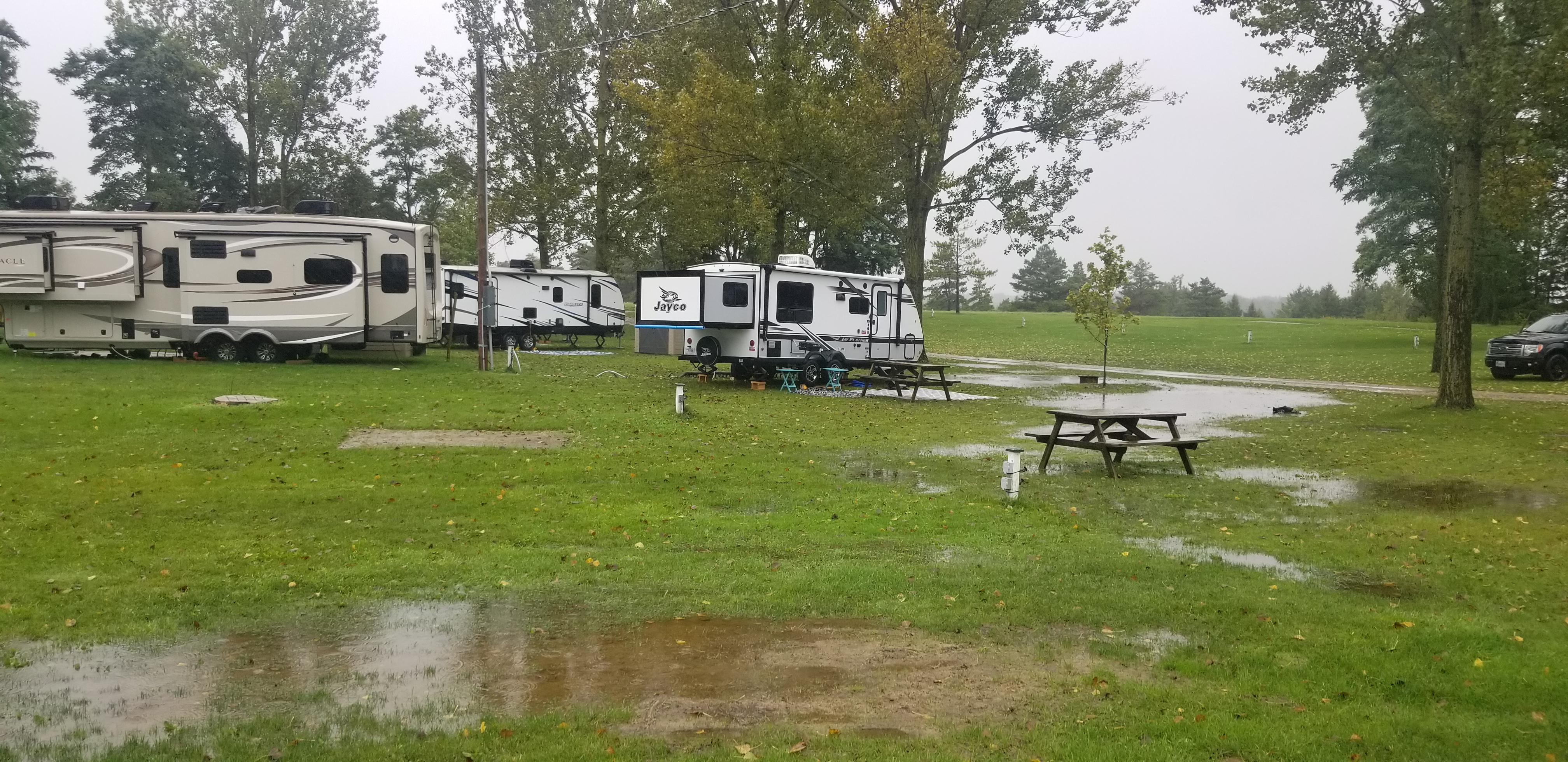
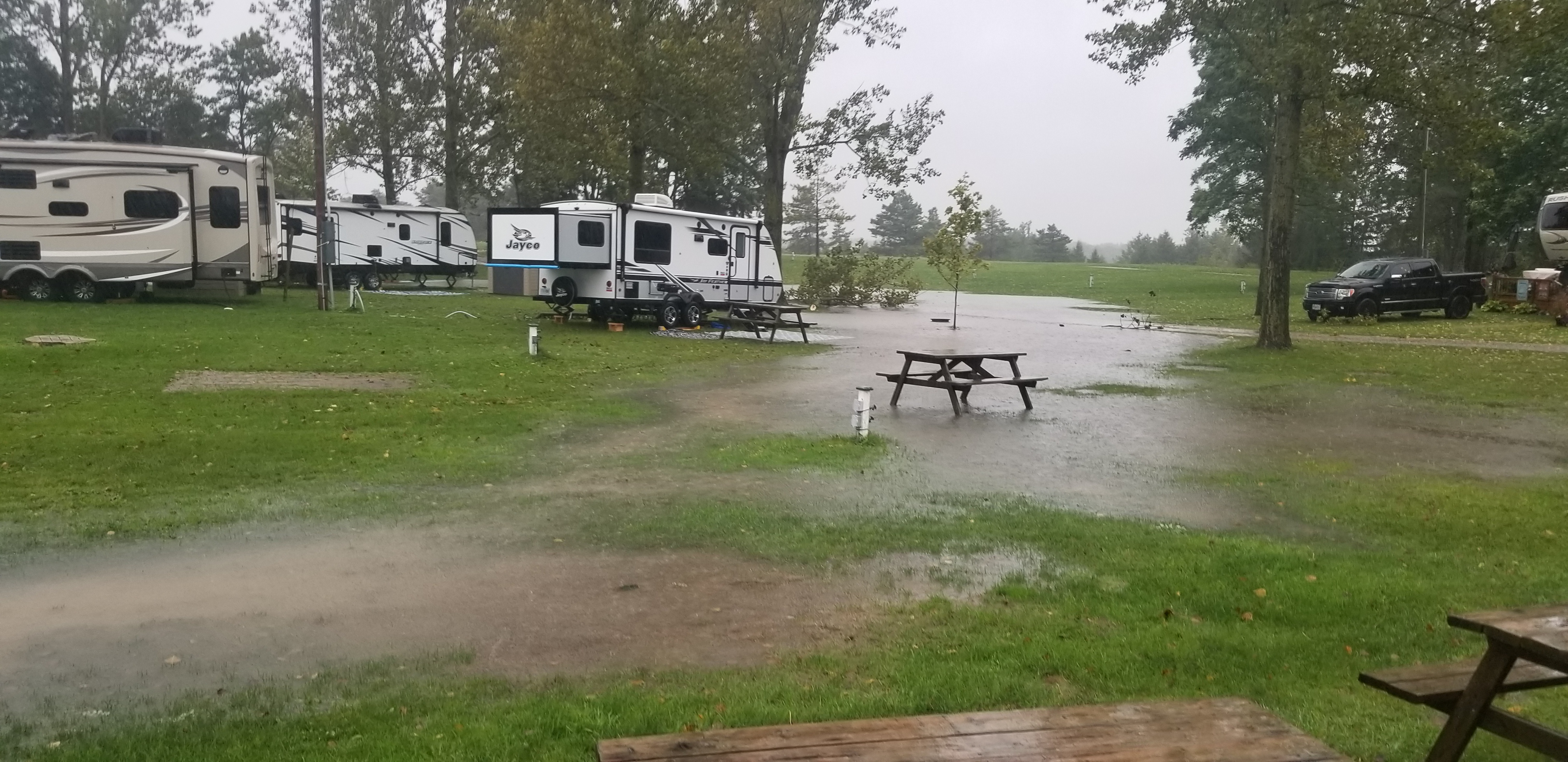
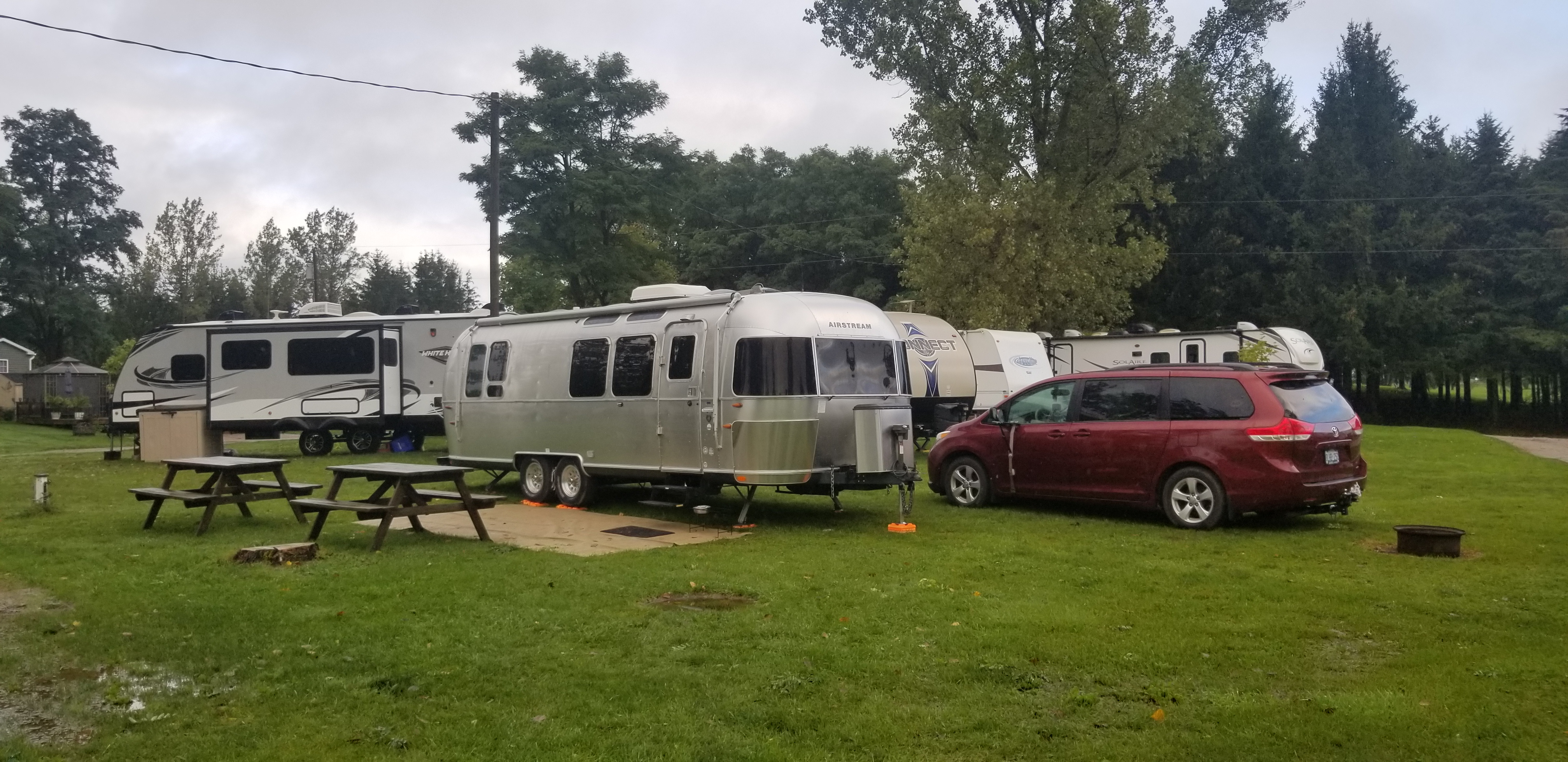
The following morning I watched as the flood waters rose, the three pictures at the top show the progress of the water. We were on a hill for goodness sake, but a wide river was forming a few feet away from us. I didn’t know at the time, but a storm drain had been blocked and the water that was supposed to be underground, wasn’t. I’d never seen anything like it.

When the rain did subside later in the day, so did the flood. The campground owner was out and about and told us that he had unblocked the drain, which was why the water disappeared quickly. The flooded area, though, was still very boggy and I was glad that I had decided on a slightly higher site. We hadn’t moved off the campground in two days, and the dog was in pain; it hadn’t been a great trip.

My mind moved to how we were going to get off the site without going through the bog, but come leaving day I moved the fire ring and made a sharp, inelegant, left, not skidding on the wet grass and not getting bogged down. That untypical tow vehicle of ours had come to our rescue again, with its front wheel drive and gentle transmission easing us away rather than digging in, as bigger vehicles might have done.

We haven’t had such a wet trip since, and given that it was also the dog’s last but one run out in the trailer, it was memorable. We haven’t been back to Science Hill since, and I have to say that I’m understandably nervous about doing so!

As a sort of postscript, we went to Rondeau Park a few weeks later, and while we had fine weather for most of our stay, the last night there was stormy and again we had to rely on our non-standard tow vehicle to haul us out of a mini-flood. Camping; don’t you just love it?

Houses

07 Saturday Oct 2023

Posted by Steve Mayne in Opinion

≈ Leave a comment

Tags

Building, Houses, North America

Or “From The Ground Up”

In my old persons way, I like to watch the construction of new buildings, and there’s been a lot of that around here lately.

Houses are not built the same way here as they are in Europe. Most will have a basement, or cellar, and the wooden frame of the house will be built on top of that. Where you see bricks, they’ll just be an outer skin with no serious weight bearing going on; that’s the job of the wood.

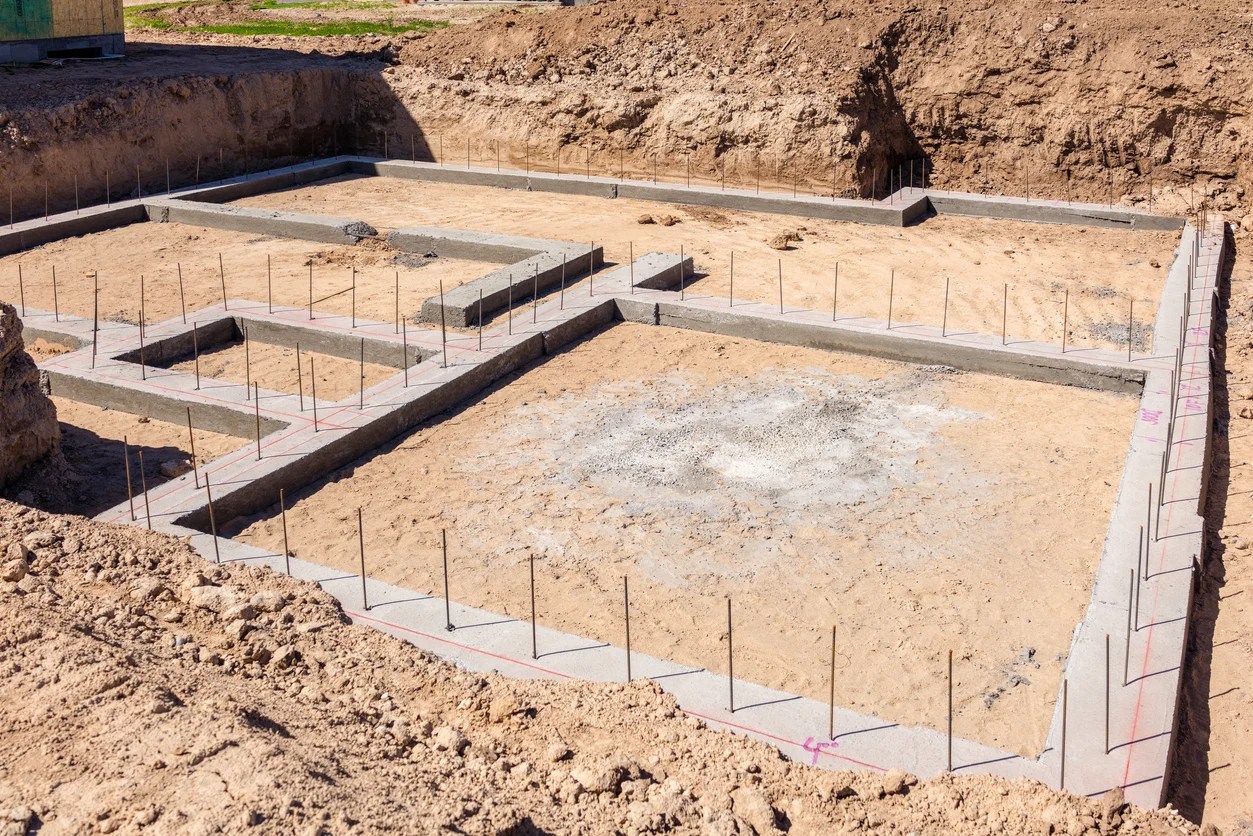
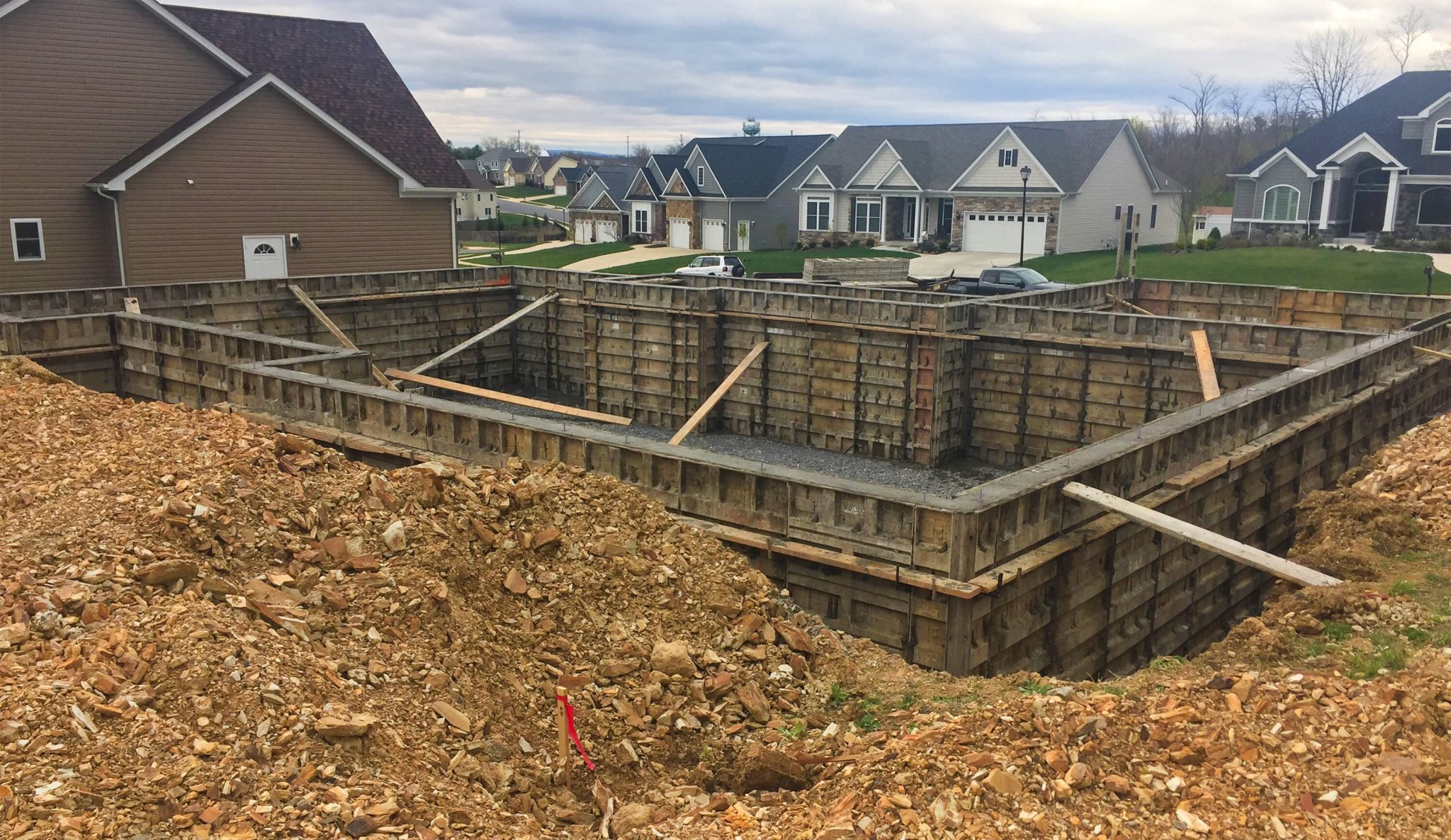
The footings of the house will be much the same though, as the top picture shows, with the exception of the steel rebars, and the fact that they’re normally in a hole six or seven feet deep. The land inside the borders of the footings is often filled with gravel because later, concrete will be poured in on top to form the basement floor. there’s also a sump, or small well, built into the basement floor, and water pipes that collect groundwater from around and under the house will feed into it. This keeps the basement dry, but only if you have a pump set up to remove that which gathers in the sump. There’s a whole debate, for another day, about the utility of a basement sump.

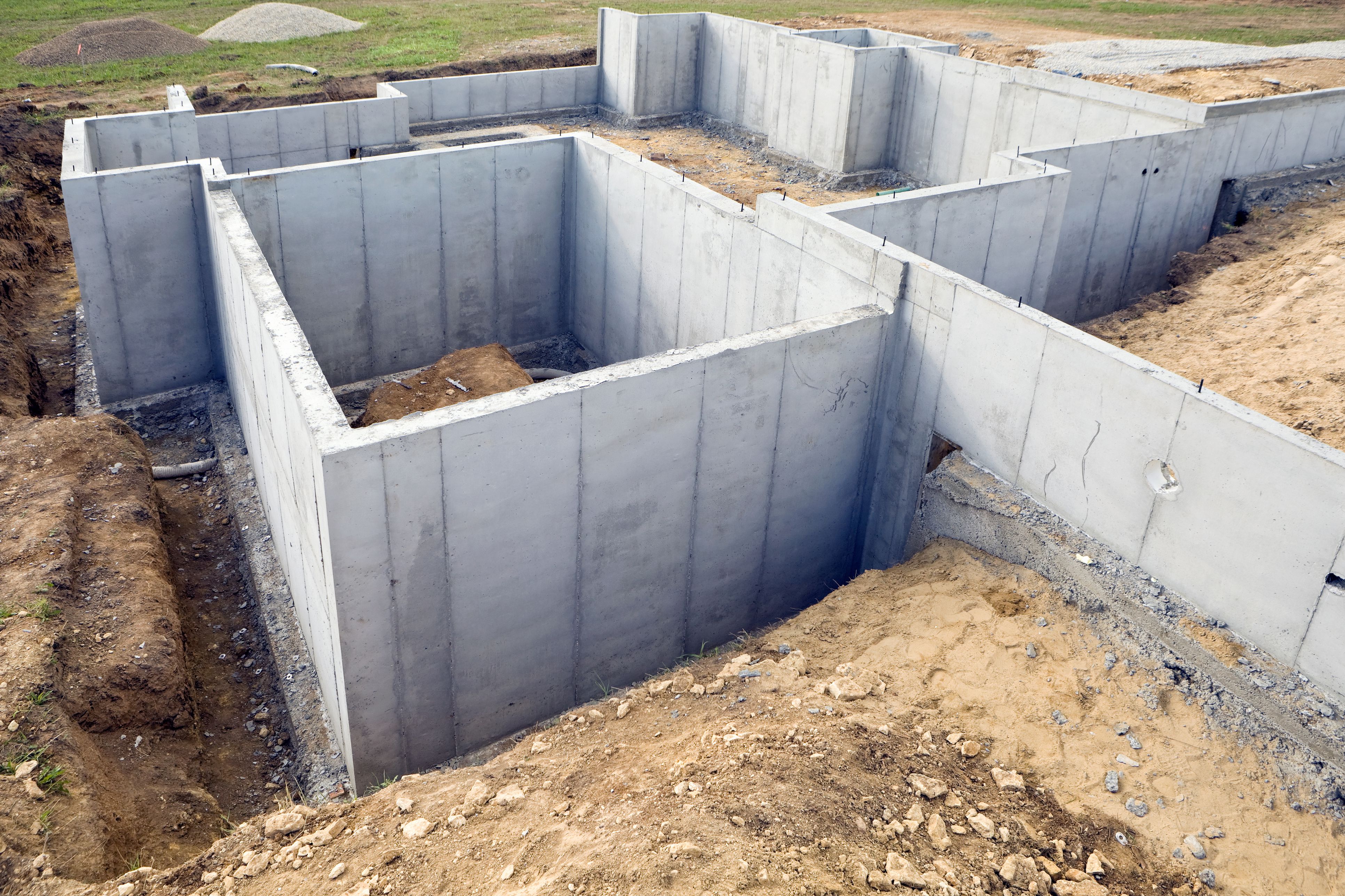
The basement walls are formed on top the footings and make use of the exposed rebars for strength. The formers for these walls are often dropped in from a truck and are stacked in a handy dandy crate with a big loop at the top so that the truck’s crane arm can just drop them into the hole in the ground. When the formers are finished with, they’re stacked back in the crates and lifted out, to be reused on another house. The second picture shows the formers in place, but those don’t look like the little modular things that I see being used. Either way, you can see the walls being formed. The third photograph shows the walls without the formers.

Once the basement is in, the house quickly goes up as a wooden frame. There’s sometimes some steel to hold up the floor on the ground floor (or first floor if you’re a North American), but other that it’s all wood. Wood is cheap here, probably cheaper than cinder blocks and bricks, and the house look skeletal as it’s going up, as the fourth picture shows. When the house is just a frame of wood like that, it’s really simple to install the services like water, waste water, electricity and gas. Internally the walls and ceilings are added using plasterboard, or drywall as it’s known here, and the floors are double sheets of plywood, that’s before any other surface like tiles or laminate flooring is added. Roofs are also interesting with the normal method being sheets of marine plywood that are nailed in place and are eventually covered with shingles, actually strips of roofing felt made to look a little like slates. The advantages of this this system are that they are cheap and come in a whole range of colours and styles, they’re also very light compared to European style clay or cement tiles, or even traditional slate. The disadvantage is that the shingles will need replacing every fifteen to twenty years, which is why steel roofs are becoming more popular, often fixed straight on top of the old shingles if it’s a retrofit, as they mostly are. Steel isn’t as light, but it comes in different styles and colours, too. Even steel, though, will need replacing eventually as it will rust in time.

The outer walls of the houses are thoroughly insulated before an external cladding is added, sometimes siding (wood, metal or vinyl), sometimes brick, usually a mixture of both. As I said before, the outer brickwork has little load bearing ability.

Windows were a bit of a shocker for me. As there isn’t much depth to the walls here, window sills don’t really exist. The windows themselves are usually double or triple glazed, although much to my surprise, many of the new houses being built are just single glazed, which is a travesty given how cold it can get here, and how important insulation is for keeping heating and cooling costs down.

Most new houses here are heated by forced air, pumped around ducts by a furnace in the basement. It’s not the most efficient method, but is easily switched to cooled air in the summer. Most heating furnaces will use Natural Gas to heat the air, and we haven’t really caught onto heat pumps yet.

Back in the basement, people use them for many things, including laundry, workspaces and a favourite here, TV and games rooms. Given that most of the basement is below ground level, they are ideal for cozy TV rooms, for sure. Many new houses are sold with “unfinished” basements, just the bare concrete walls and the service machinery, but you can “finish” them yourself to your own specification, which could include stud walls, carpets and the rest. It is possible to have someone live in the basement, assuming you can get waste water away effectively, although with new places, you need to include an escape route, and that can mean a lot of work for an already finished basement. Whatever you do down there, just make sure that you have an effective sump pump, and a backup should the power go out (as it so often does).

Your average North American new build is still significantly bigger than its counterparts in Europe, space being the key, I think. Mind you, they’re getting smaller here as well, which is more guided by profit per square foot than availability of land.

Which do I prefer? Well, North American house are bigger, and that basement is a plus, but they are comparatively flimsy and I doubt our house, now forty years old, will still be here in a hundred years’ time like so many of their more sturdy European counterparts. I don’t like the shingle or steel roofs here, but even quite major work on timber-build houses is quite cheap and easy. I don’t know, I’m happy wherever I’m living!

Safety First

03 Tuesday Oct 2023

Posted by Steve Mayne in Opinion

≈ Leave a comment

Tags

Collision, School Bus

Or “Who Said This Was A Good Job”

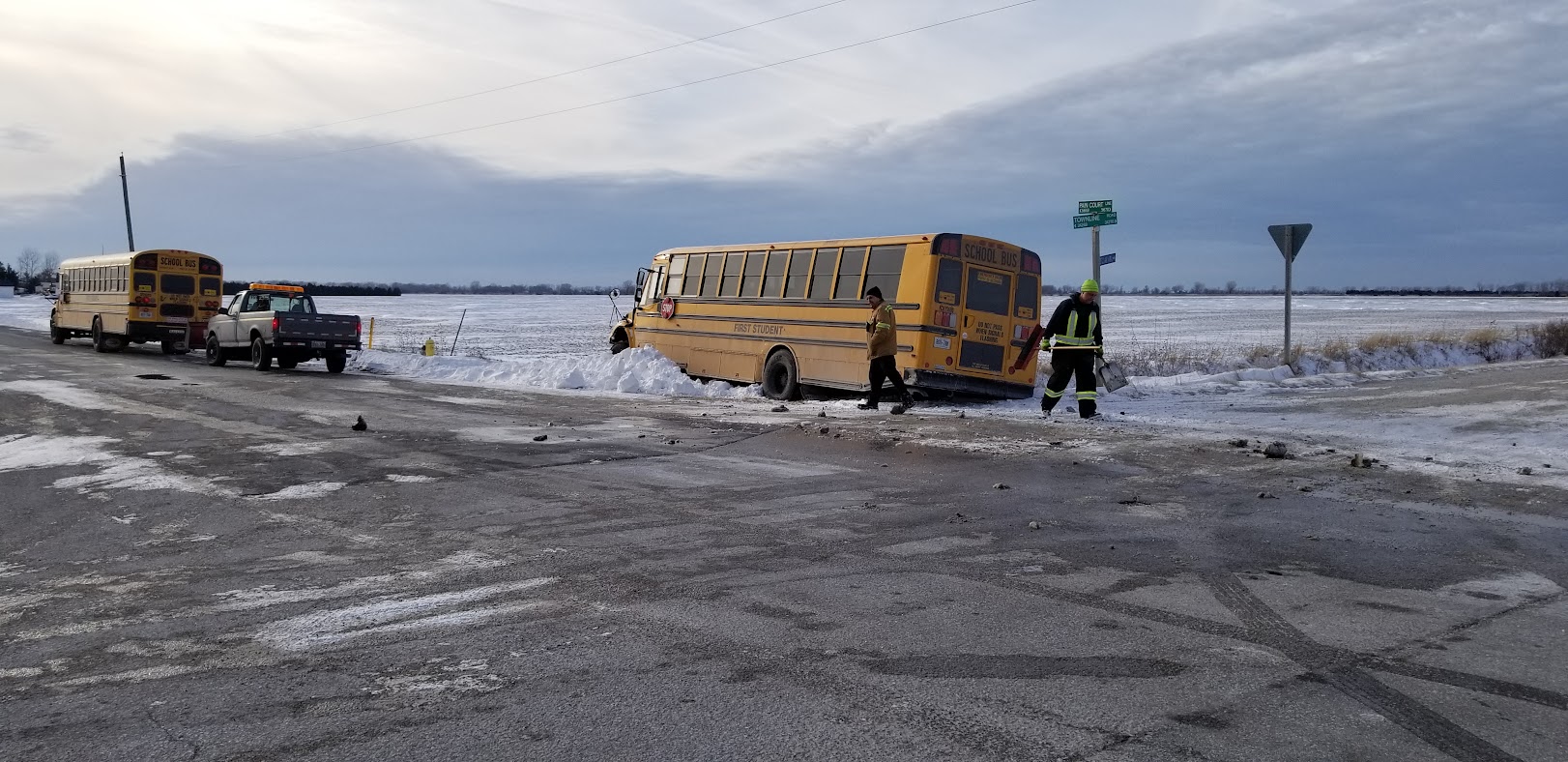
One of my tasks while working full time at the bus yard was to attend any collisions or mishaps that happened while buses were out on the road, and make some preliminary investigations. I thought this picture would be a good illustration as the collision was minor, but did force the bus into a snow bank. Also, there were students on the bus, but no one, driver included, was hurt, in what was an odd collision. Shortly after I took the photo, the Police arrived, cleared the scene for recovery, and the second bus took the kids home, just in case you were concerned.

This was on a quiet back road one winter’s afternoon and the driver was dropping the last few students off. He’d been motoring at just below the speed limit (GPS records this at three second intervals) and was approaching the intersection that crossed his road. Visibility was good and the driver of the bus saw the pickup truck approaching his road, from the left, at right angles. Knowing there was a Yield sign for the truck, although not for the bus, our driver did slow, but the truck kept coming. It didn’t stop, and shot out in front of the bus, with the bus front left side catching the truck, but the evasive action our driver took led him into the snowbank. The truck driver got out of his vehicle, came over to check everything was OK, got back in his truck and drove off!

That was odd, but odder still was the fact the the truck driver dropped his wallet as he got out of his truck, and that his drivers’ licence was still in it. There’s nothing like leaving evidence at the scene. Once the kids had gone and the recovery truck had hauled the bus out of the snow bank, I had to drive the mechanic’s truck back to the bus yard. I don’t know if you’ve ever driven a pickup truck with a massive snow plough blade on the front, but believe me when I say that it’s a strange sensation.

Pulling all the data together afterwards, we felt that our driver wasn’t to blame, although he could possibly have avoided the collision with a little more caution given that the approaching truck was clearly visible, even if it was supposed to yield. The Police rounded things off by saying that the truck driver was probably drunk, although by the time they caught up with him, they couldn’t prove it.

That was one of many similar incidents I had to attend, most of them thankfully minor. The investigation was never fun, though, and sometimes ended up with our driver getting into trouble. Our drivers would often leave details out of their accounts, embellish their account and sometimes outright lie about what happened, but I guess it’s natural to be defensive when you’re likely going to be blamed. Still, we never had to fire a driver, just retrain them, and guess who had to do that!

Pickup Trucks

02 Monday Oct 2023

Posted by Steve Mayne in Opinion

≈ Leave a comment

Tags

Airstream, Tow Vehicle, Truck

Or “What’s The Point Of Them?”

It’s no secret that I’m not a fan of pickup trucks. Much of my animosity has been derived from my fellow Airstreamers, or most of them at least, who are implacably opposed to towing their Travel Trailers with anything else. Of course, I don’t tow our Airstream with a pickup truck. The arguments are long and tedious and essentially boil down to “I want a truck because they’re big and manly, and I’ll use my towing requirement to justify the spending of huge amounts of money that are required to buy one”.

But am I right? If you look at the concept of the truck, a rugged utility vehicle capable of carrying loads in the bed, then there’s definitely a market. If your business is towing goose-necked trailers, hauling freight, or dirty and odd sized equipment, then the pickup is for you. It’s a workhorse, and usually a capable one, albeit that the basic technology is pretty ancient.

The problem is that the modern truck has become a status symbol. The engines are huge, the wheels are huge and the radiator grille is huge. They sit so high off the ground, too. Certainly they have all Mod. Cons. these days, as is demanded by the consumer, but for all that they’re still just a utility vehicle. A very heavy, un-sprung body on twisty steel ladder frame, with live axle leaf spring suspension, isn’t the best format for a modern vehicle capable of some quite high speeds. But it is, apparently, what the punter wants. The thing is, people buy these gas-guzzlers for their status value primarily and will never, ever, use it for its intended purpose, that is, hauling stuff. They will use it to tow their $150K Airstream when it really isn’t a great match for such a smart trailer, but they will also use it for their daily commute, to go shopping, even to go on holiday. What they won’t use it for is, God forbid, putting messy and heavy stuff in the bed.

A pickup is really bad at driving, too. It’s heavy on gas, has too high a Centre of Gravity to be safe, has ancient body on frame technology, and rubbish suspension. Why are they so popular then? Well, it’s all about having a big one. Vehicle that is. The owners sit up high, and feel all manly and powerful, usually entirely unaware of what dreadful vehicles they are really driving. Is it true that the size of a man’s vehicle is inversely proportional to the size of their wedding tackle? I wouldn’t know, but it’s a fair old theory.

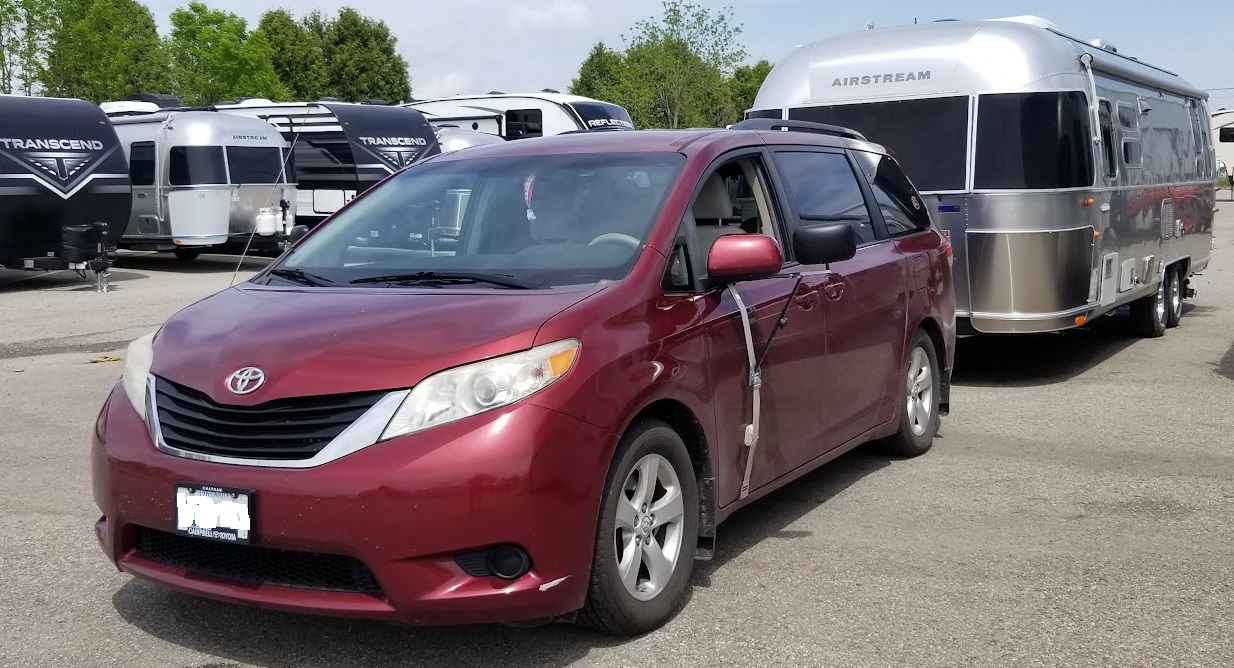
Here’s a proper Airstream tow vehicle…

North Shore, Lake Erie

01 Sunday Oct 2023

Posted by Steve Mayne in Opinion

≈ Leave a comment

Tags

Ontario, Road Trip, Treaties

Or “We’re Really Luck To Live Here”

We live not far from the north shore of Lake Erie, in Ontario, Canada.

We haven’t always lived here, or indeed in Canada, and that is perhaps what helps us appreciate what a lovely place it is to live. Certainly it’s not exciting, there are no high mountains (or even hills!), or deep valleys, but it is bucolic, and pleasantly so.

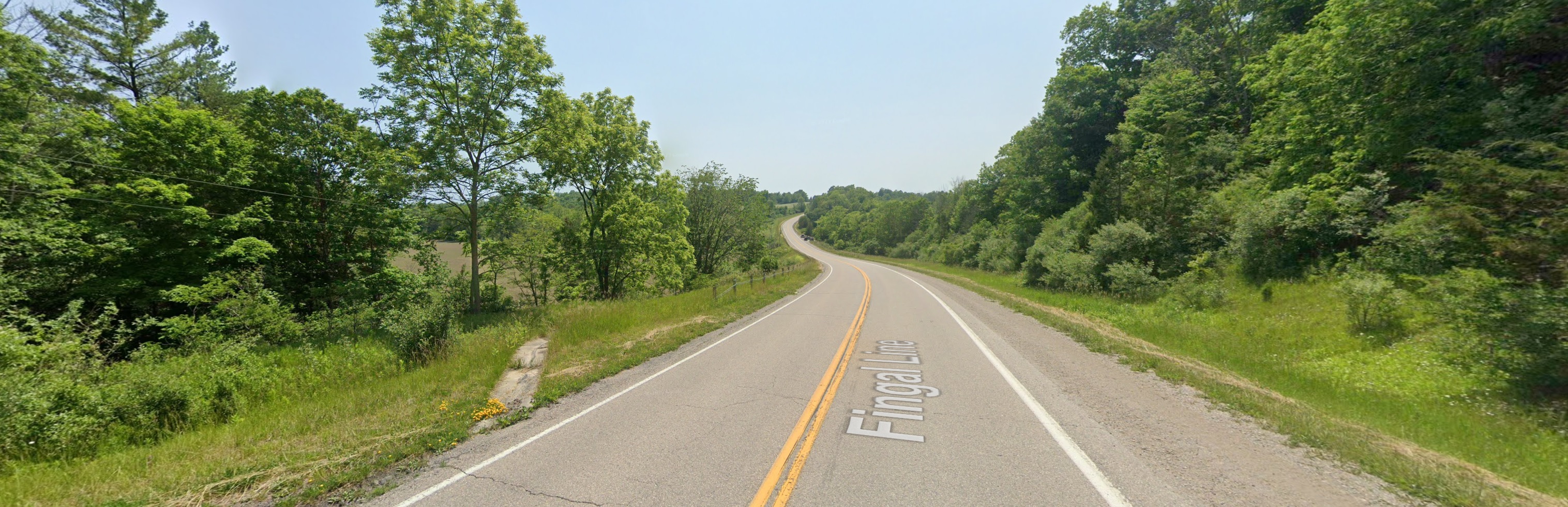
We drove along the old Talbot Trail for a while, one of those ruler straight roads built by the settlers to allow both access to land, and to get from Lake Ontario to Windsor and Detroit. Because it’s been superseded by the 401 freeway, it’s a very quiet road and you can drive for ages without seeing another vehicle, and yet it’s wide and well surfaced. We use it in preference to the freeway if we’re not in a hurry, and it’s to be recommended for easing your blood pressure. The road links some of the old farming communities; Blenheim, Guilds, Morpeth, Palmyra, Eagle, and Wallacetown, to name but a few. It was in Wallacetown that we took a dive south and followed Fingal Line for a few miles, and that it is even quieter than the Talbot Trail. It also has a few dips and turns as it negotiates some of the valleys scored into the soft land that’s close to the lake, to give some nice relief from the flat and straight of the land further west.

All along this lake-side, east-west route, is intensively farmed land, with Corn and Soy Beans stretching as far as the eye can see. At the westerly end of Talbot Trail, there are far fewer trees and far larger fields, but that vista gives way to more trees and smaller fields as you move eastwards. Because it’s an old road, it’s lined with many mature trees, some native to the area, some not, but as this trip was on the last day of September, most were beginning to turn for winter, with yellow, red and brown showing up in among the green. It may not be as spectacular as Algonquin, but in this more gentle countryside it looked fabulous on a sun-drenched day.

The roadside ditches are filled with Asters, Goldenrod, and Sumac, with the remnant of Milkweed still around after their summer bloom. Despite the heavily farmed fields, it seems that the native plants are not going away, and that pleases me.

Of course all that I have described is the post-Contact world, tamed by generations of European settlers. Pre-Contact, the entire area would have been wooded, mostly Carolinian Forest along the lake’s edge, and populated with native people. They had their own routes to travel, of course, naturally made and never using a ruler on a map. It would be wrong of me not to acknowledge that, and of the treaties broken by successive groups of incomers that took the land from its native population, broken by the people who drew those straight lines and cleared the forests. We can’t go back, but we can accept that we Europeans are recent interlopers and really do not own the land, despite what the maps say. It’s fitting to note that we drove this trip on September 30th, National Truth and Reconciliation in Canada, and did acknowledge our presence on stolen land.

Training

29 Friday Sep 2023

Posted by Steve Mayne in Opinion

≈ Leave a comment

Tags

Driving, School Bus, Training, Work

Or “This Is Easier Than I Thought”

Even before I’d started in my full-time job at the bus company, I had embarked on the process to become a Driver-Trainer. Certainly it was an opportunity to work some more hours, but it was also an intense and satisfying job.

In Ontario, the testing of commercial vehicle drivers has been devolved, mostly, to the commercial companies themselves. Given the correct qualifications, people like me employed by the bus company, were able to supervise training and execute written and road tests on behalf of the Ministry of Transportation. While you might think that there’s too much self-interest involved, that is we could just pass anyone and not bother with proper training, it was all very well run by the Ministry and we as testers and trainers were constantly monitored and assessed. Vehicle collision data involving new drivers was always scrutinized by the Ministry and were we to be cheating and not doing our jobs for drivers who crashed, we would surely have lost our place on the devolved licensing scheme.

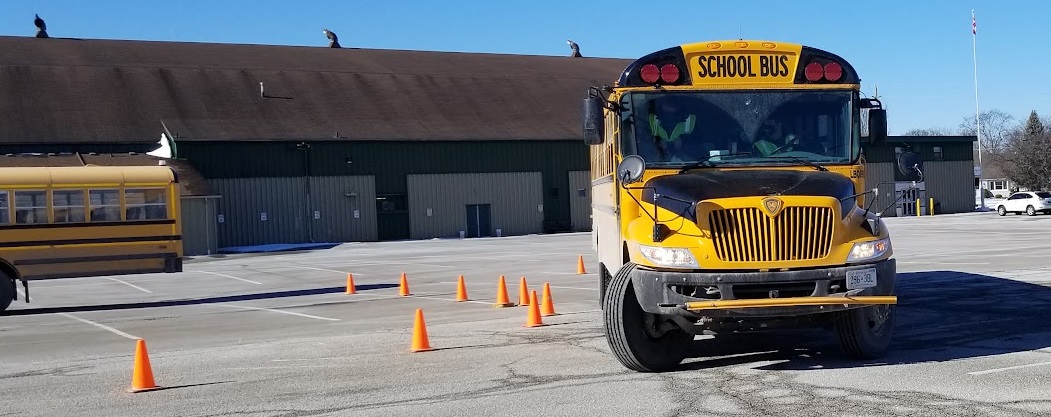
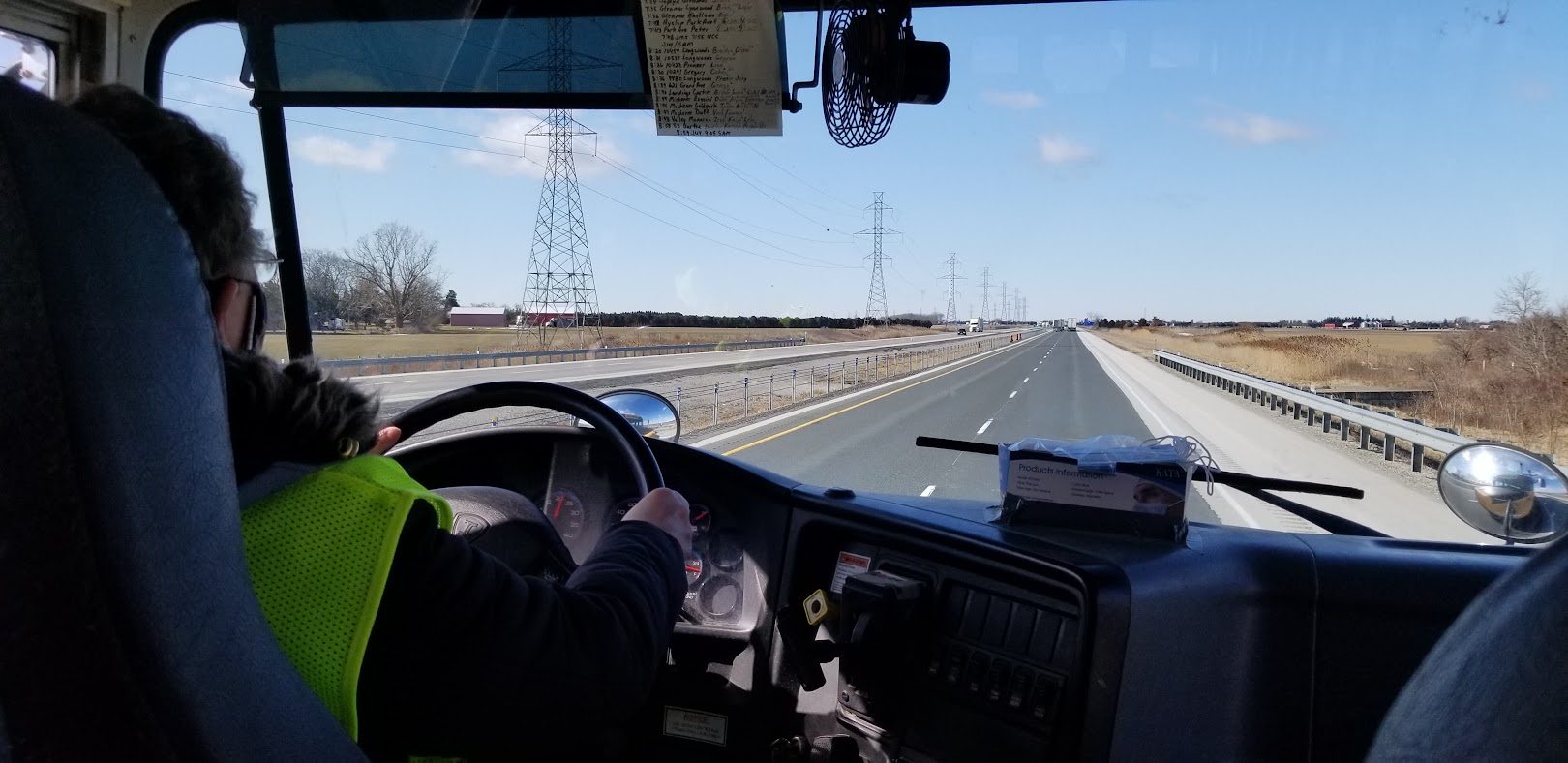
There are lots of hoops that you have to jump through to become a tester, not least a week on a residential course, learning to teach others. Fail that and you’re simply not considered by the Ministry. But I passed, and was soon teaching others in the classroom, on the Skills Station (photo above), and out on the road (photo below).

Drivers were assessed daily and booted if they were not up to the required standard, although I only failed a handful, and always at the early stages of training, before they were allowed out on the road. Telling someone that they weren’t going to make it, we wouldn’t enter anyone for their tests if we didn’t think they’d pass, was tough and often involved tears – not mine I should add. One trainee I worked with wasn’t getting it, but I felt that she would, given time. I sent her home for a couple of days break from training, and we picked it up again in a much better place for her, and she passed her test comfortably in the end. Perseverance from both trainee and instructor can work sometimes. The last one I failed simply wasn’t getting some the basics, not even after I’d allowed double the amount of time allowed, and it’s interesting to note that it’s generally those that tell you up front what a great driver they are who don’t make the grade. I didn’t keep track of the number of new drivers I trained to a successful conclusion, but I did do twenty-two in six months one year.

There didn’t seem to be a specific type of person who did well, either. Two of the standout trainees were young women with minimal driving experience, who both caught on really quickly, and yet some of the “old and bold” people, mostly men, with decades of driving experience, were the ones most likely to fail. Indeed, a couple of the oldies who had previously held bus driver licenses were the hardest to train and to get through the test. There’s a rule in Ontario that if you are a school bus driver over sixty-five and you catch two or more Demerit points, in your or car or in a bus, then you have to be tested again by Ministry contractors. Despite spending countless hours training with a number of these fellows, I never got any of them a pass, so they all lost their bus licenses. I think it was a case of trying to teach old dogs new tricks, and none of them wanted to learn.

Mostly, though, it was hard work but good fun. I’ve trained with babies in car seats alongside their mothers, people into their seventies and driving bus for the first time, and lots of folk struggling to get work. All of them, though, once they’d mastered the tricks of the trade, were all really happy to be behind the wheel of the “Big Yellow”.

I’d like to have continued training without having to drive daily bus runs as well, but my employer was having none of it, and that is why I’m now fully retired.

Driving On The Freeway

28 Thursday Sep 2023

Posted by Steve Mayne in Opinion

≈ Leave a comment

Tags

Driving, Freeway, speeding, Tail Gating

Or “Why Does Nobody Know How To Drive?”

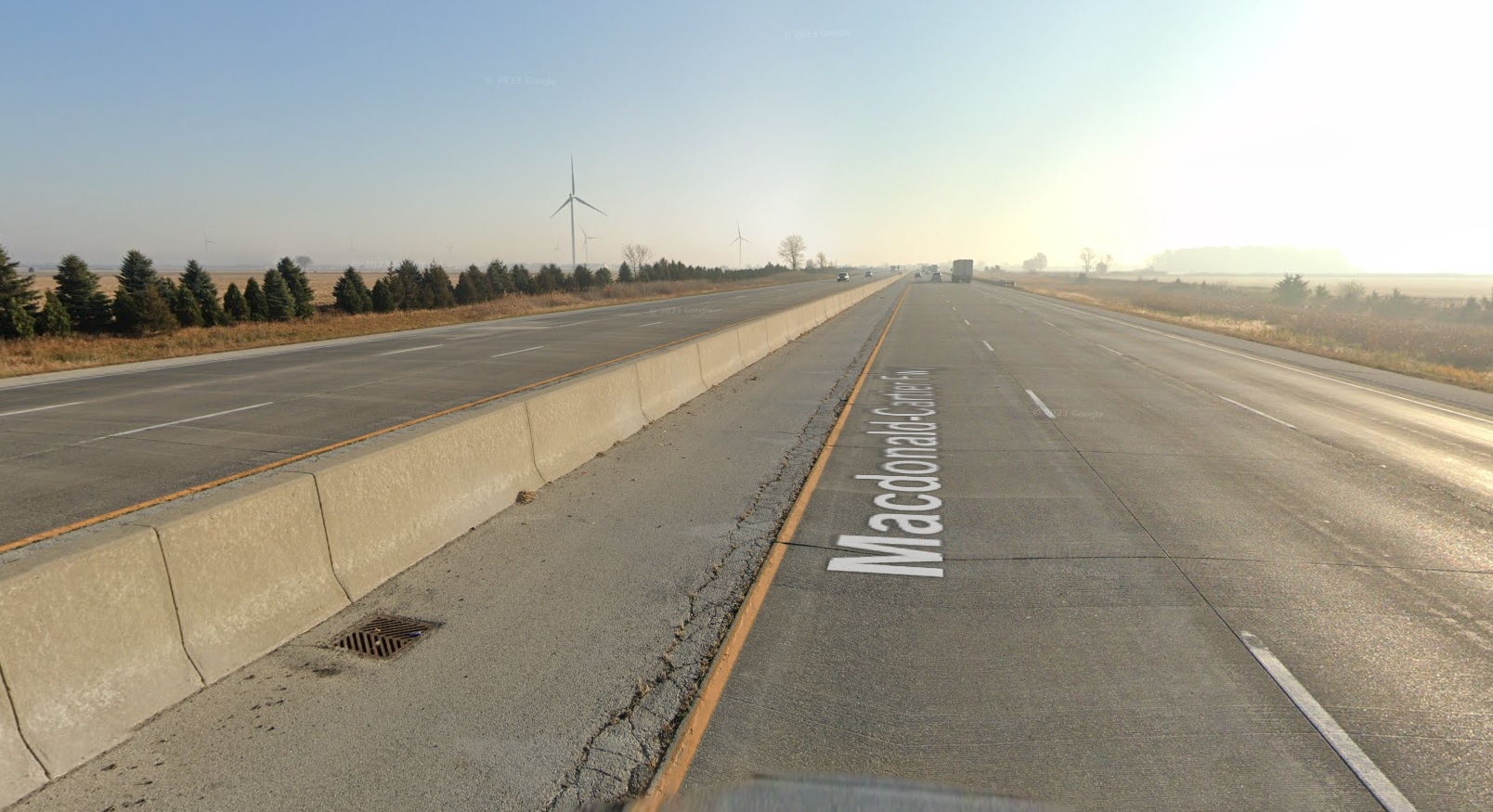
We had occasion to drive along the lovely King’s Highway, better known as Highway 401, today, between Tilbury and Manning Road in Windsor. It’s Ontario’s primary motorway/freeway/autoroute and has a fearful reputation.

Down here at its western end it’s not so bad, though, with three lanes in each direction between Tilbury and Windsor, and relatively light traffic when compared to that in the Greater Toronto Area. However, the wide open spaces do not good drivers make.

Speed has always been an issue. The limit of 100 KpH means to everyone, including the Police, you should drive at a minimum of 120 KpH in reality. Where the limit is 110, then read 130. It’s not really policed seriously, unless you feel like doing 150+, then you may get caught.

Then there’s tailgating, driving too close to the rear of the vehicle ahead of you, which appears to be more popular in Ontario than hockey. That minimum 4 second safety gap is normally 0.4 seconds on the 401, and I’m really not exaggerating.

Today, though, was the day of the left lane cruisers. So many do not appear to know or understand, on a three lane road, that only the right-side lane is the driving lane, and that the other two are passing lanes only; that’s the law. I get it that you might end up in the centre lane for a while if there are too many trucks in the right lane, but today we had car after car cruising along a near-empty road in the left lane. Certainly, they’re only holding each other up and not doing too much harm, but why do they do it? It seems the height of stupidity to me. Mind you, at least some of those left lane cruisers were keeping to the 401’s unofficial 0.4 second gap rule.

It’s long been my contention that driving education and testing in Ontario is sadly lacking. Indeed, the two kids’ driving instructors both imparted incorrect information to their students, one about speed and one about making left turns. If the instructors don’t know, there’s not much hope. As a former instructor, and tester, myself I speak from a position of knowledge.

All that said, if everyone did as they should when driving, what would I have to complain about?

** An after publication edit. Why do so many people visiting from the United States feel that it’s OK to drive at 130 KpH on a Canadian road with a 100 KpH limit? It seems disrespectful to me.

← Older posts
Newer posts →

Subscribe

  • Entries (RSS)
  • Comments (RSS)

Archives

  • November 2025
  • October 2025
  • September 2025
  • July 2025
  • May 2025
  • April 2025
  • February 2025
  • December 2024
  • November 2024
  • September 2024
  • August 2024
  • July 2024
  • May 2024
  • April 2024
  • March 2024
  • February 2024
  • January 2024
  • December 2023
  • November 2023
  • October 2023
  • September 2023
  • July 2014
  • June 2014

Categories

  • Admin
  • Opinion
  • Uncategorized

Meta

  • Create account
  • Log in

Website Built by WordPress.com.

  • Subscribe Subscribed
    • Stevemayne's Blog
    • Already have a WordPress.com account? Log in now.
    • Stevemayne's Blog
    • Subscribe Subscribed
    • Sign up
    • Log in
    • Report this content
    • View site in Reader
    • Manage subscriptions
    • Collapse this bar
 

Loading Comments...