With Remembrance Day just around the corner, it was fitting that I should come across another of my relatives who lost their life in the First World War.
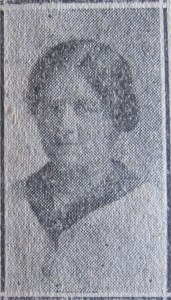
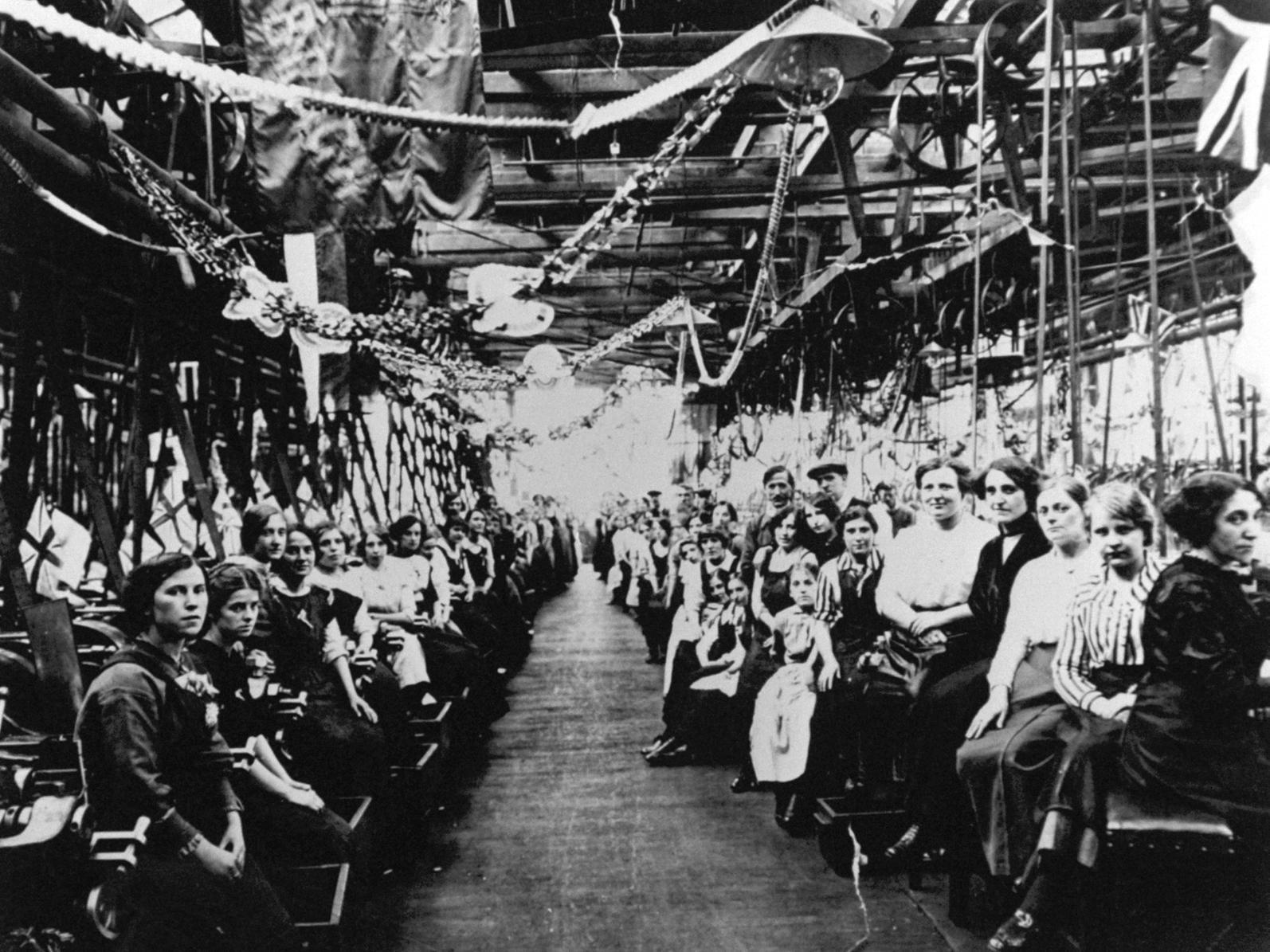
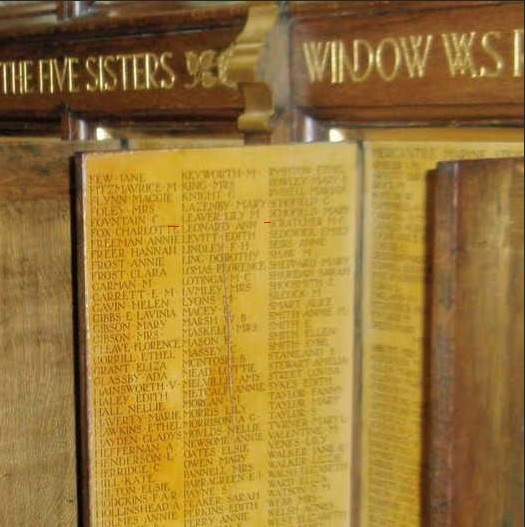
Ann Leonard, a second cousin once removed, was just twenty-four when she succumbed to TNT poisoning while working at the Barnbow munitions factory near Leeds, Yorkshire, England.
Born in October 1891 in Morley, Yorkshire, she was one of ten children to William Leonard, a Coal Miner, and his wife Emma. Her death certificate said she had died from “atrophy of the liver” as a result of working with munitions. She was one of many women killed in the production of weapons and ammunition throughout the Great War; explosion and disease were constant threats in the workplace. While Ann died from liver failure in the July of 1916, on December 5th of the same year, an explosion tore through part of the Barnbow factory and killed 35 women outright, and maiming and injuring dozens more.
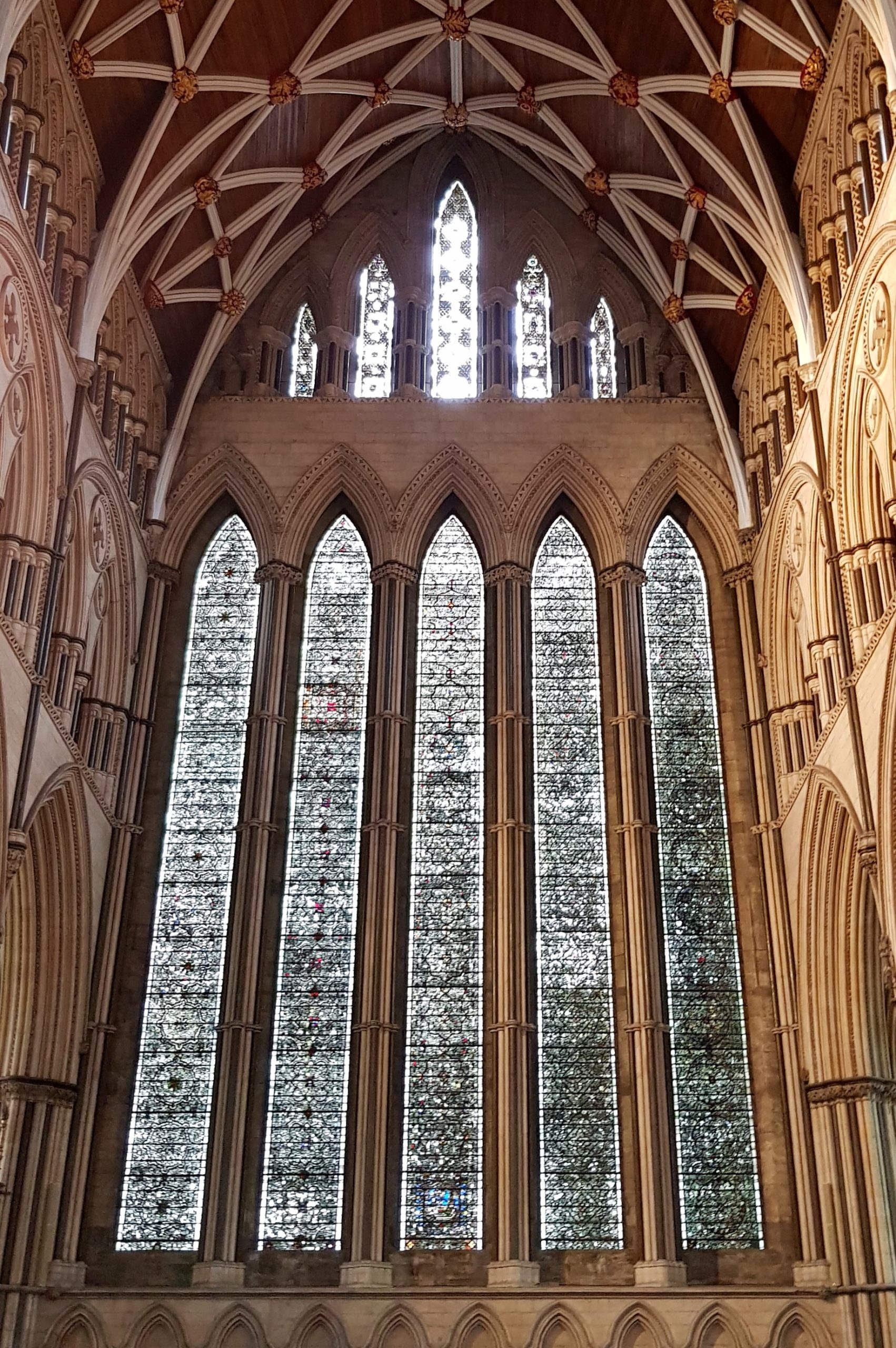
I was surprised to hear that Ann’s name appears on a Roll of Honour in York Minster, underneath the 13th Century series of stained glass windows known as the Five Sisters. The window was renovated between 1923 and 1925, and then dedicated “Sacred to the memory of the women of the Empire who gave their lives in the European war of 1914–1918” as a lasting memorial for all those women who died as part of the conflict.
In a cruel twist of fate, her brother Edward, himself only twenty-two, was posted as “Missing presumed dead” in France, just twenty four hours after Ann died. I can’t begin to imagine what their parents, must have gone through.
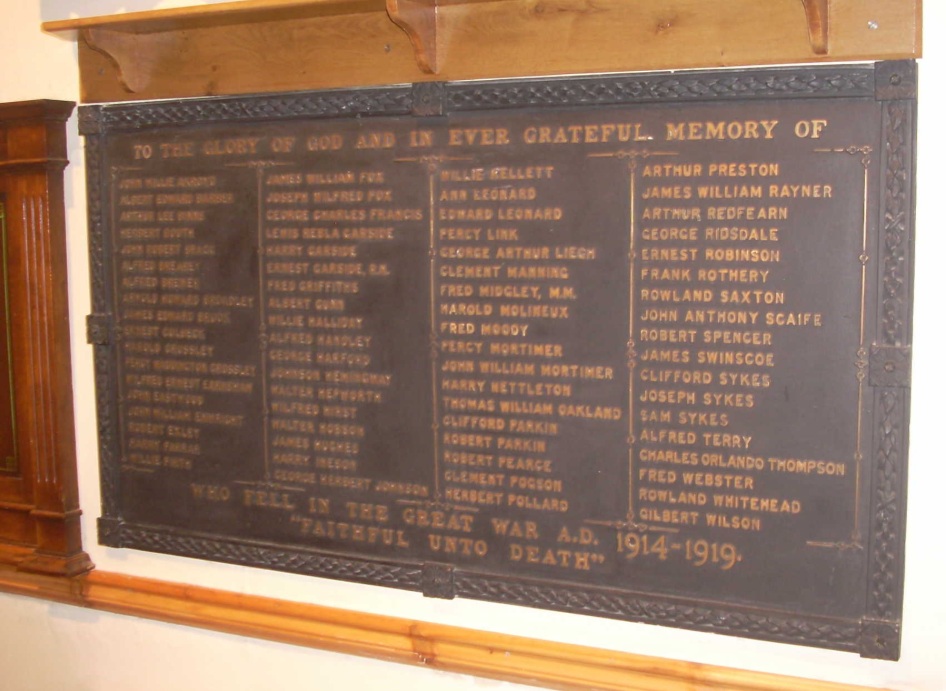
Aside from the Roll of Honour in the Minster, both Ann and Edward are featured in a plaque in the church of St John the Evangelist in Carlinghow, Batley, Yorkshire.
The Imperial War Museum maintains records of the casualties of war, and Ann’s entry can be found here.
I have more than seventy family members recorded in the Commonwealth War Graves Commission records, across the First and Second World Wars. Family war casualties came from the UK, the USA, Canada, and South Africa. This November 11th I will be keeping Ann uppermost in my thoughts as we remember all those who have died in modern wars.
I started looking into my family tree a short while before my father died in 2009, but didn’t get very far. I think Ancestry.com was around then, but I hadn’t signed up, and anyway I was heading off for my new life in Canada.
Finding myself with more time than I’d anticipated, I picked everything up again a few years later, and this time I did sign up with Ancestry, which opened up more doors than I thought possible. I now have a family tree with over fourteen thousand people listed (not all that I’d call very close relatives, to be fair), and many of them are, or were, situated in places that I didn’t know my family had reached.
Two things set the ball rolling in an unstoppable way. One was Mary, a native of Indiana, contacting me out of the blue, and the other was doing the Ancestry-linked DNA test.
I was, I will admit, perplexed that I appeared to have a relative from the United States. My family, my dad’s side at least, was pure Yorkshire, from Leeds, I thought. Goodness, how wrong I was. Mary pointed out that we had a common ancestor, Joshua Mayne (b. 1761), and everything fell into place from there. With Mary’s help, I was able to discover that one of Joshua’s offspring had left Britain in 1822, bound for New York, and from there had built a formidable Mayne dynasty in the New World. Not only that, another of Joshua’s sons had, in 1849, taken his young family to Durban in South Africa and had set up a similar Mayne dynasty there. To top it all, Mary established that Joshua himself, and his wife Elizabeth Collins, were not from Yorkshire at all, but had arrived in Leeds from Cork, Ireland in 1792.
The DNA test came up with equal amounts of potential contacts on my mother’s side of the family, as well as my dad’s, and that was an area I hadn’t addressed up to that point. Building up her side of the tree has shown that we were drawn from agricultural stock in the north of Devon, England, and while many of the family had stayed there and are there to this day, many more had moved away from the land for a new life in Canada and, ultimately, in the United States. Indeed, direct Devon relatives had made it to rural Southern Ontario 150 years before I did.
I haven’t yet found the outer limits of the family tree, either on my dad’s or my mum’s side. I can find very little about my paternal grandmother who’s father arrived in Leeds from Belfast, Ireland, at some point in the early 1880s, although my 24% Irish DNA is in part her legacy to me. Her mother was from Leeds, but her father was from Liverpool, and with a name like Garrett, the chances are that there’s Irish blood from him as well.
On the whole, both sides of my family are from poor stock. Some have done well, though, the South African connection has links to the DeBeers diamond industry. There was some conspicuous DeBeers-related wealth on show in the early twentieth century, with homes in Portman Square and Kensington in London, and even a family burial plot in a Royal Park, the Royal Brompton Cemetery in West London.
My grandfather married into, worked for, and eventually took over, the Pickersgill family business in Leeds in the 1920s. Joe Pickersgill, a very wealthy Turf Accountant, was said to have held the Prince of Wales own betting account in the 1910s and was a millionaire when he died in 1923.
On the American side of the tree, a distant cousin married Mariko Terasaki, the daughter of Hidenari Terasaki and Gwendoline Harold, in 1953. Hidenari was a Japanese diplomat who married Gwen, a Tennessee girl, and worked to avoid Japanese conflict with the USA in the late 1930s. Both were forced to flee to Japan after the Pearl Harbor attack, but Gwen wrote a book about her experiences which was made into the Hollywood movie A Bridge To The Sun. Mariko’s children, those that survive, are prominent peace campaigners, following their grandfather’s lead.
But most of my family tree is comprised of poor people doing poor people’s work, and very much echoing the social structure nineteenth and early twentieth century Britain. Farmers, farm workers, labourers, coal miners, and factory workers, all living in mostly poor conditions but surviving nonetheless. One thing that does jump out is the number of war deaths, at the moment numbering seventy-two. One of the first on my family recorded in the Commonwealth War Graves Commission databases was killed when his ship exploded in the Thames estuary in 1914. One of the latest was a young Canadian naval officer, killed two days after D-Day in 1944 when his ship was sunk in the English Channel.
As I’ve grown the tree, there have been a lot of fascinating stories come out about the individuals in it. In future posts here I’ll try to record some of their stories; not about my family necessarily, but the places they lived and the lives they led, which were in large part, entirely typical.
It’s been an education thus far, and I’d like to document as much of it as I can.
We had occasion to visit the lovely town of Blyth, Ontario, in Huron County. It’s about two and half hour’s slow drive from home, and a lovely place to enjoy a play at the annual Blyth Festival. It’s also close to the place where a large group of my relatives, on my mother’s side, had ended up after emigrating from England in the middle of the nineteenth century.
From my family tree research, I had discovered a few graves of those relatives just twenty minutes from Blyth, and this was too good an opportunity to be missed.
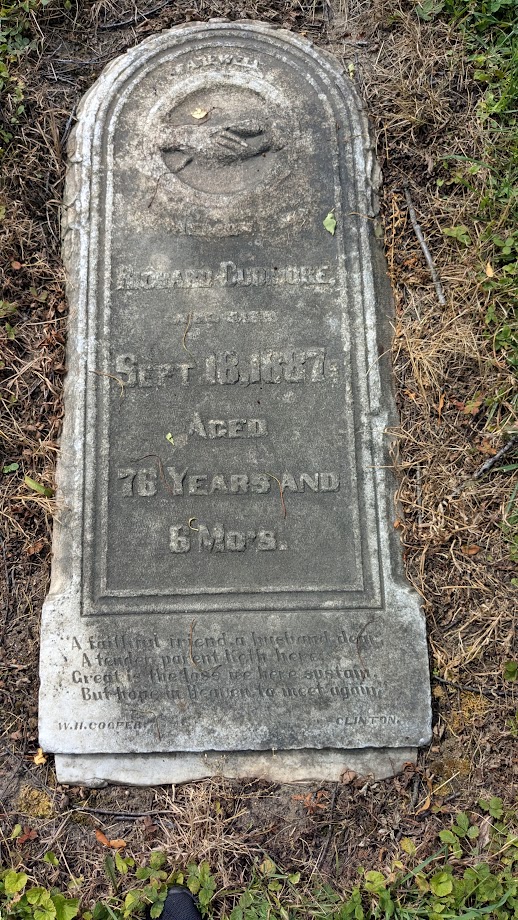
At the top of the list was John Richard Cudmore (1811-1887), my great-great-great-granduncle. His sister, Elizabeth Cudmore (1796 – 1873) was my great-great-great-grandmother, and the mother of William Bater (1829-1894), my great-great-grandfather, whose grave we had visited in the churchyard of St Edmund’s, Dolton, when we were in England last year. John Richard, better known simply as Richard, arrived in Canada at some point between 1841 and 1845, and his first Canadian born son, William Horace Cudmore, entered this world while the family were in Tuckersmith Township, now Clinton Township, in 1845.
In the England and Wales Census of 1841, Richard Cudmore is shown as being an agricultural labourer and living in Dolton, Devon. In the Census of Eastern Canada for 1861, Richard is listed as being a farmer and living with his wife Alice and their six children in a single story, log-built house. I can’t verify whether he was farming his own plot of land or working for someone else, but Tuckersmith, like most other rural townships in North America, had been divided up into small parcels of land and it’s likely that he worked one of these. I’ve seen maps of other areas, notably in Kansas and in North Dakota, with the land parcels’ owners named, but the records of Huron County, at least those I’ve found so far, don’t go into that detail.
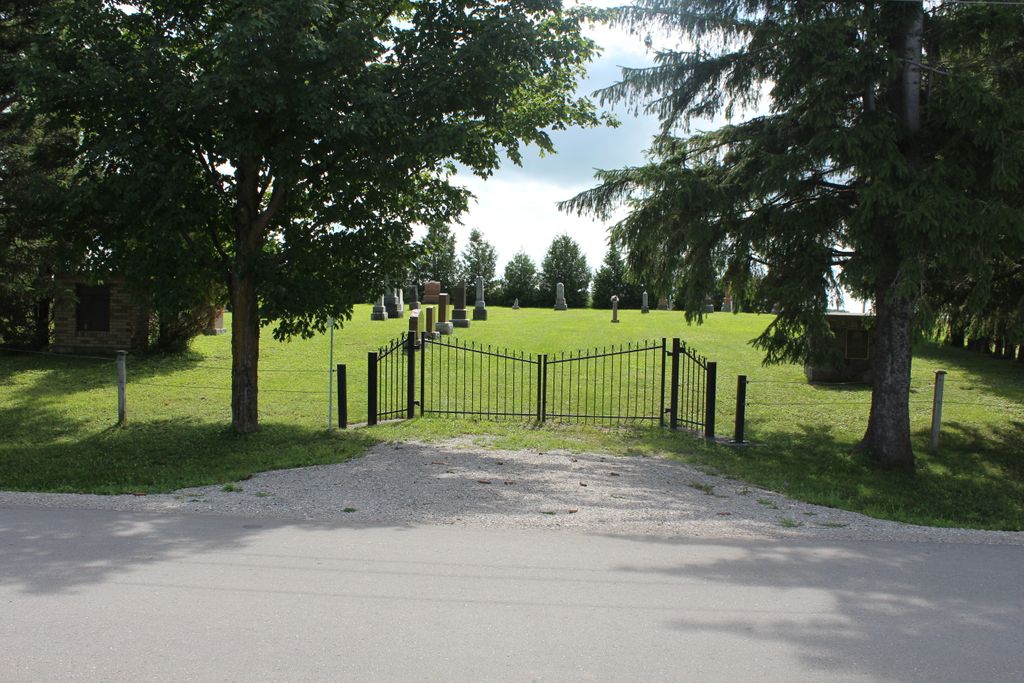
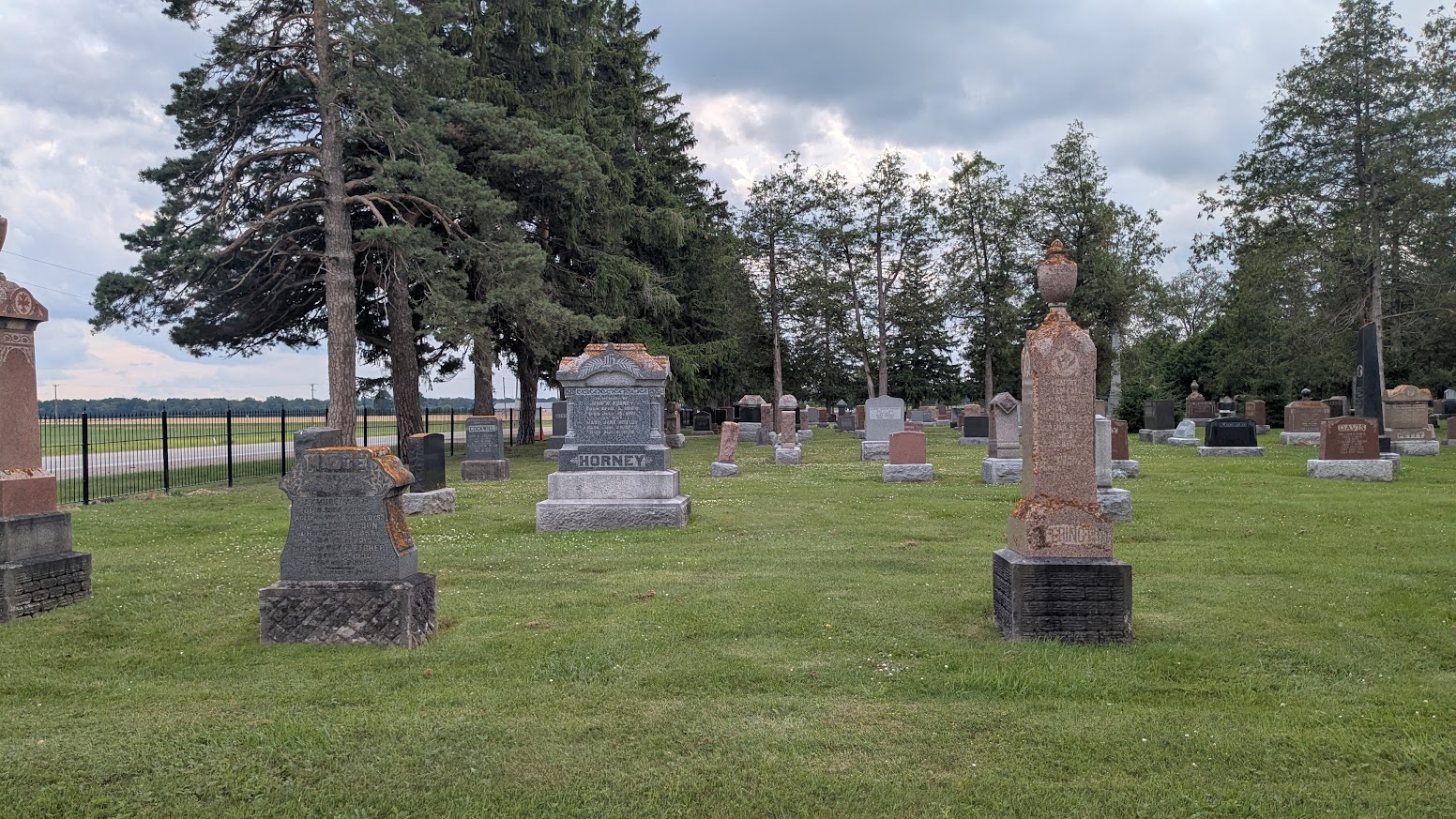
Richard Cudmore stayed in Tuckersmith for the remainder of his life, and died in 1877. He was buried in Turner’s Cemetery, just south of Vanastra, Ontario, between Clinton and Seaforth, and there he remains. It wasn’t hard to located the cemetery, nor the grave, and it was quite the feeling to be close to one of my relatives, but in a country thousands of miles away from our shared homeland. The cemetery is small, but meticulously maintained (by whom I don’t know), and is fittingly surrounded by the rich, arable farmland that Richard had worked.
Talking of land, I must acknowledge that the area around Tuckersmith is native land and was the subject of Treaty 29, The Huron Tract Purchase, signed by the English Crown and certain Anishinaabe peoples on July 10th, 1827. Full details of the treaty can be read here.
Of course, Richard Cudmore wasn’t the only one of my dead relatives in Turner’s Cemetery. His son John and his daughter Elizabeth are there, as is another daughter, Sarah Alice Crich. There are many members of the Crich family in Turner’s cemetery, as there are on the census listings for the time. It was inevitable that a Cudmore would marry a Crich at some point in Tuckersmith, and of all those Crich family members resting alongside Richard Cudmore, I’m certain that there will be family connections. Indeed, subsequent research has shown up many more family graves in Clinton itself, right up to Keith Ward Jenks, a direct descendent of Richard Cudmore, who died in 1944 when he was aboard a Royal Canadian Navy vessel taking part in the D-Day Landings.
While we were out and about in Huron County, we visited a grave in Harpurhey Cemetery near Seaforth, that of another of Richard Cudmore’s sons, Henry, and his wife Ann. Henry died in 1930 and Ann died in 1945, so their gravestone was significantly newer than those we found in Turner’s Cemetery.
On the way home we called in at the Exeter (Ontario) Cemetery looking for a member of the Crich Family. As it’s quite a large cemetery compared to the country burial sites, and I couldn’t work out the plot numbers, I didn’t find the grave. I’ve since discovered that he’s in his wife’s family plot, the Rowcrofts, so if we go again I know what to look for.
I can only speculate what drove agricultural workers from North Devon to get on a ship and travel to the New World. It may have been a lack of work in England, or it may have been the prospect of being able to own (subject to the treaty of course) some land of their own. My family tree is littered with Baters and Cudmores who travelled from Devon to Canada and to the United States, sometimes landing in one country and ending up in the other, but they were nearly all farmers, or in a trade related to farming.
Following up the descendants of these immigrants, I’ve discovered that after they established themselves, some made their way to other homesteading projects both in Canada and in the USA. Crich family members set up in Saskatchewan, while others went to North Dakota, curiously not too far apart geographically, even if they were in different countries. Indeed, after Richard Cudmore’s death in 1877, his wife Alice went to live with their daughter Ann and her husband John Fitzpatrick, in Park River, North Dakota, and never returned to Tuckersmith Township in Canada.
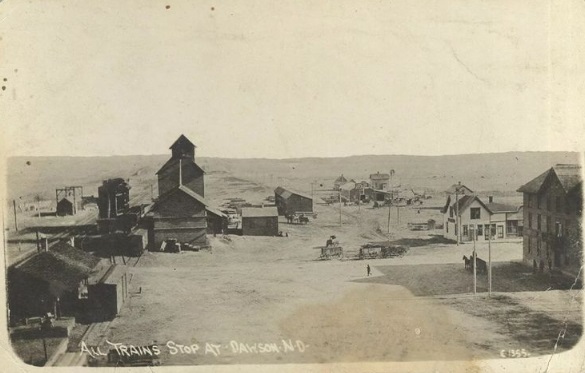
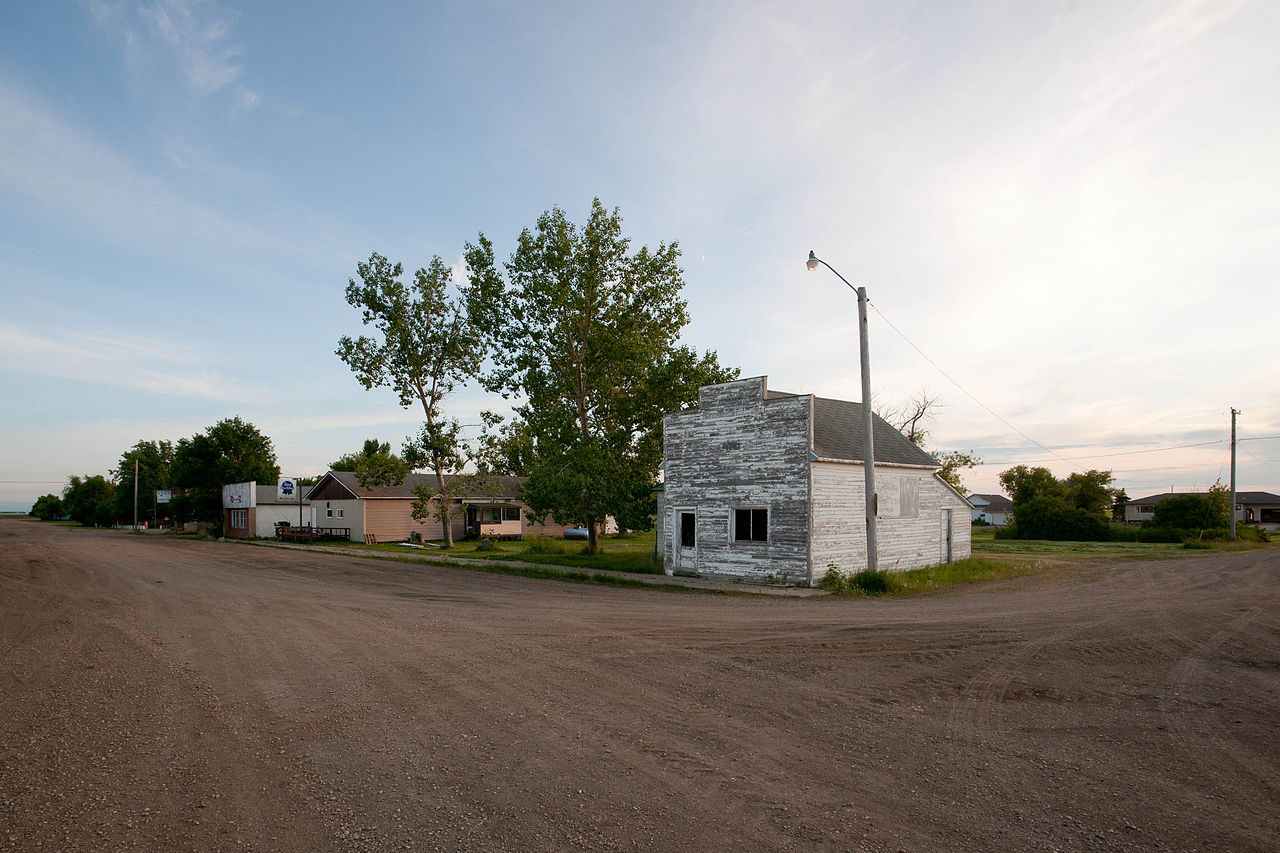
Browsing through Google Maps and Streetview, as I do, I was hugely interested to see the settlements these immigrants made their way to, and what they look like now. One was a town called Wales, North Dakota, which even in it’s heyday was little more than half a dozen grain elevators by the railway track, and Hannah, a little further north, at the end of the railway line, and just a few miles south of the Canadian border. Hannah was very similar to Wales, except that there is a cemetery there and yes, there are some of my family’s graves there. Both Wales and Hannah are little more than ghost towns now, with Wales listed as having a population of ten. However, the land around the towns is still extensively farmed and probably doesn’t look too much different now than it did in the 1920s and 1930s.
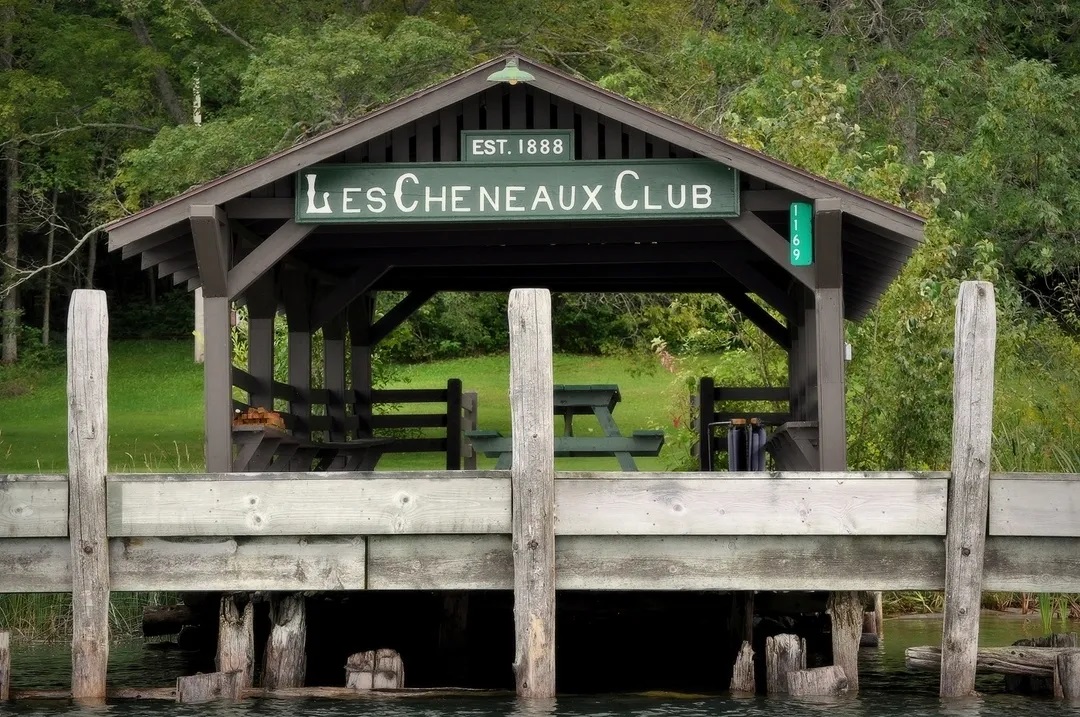
Another branch made their way to Cedarville, Michigan, not too far from Ontario’s Huron County. As some point the family became involved with the Les Cheneaux Club on Marquette Island, which is in the Mackinac Straits and not too far from Mackinac Island. Marquette Island, and specifically the Les Cheneaux Club, was a summer getaway for wealthy Chicagoans when their summers became too hot, and my relatives were caretakers of the Club in summer and winter in the early part of the twentieth century. Indeed, my fourth cousin, once removed, Uldene Ethel LeRoy (nee Rudd), wrote a book called Six on an Island: childhood memories from Lake Huron, which was published in 1956. While searching around for the book, I discovered an undergraduate paper from Grand Valley State University in Grand Rapids, Michigan, written by Uldene’s grandson, Joshua Lycka. It references her book and compares his own memories with hers. The things you find on the Internet!
Both my mother’s and father’s families have extensive connections with emigration to the New World. The Mayne’s led the way, but the Caters and the Cudmores from North Devon, and quite a few of them, followed up a decade or two later, and both branches of the family are now spread far and wide across Canada and the United States. I wonder how much more I will discover as I delve even deeper?
I’ve not written anything for ages, so, as it’s well into the new year, I thought I should knuckle down. The trouble is that there’s so much “noise” out and about, what with Trump, Musk, et al. Still, life goes on and I can always look away from the awfulness unfolding around me.
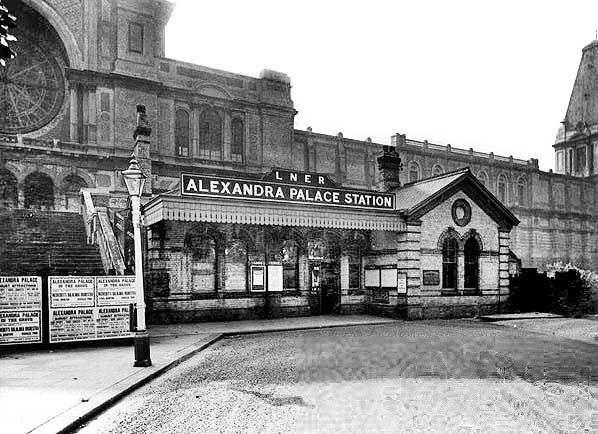
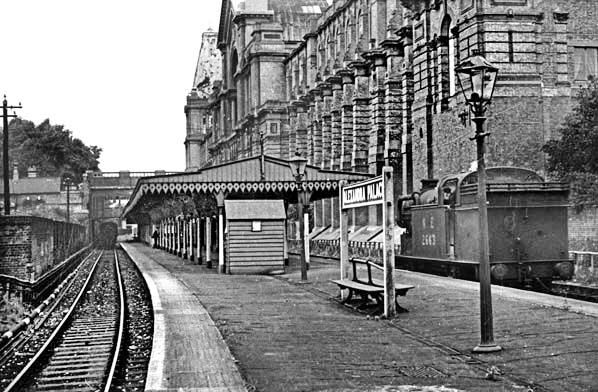
Someone posted a photograph on Facebook of an old railway station at Alexandra Palace in North London (UK). It was built right into the main structure of the Palace, too, which caught my eye, not least because I didn’t know there had been a railway there. I have no great connection with Alexandra Palace beyond my living in North London myself for a few years, but I did travel past the place every day when I was commuting from Stevenage in Hertfordshire into London every day in the early 1980s.
Alexandra Palace isn’t a palace in the royal sense, but a palace of entertainment and sports. It’s known affectionately as “Ally Pally”, and because it sits atop a big hill, you can see it for miles around, even in the suburban jungle of North London. It was opened in 1873 and has gone through many iterations in its lifetime, most notably perhaps as the BBC’s first home for a regular television service, starting in 1936. Ally Pally is still functioning, too, as concert, exhibition, and community venue. Curiously, though, despite having seen it every day for years, and lived relatively close by, I’ve never been inside.
But I digress. The station was the terminal point for a broad loop of line coming out from the London to Edinburgh Eastern main line. It must have been quite a slog up the hill with a full load, because it’s some climb up to the Palace. The branch was opened in 1873, along with the venue, but closed in 1954. The track bed is still in use, only now as walking trail, known as the Parkland Walk (North), and still utilises some of the old railway infrastructure to traverse the now busy roads.
I write all of this as a way of both highlighting my total ignorance of the history of North London and it’s many esteemed buildings and infrastructure, and the fact that my trips past Ally Pally were now over forty years ago. Where on earth did the time go? Indeed, this realisation of time past manifested itself on a trip to the UK in 2023. We were on a train going from Hackney Downs into Liverpool Street and I was remarking to the good lady wife that the trains were somewhat improved compared to the ones I’d used on that route in, wait for it, 1981! I hadn’t even begun to consider the passage of time, beyond a decade or two, but four decades and counting? It was no wonder things had changed.
Anyway, enjoy the photographs of Ally Pally station, and check out the links below, while I go away and consider how time passes so darned quickly.
My old PC, an HP all-in-one with a 34″ curved screen, was showing signs of imminent failure. Microsoft Blue Screens of Death started happening with WHE (Windows Hardware Error) codes, and the screen started to get intermittent yellow lines on it, from top to bottom, and none of that looked good. The old girl had to have been at least seven years old and didn’t really owe me anything, so I thought I’d pension her off before she turned up her digital toes. It’s a bit sad because I’d done some good upgrades, including replacing the original 150GB Solid State Drive (SSD), that was supposed to be the boot drive with a 1TB upgrade, and I swapped out the old 1Tb mechanical hard disk for a 1Tb SSD. That upgrade on the mechanical hard drive was a bit of disaster because I managed to damage the LCD screen when putting it all back together, and lost an inch of visible screen on the left side, and suffered a growing dark stain over about a third of the bottom of the left-hand side of the screen. It was still useable, especially as the screen was so big, but the problem was getting worse.
The HP all-in-one cost me an arm and a leg when I bought it, and right now I don’t have the cash to lay out for a similar system, so I downsized. Now it’s an HP all-in-one with a 27″ screen, but with a bit more memory and slightly faster processors than the old PC. Happily, it cost less than one third of the old machine, which pleased me greatly. My needs are fewer these days, so I’m quite content with the downgrade. Anyway, I can see my desk again, now.
Buying a new PC is quite easy. I shopped around, checked out a few early Black Friday deals and settled on the new HP, direct from HP Canada. I managed to get nearly $700 off the list price, so that was the clincher. I ordered it on the Tuesday night, and I had it in my grubby little hands on Friday afternoon, which was pretty much Amazon speed. Alarmingly, HP Canada proudly boasts Canadapost and Purolator as its partners, which was a quite concerning given that Canadapost is on strike right now. However, it didn’t appear that Purolator was involved in the strike, even though it’s the parcels arm of Canadapost, and I was mightily relieved to see the Purolator van pull up outside my house.
The packaging of the computer was quite ingenious, and the way it was all fitted into the box, meant that because I followed the instructions properly, I didn’t have to handle the screen while getting it out from all the padding. Take it from one who has manhandled a 65″ thin screen TV onto a wall, that’s a real bonus. The keyboard and mouse were both wired models, actually perfect for my needs, and battery-free, but they are very cheap and cheerful, so it hasn’t taken me long to replace those with better models that I had knocking around at home.
Then I began the set up process. Years ago when I was in IT support, I installed hundreds of software packages onto hundreds of PCs, and all using boxes full of floppy disks. It was a slow and painful business, and done at a time when very few PCs had an Internet connection, or even a Local Area Network. Compuserve was our friend back then, but only on the PC that had a modem and telephone line attached. Today, all I had to do was plug a network cable into the back of the PC and let it do its thing. The PC came with Windows 11 pre-loaded, but that all has to be updated and tweaked, but even then I had the thing working within a few minutes and was downloading all the paid software I have collected over the years. I could have cloned the boot disk from my old machine as it was the same size, but doing it the long way, by treating it as a first-time set up, I’ve been able to leave things out and make a few adjustments. A clean start is a good start, even if it takes a little longer.
Early impressions of the new PC are good. The screen resolution isn’t as tight as I’d like, and I could probably tighten it up a little, but I’ll leave it as it is because I’m sure to get used to it. I did hang a second monitor from the PC, and marvelled at how easy it is to do these days with an HDMI cable and Windows 11. The boot up is fast, and the response is good, although as so much is done through the Internet these days, it’s as much about having a decent connection as it is about the speed of the computer. I am slowly switching off all the little things that Windows likes to add, the bells and whistles as it were, that I have no need for. The very first thing I did was revert the right-click context menus to the Windows 10 version. The newer iteration of Windows uses little pictograms for Cut, Copy, and Paste, and if you want a full context menu you have to select it from the top menu, a retrograde step in my view. It seems that there are many Windows users out there who think the same as I do, though, because when you Google “Windows 10 Context Menu”, there are thousands of hits showing you how to achieve your aim. Perhaps Microsoft should take note and offer a choice of context menus at startup?
It’s probably an age thing, but I don’t get the use of so many pictograms in place of the written words. The Windows symbol for “Crop”, for example, means nothing to me. Sure, use the symbol, but put the word “Crop” underneath it for those of us that can read. It’s not just Microsoft, though, smartphone-based Millennials have been brought up on using pictures rather than words, and it’s they who are writing today’s software. Won’t anyone think of the old folk?
Time will tell if the new PC is up to the job, and I do intend to work it quite hard. For now, though, I will sit back and reflect on how all those years of setting up computers at work have proved to be very useful in retirement, even if I don’t need floppy disks anymore.
I had an e-mail a couple of weeks ago that came with a PDF file. In that file was a letter to me from someone I didn’t know, claiming that they knew things about me and that my “secrets” would be made public if I didn’t send some money to them. Given that the street address, phone number and e-mail address was correct, it was a little frightening. Or it would have been but for some fundamental errors in the letter.
The first error was that they thought the phone number they were quoting was a cell phone, which it wasn’t. Threatening to put all manner of malware on my phone wasn’t going to work on an old fashioned landline. Then there was the issue of the person claiming to “see” inside my home, presumably through a camera on a computer or my cell phone, but that can’t happen with my computer and phone set up at home. Having access to my computer was another claim, and while I can’t claim to have the most secure set up, I do take precautions and I’m confident that no one has access to my computer, at least not that I’m not aware of. But, armed with some genuine information, data that is actually publicly available or maybe had been gleaned from a data breach somewhere, someone has attempted to extort money from me.
I toyed with reporting the matter to the Police, but the e-mail address was not traceable, and while they may have investigated, it would have taken a long time and probably revealed nothing. So, I deleted the e-mail, and the PDF file and awaited further contact.
The issue here is that if you’re not particularly tech-savvy, you might take this kind of threat seriously and be goaded into parting with money. Push out a ton of these letters and you’ll get some return from your efforts, I’d guess. The world can be a dark place sometimes.
What the incident did do, though, was prompt me into reviewing my online security arrangements. I subscribe to three different security packages covering phones and PCs. They were all up to date and reporting nothing untoward, which was good. I made sure all my Operating Systems were updated, too, as they are the front line of security. I also use a Virtual Private Network (VPN), at least some of the time, although I’ve found that online functionality can suffer with the VPN running, at least when working with certain software, or on certain websites. Where I lacked security, and it’s not directly associated with the attempted extortion, was with passwords. I had used the same passwords across a broad range of online accounts, and while not having had an issue so far, I thought it was time to tidy that up. With the use of a paid third-party password manager, I revisited all my online accounts, changed the passwords where I needed to, and took advantage of the additional protection the password manager software gave me. I looked back through the password records of my web browsers and was amazed to find data going back years. While the browser providers will always assure you that this data is safe, it is information that could be compromised, so I’ve stripped that data right down and now the browsers carry no significant password data. Changing passwords regularly is a must, anyway, and made easier with the use of the password manager. As an added layer of protection, I’ve gone to using just a single browser, rather than the chopping and changing browsers as I’ve been doing. There are issues with that, “all the eggs in one basket” so to speak, but at least I don’t have more than one Browser password file to manage now
No word back yet from my extortioner, and the original contact was a month ago. There have been no notified attacks on my computers, either, so it’s looking like it was a fishing trip. Obviously you never engage with people like that, but if I did I’d than them for boosting my online security, it’s been a very productive exercise
I’m still smarting from Trump’s victory in the US elections two weeks ago. Not that I had any influence, being Canadian and all, but his assumption of, or resumption to, power will affect me, and not in a good way.
Obviously the American people can choose who they want as their President; they have their ways and their rights. It is galling, though, to see a man who lies so easily, who cheats (on businesses and wives), who is a convicted felon and who has sexual violence judgements against him, get elected to the highest office in that land. I don’t understand how a man with his track record could attract the Evangelical Christian vote, and I don’t understand how people saw his policies, such as they are, as a viable alternative to those offered by Harris. But maybe that’s just me.
Certainly, the American people have been deluged with Trump propaganda since 2015, and that must get tiring. From the ludicrous claims of 2016, to the incitement to attack the Capitol to prevent Biden’s assumption of office, to the even more ludicrous claims of “They’re eating the cats…”, it’s all been backed up and amplified by Fox News, and now Musk’s Twitter, so I get it that people have been bamboozled. What I don’t get, though, is the lack of critical thinking, the lack of anyone, from individuals to national broadcasters and newspapers, actually asking Trump, “Just how are you actually going to fulfil your promises to ordinary people?”. The voters wanted a change, saw an alternative to the current regime and voted for it, without asking any pertinent questions of that alternative.
Still, as I said earlier, it’s the American people’s choice. I hope they don’t live to regret that choice.
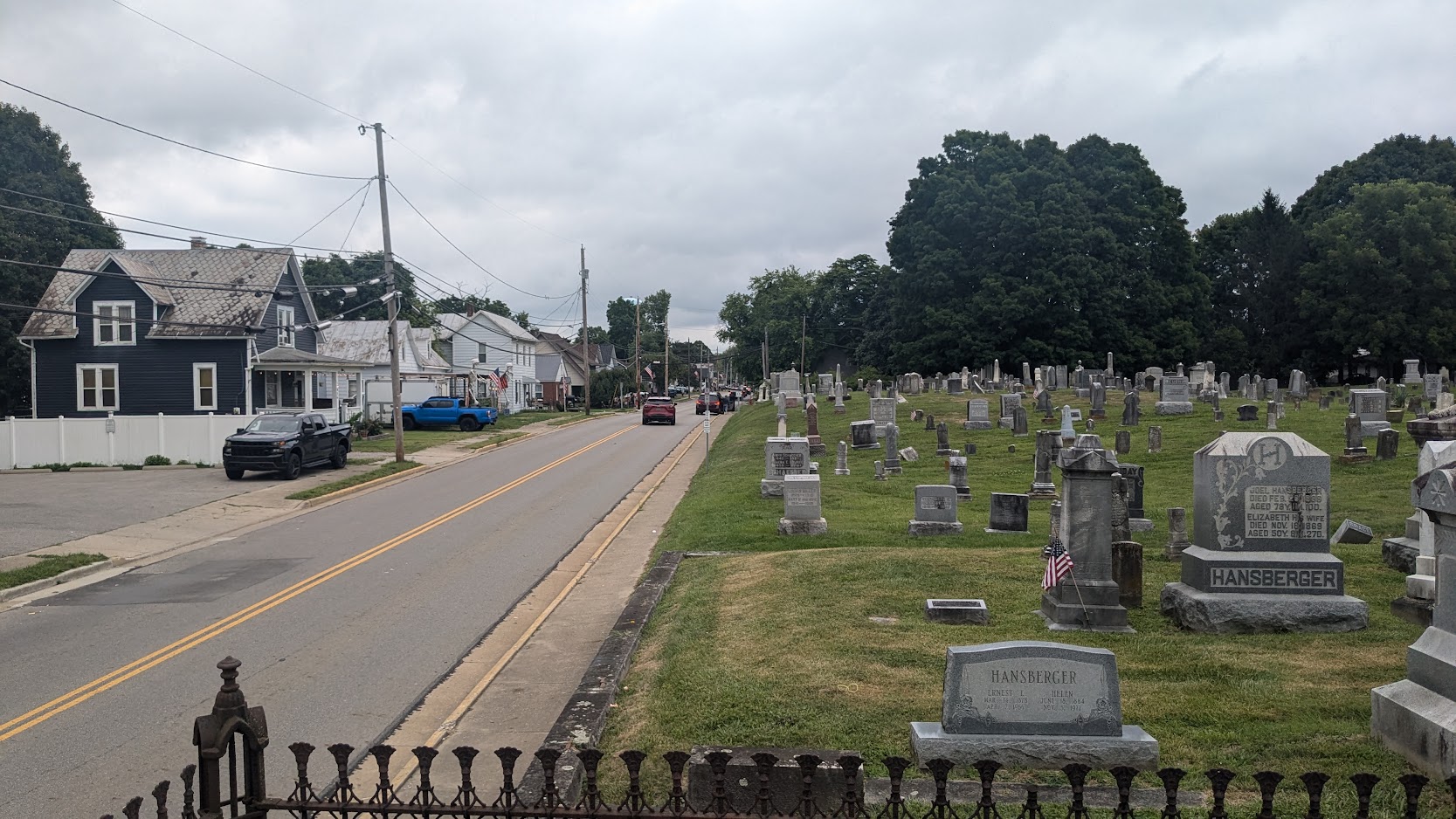
It occurred to me that I hadn’t noted down any details of our trip last August to Fairfield County, Ohio, and the grave of Washington Franklin Mayne. We were in Columbus for the weekend on another matter, but couldn’t pass up the opportunity to visit old WF’s last resting place.
Why? You may well ask.
Washington Franklin Mayne was the third child of Henry Collins Mayne and his wife Anna Robinson, and was born in Loudoun County, Virginia, in 1826. Henry and Anna had arrived in New York from Leeds, in the English county of Yorkshire, in 1822 and made their way to Northern Virginia to set up a farm. Henry’s father, Joshua Mayne, is my great-great-great-Grandfather. Not only was Washington Franklin the third Mayne born on US soil, but he was the last to be born in Virginia as the family moved westwards, to Perry County, Ohio, after his birth.
Not much is known about Washington Franklin as he grew up in the Zanesville Ohio area, but we do know that he studied at Ohio Medical College to become a Doctor and started a practice in the village of Basil, Ohio. As well as being a respected doctor, Washington Franklin acquired a lot of land in Basil and was a well known figure in the area.
The land acquired by Washington Franklin Mayne was on the original lands of the Shawnee, Mingo and Delaware peoples, and their ownership of that land is fully and respectfully acknowledged.
Washington Franklin married Eliza Jane McNeill of Ross County, Ohio, in 1865 and they became the parents of four children while living in Basil.
All that is by way of background as to why I would want to visit a small and very pretty little village in rural Ohio. Washington Franklin died in 1884 at the age of 56, and was buried in Basil Cemetery, just yards from the home and doctor’s office he built in the village. Eliza Jane died in 1924 at the home of her daughter Gertrude, in Piqua, Miami County, Ohio. Although buried in Piqua, Eliza’s name is engraved on the handsome stone memorial that marks Washington Franklin’s final resting place.
As we motored south from Columbus, it’s only a 35-minute drive, we both remarked on how similar this part of Ohio was to our part of Ontario; the same crops in the fields, the same buildings on the land. As we arrived in Basil we came across a town parade, an annual event for the people of Baltimore Ohio, the larger town that swallowed up old Basil. I thought perhaps they were out in my honour, but alas, no. We found Washington Franklin’s gravestone easily, stood and soaked up the atmosphere, and I felt really quite humble to be there at the place were one of the founders of the Mayne’s American dynasty had built his life, and the lives of his family.
Washington Franklin and his siblings were the start of a vast family network covering a good portion of the USA, from Indiana to Tennessee, to Kansas and to Colorado, and many places in between. There are many more graves for me to visit, particularly in Indiana, but for now the is trip to see old WF’s grave and the village he made his mark in will have to do.
I like maps, and modern digitized mapping is really quite excellent. Instant access to the maps across the world, satellite imagery and Street View, what could be better? Well, understanding its limitations would be a start.
Satellite based navigation for cars really opened up the possibilities, and now cellphone-based navigation systems are bringing in a raft of developments in route planning, especially with traffic information available pretty much in real time. So if I like it so much, where’s my gripe? As it happens, it’s two-fold.
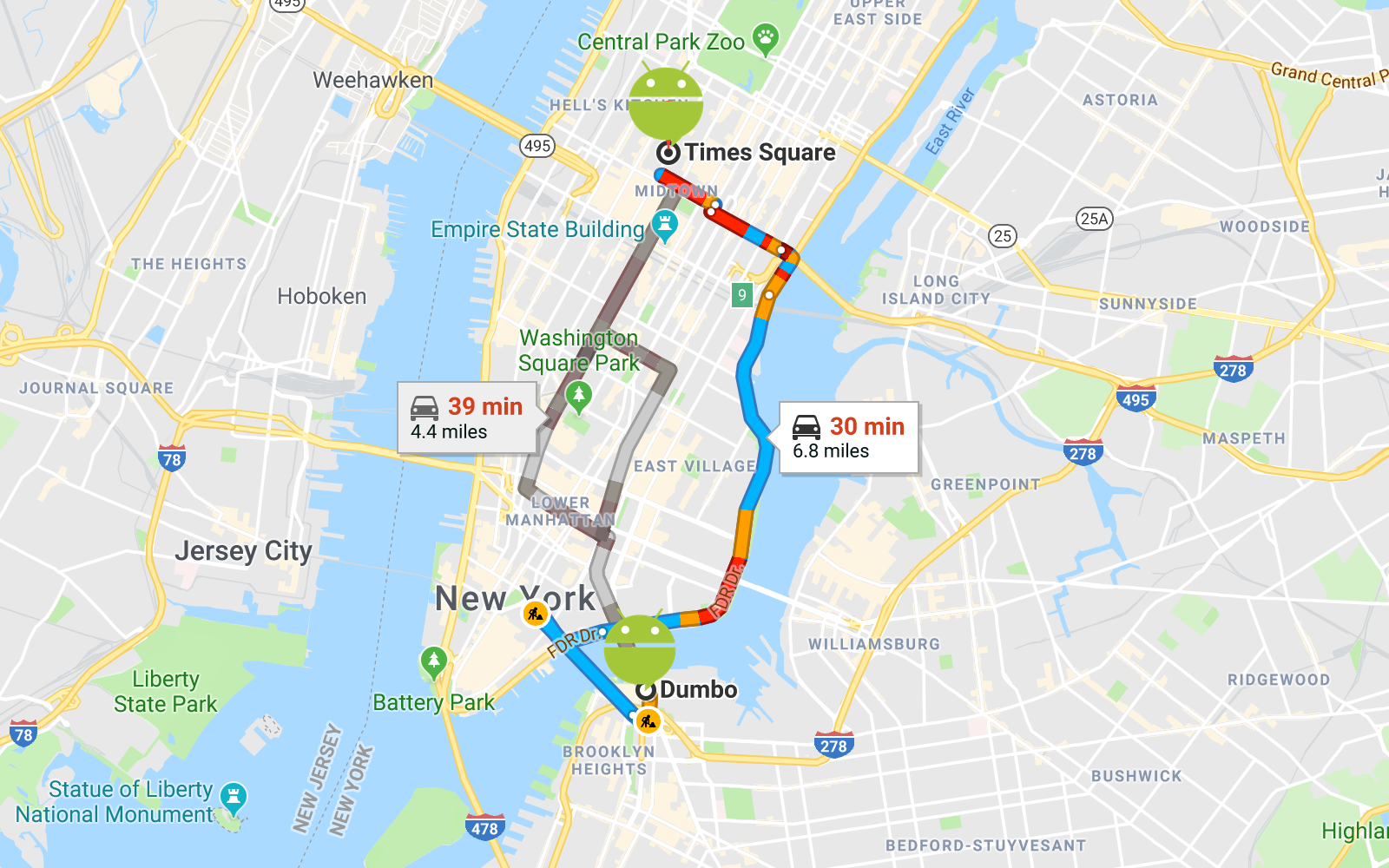
Firstly, the visibility of the map on your hand-held or inboard device is quite limited, generally around 500 metres, even on the big screens available in modern cars. The whole premise of navigation seems to based on that 500m, and the designers of the systems appear to think that you don’t need any more immediate information than that. In a big city with intersections every few yards, I’d agree, but outside of the city, that 500m is pretty paltry. It’s probably just me, but I like to be looking way, way further afield so that I can anticipate things that the navigation system doesn’t let you know, like whether your turn two miles away is to the left or the right. You could argue that you don’t need that information, but I can’t drive without having a general idea of where I’m going. There’s the rub, of course, you may not need that information but without it you’ll end up having to make snap decisions and quite possibly mistakes, all that could have been avoided with more advance information.
The second part of the gripe is the way systems’ developers want to decide the parameters of your journey for you. The prime example is the manner in which systems will constantly suggest route changes as you’re driving, just so that you can potentially save a minute here or a minute there. Seriously chaps, why would be be bothered about single minutes? I drove in a rented car from Plymouth to Manchester and had the navigation system constantly suggesting route changes, to a point at which it became intrusive. I spent some time trying to get the system to stop making suggestions, but when set to “Quickest Route”, those suggestions were not optional. That particular system, in an Audi, sent us on three different routes on three different days between the same two points. Interesting for sure, but why? I couldn’t discern that any of the routes was better than the other. I can’t imagine a long(ish) drive where you did take up all of the system’s supposed time saving route alterations.
There are myriad stories of people being directed down inappropriate roads by their navigation systems and I can’t help thinking that with a bit more information, a wider view, people might not be inclined to blindly follow the instructions.
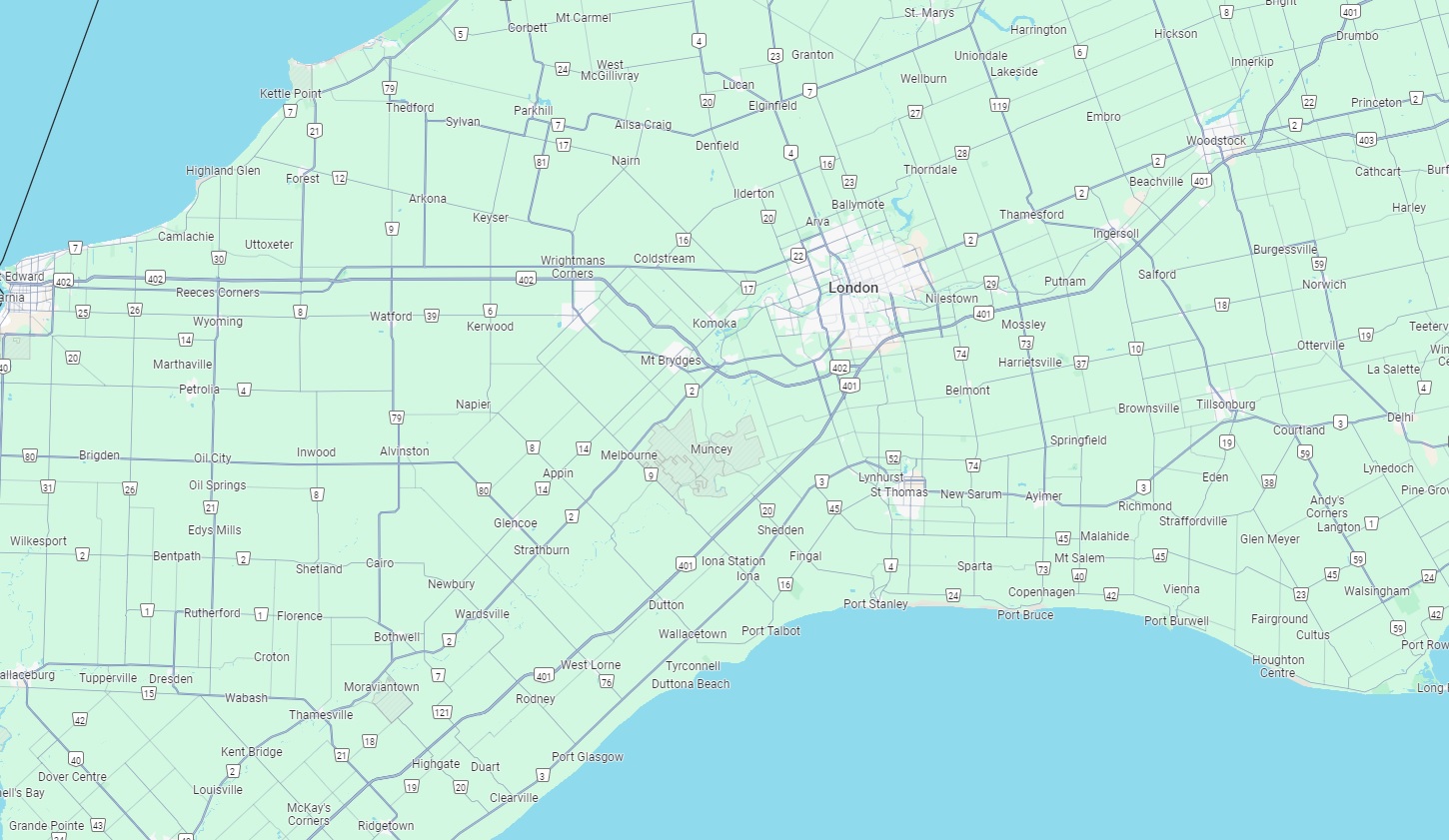
My solution is to peruse a map before I travel, paper or digital. That way I can get a feel for where I’m going, and use the navigation system to augment that broader information. Travelling across London (Ontario) yesterday, I had checked on a digital map to see that I’d need to be travelling from east west to catch a link road that ran north to south. The cellphone navigation system called out the turns, but I was at least able to follow the wider route I had lodged in my memory by making sure I was moving in the correct direction.
OK, it is me, normal people manage with navigation systems just as they are. Me, though, I still like that broader view.
I do like my football. That’s the game played with the feet and a ball, not hands and an egg; that’s Handegg and only played in North America,
Watching football on TV is very easy in North America, though, and it’s cheaper than if you were watching in the UK. The number of games on offer is very good, as is the quality of the video feed. Well, I say that, but here’s the rub, the commentary is awful.
Games from the English Premier League (EPL) are broadcast in Canada through a streaming service imaginatively called “FUBO TV” (named, I think, by some drunk marketing people after a good afternoon out at the pub). Fubo gets its video direct from the EPL using the “International Feed”, that is for broadcast in English speaking countries that are not the UK. The EPL use a variety of professional match commentators, who are journalists I believe, and a former professional player as a “Summarizer”. I don’t know that there are any rules on impartiality when creating this feed inasmuch as it will be going out to various non-UK countries and isn’t subject to the UK’s broadcasting standards. As a consequence, the commentary and the summarizing is simply awful.
You can bet Beglin was summarizing on this game at Anfield. Slippy Gerrard having a pop at Everton’s goal.
As an initial example, take the number of Liverpool games summarized by Jim Beglin. It seems that every time the reds run out in a televised game, good old Jim is there to provide the insight. That would be OK except that Jim Beglin played 98 professional games for Liverpool in the eighties, and he absolutely adores everything Liverpool, and Liverpool related. Cut him in half and he has the word Liverpool running through him like a stick of rock. (Google it). He has improved over the years and no longer relates everything to his Liverpool playing days, but he still roots for the reds and it’s frankly embarrassing to have to listen to him. Worse than that, the match commentators will often take the lead from the summarizer and amplify the outrageous partisanship. I can only assume that Jim lives in the North West of England somewhere, and finds it easy to get to Anfield. There can’t be another explanation as to why they let such favouritism go unchecked.
A far worse example is that of match summarizer Andy Townsend. Now Andy has played for my team Chelsea 110 times, but he clearly left under a cloud because it’s virtually impossible to get to hear him say anything positive about Chelsea, and it doesn’t matter who their opponents are. He’s being doing it for years, too, as I have bad memories of a game where Chelsea played Stoke City, in Stoke, and Townsend was all but coaching City for about two-thirds of the game. Chelsea won anyway, but I really couldn’t fathom why he was so negative. Things have continued like that for season after season, and the only time he relents is if Chelsea are winning well and there’s not much time left to play. The game with Newcastle United this past weekend was a case in point, with Andy disparaging everything Chelsea did, until they went 3-1 up and the game was sealed. We thankfully don’t get Andy summarizing as much as we used to, at least not Chelsea games.
I think the commentators and summarizers read the back pages of the tabloid newspapers before they start work. They keep regurgitating the current gossip and the speculation, 90% of which is nonsense, but I guess they do it for the same reason the tabloid hacks do it, to sell advertising space. Like the people who dreamed up “FUBO TV”, most gossip is formed in pubs by journalists with nothing better to do. I was going to mention the “Connor Gallagher to be sold” story, but it’s pure fiction so not worth mentioning.
More tabloid bollocks, this time from the New York Times’ The Athletic. Pure fiction.
Anyway, words are important and footy fans are not (all) stupid. They no more like to hear favouritism from the commentators than they enjoy seeing their own team lose. I shall be penning a furious letter to the EPL if I hear Townsend summarizing a Chelsea game again this season, but apart from me letting off a bit of steam, I really don’t think it matters to the EPL. Sad.
















 Stevemayne's Blog