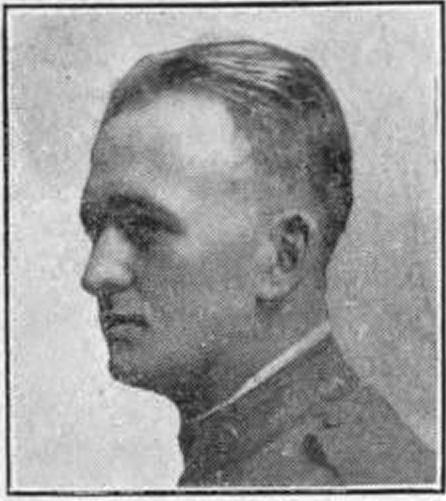
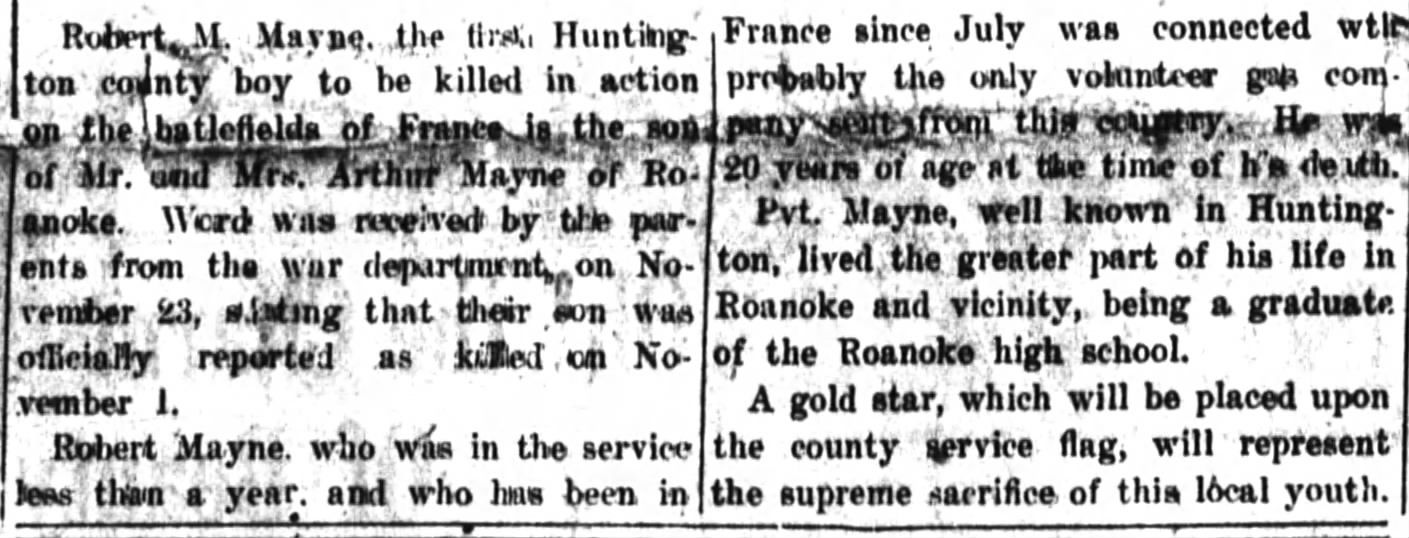
Another Armistice Day entry, and this concerns family member Robert McNeil Mayne, a native of Huntington County, Indiana. Robert was just 21 when he was killed in the US-lead Meuse-Argonne Offensive, late in the First World War. He died on November 1st, 1918, just ten days before the Armistice.
Robert was the only son of Arthur McNeill Mayne and his wife Laura Belle Purviance. He was the great-grandson of Henry Collins Mayne and Anna Robinson, who had left England in 1822 and made their way to New York. Robert and I share a common ancestor in Henry Collins Mayne’s father, Joshua Mayne.
Robert entered service on Feb 18th, 1918 at Fort Wayne and was assigned to Company E, 30th Engineers at Fort Meyer in Virginia. He embarked for France on June 28th, 1918 and was killed at Argonne Forest in Northern France four months later. Robert has the sad distinction of being the first boy from Huntington County to be killed in the Great War. He was buried where he fell.
The Meuse-Argonne Offensive claimed 26,277 American lives, over 28,000 German lives, and an unknown number of French lives, of which Robert was just one. His name is recorded in the Indiana Gold Star Honor Roll 1914-1918.
Like all the other war dead in my family tree, Robert will be in my thoughts on Remembrance Day, November 11th.
With Remembrance Day just around the corner, it was fitting that I should come across another of my relatives who lost their life in the First World War.
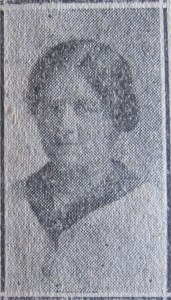
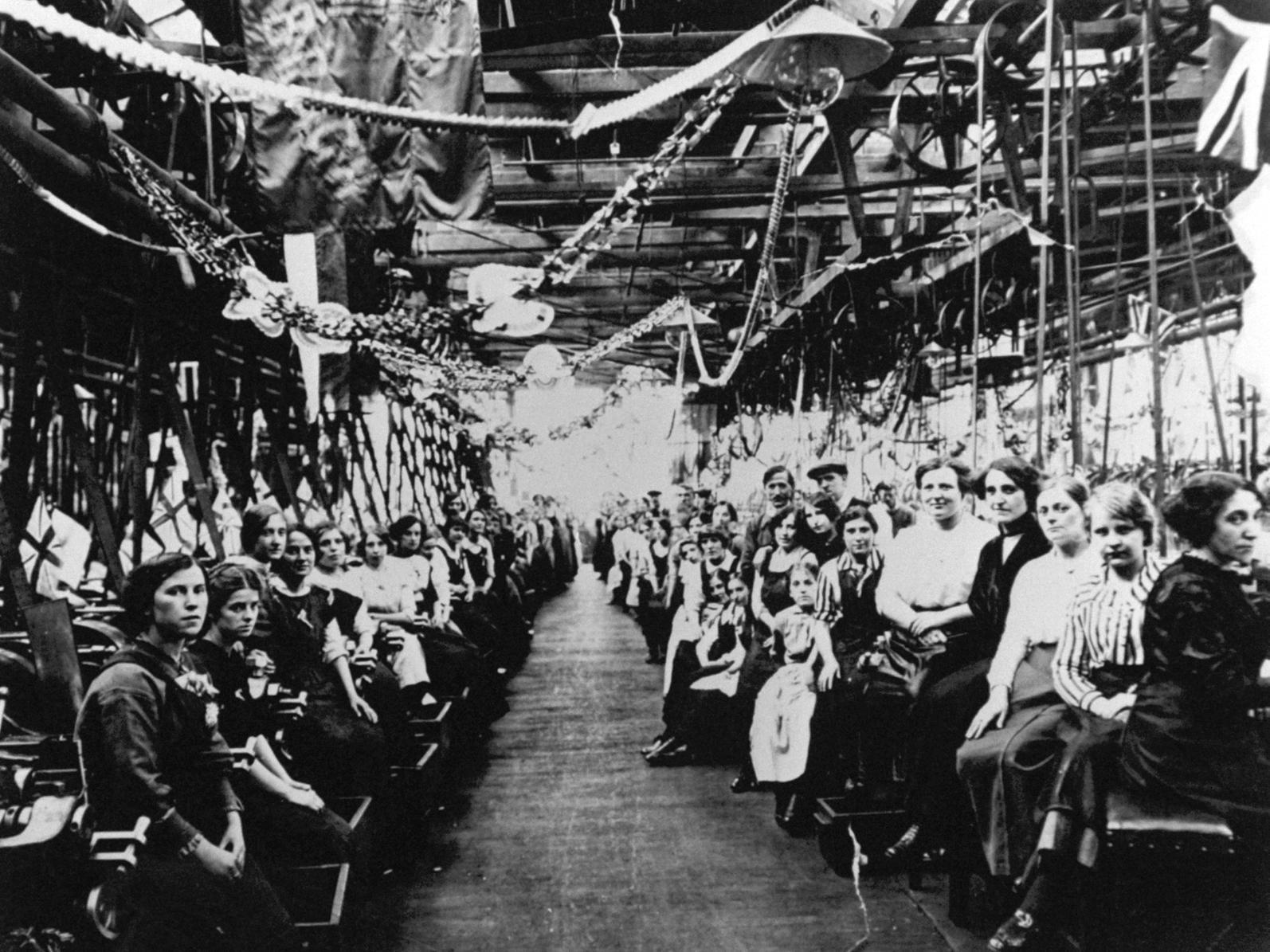
Ann Leonard, a second cousin once removed, was just twenty-four when she succumbed to TNT poisoning while working at the Barnbow munitions factory near Leeds, Yorkshire, England.
Born in October 1891 in Morley, Yorkshire, she was one of ten children to William Leonard, a Coal Miner, and his wife Emma. Her death certificate said she had died from “atrophy of the liver” as a result of working with munitions. She was one of many women killed in the production of weapons and ammunition throughout the Great War; explosion and disease were constant threats in the workplace. While Ann died from liver failure in the July of 1916, on December 5th of the same year, an explosion tore through part of the Barnbow factory and killed 35 women outright, and maiming and injuring dozens more.
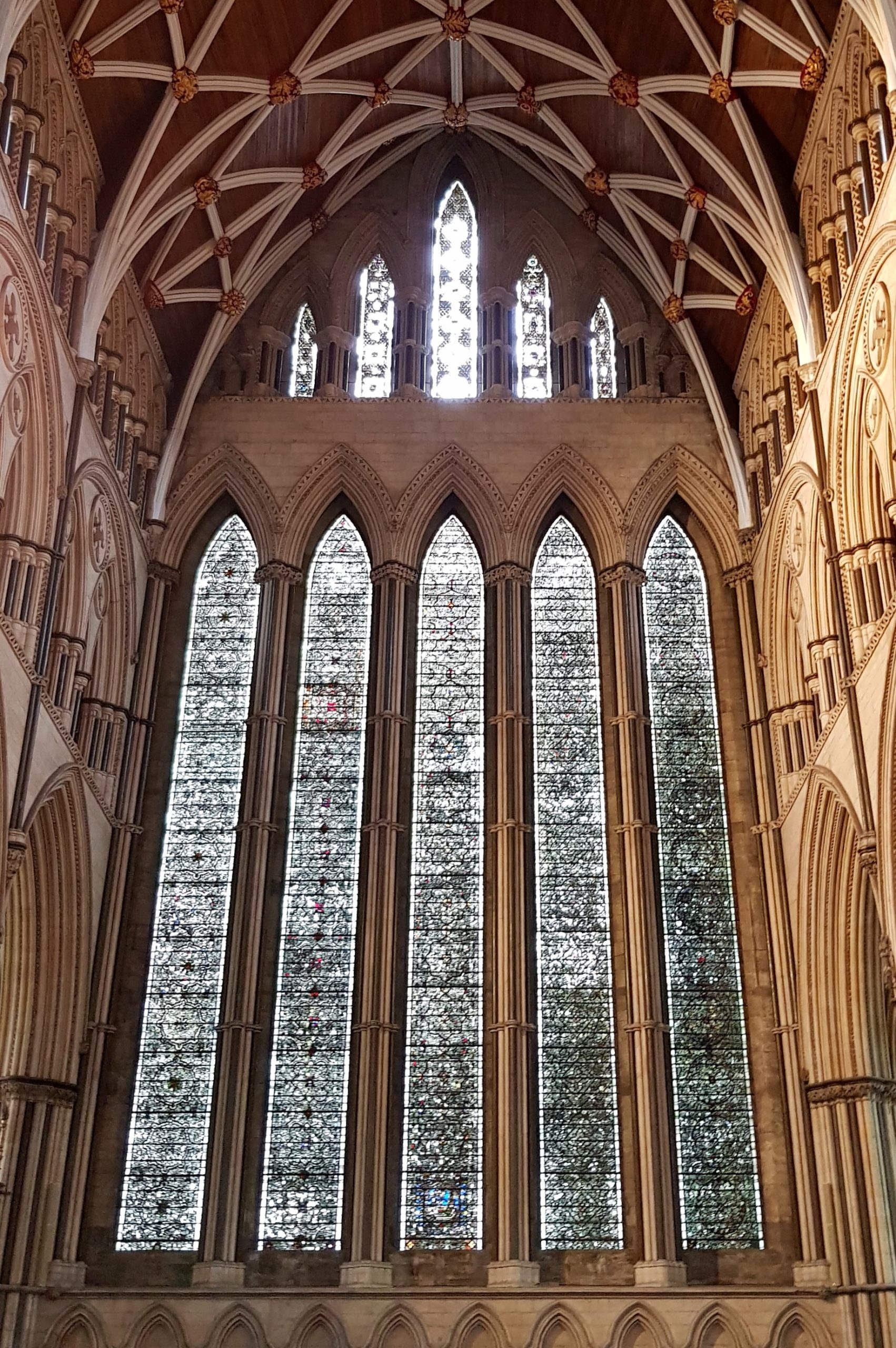
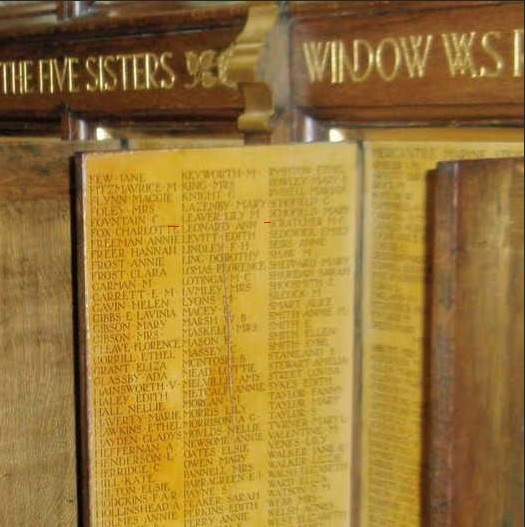
I was surprised to hear that Ann’s name appears on a Roll of Honour in York Minster, underneath the 13th Century series of stained glass windows known as the Five Sisters. The window was renovated between 1923 and 1925, and then dedicated “Sacred to the memory of the women of the Empire who gave their lives in the European war of 1914–1918” as a lasting memorial for all those women who died as part of the conflict.
In a cruel twist of fate, her brother Edward, himself only twenty-two, was posted as “Missing presumed dead” in France, just twenty four hours after Ann died. I can’t begin to imagine what their parents, must have gone through.
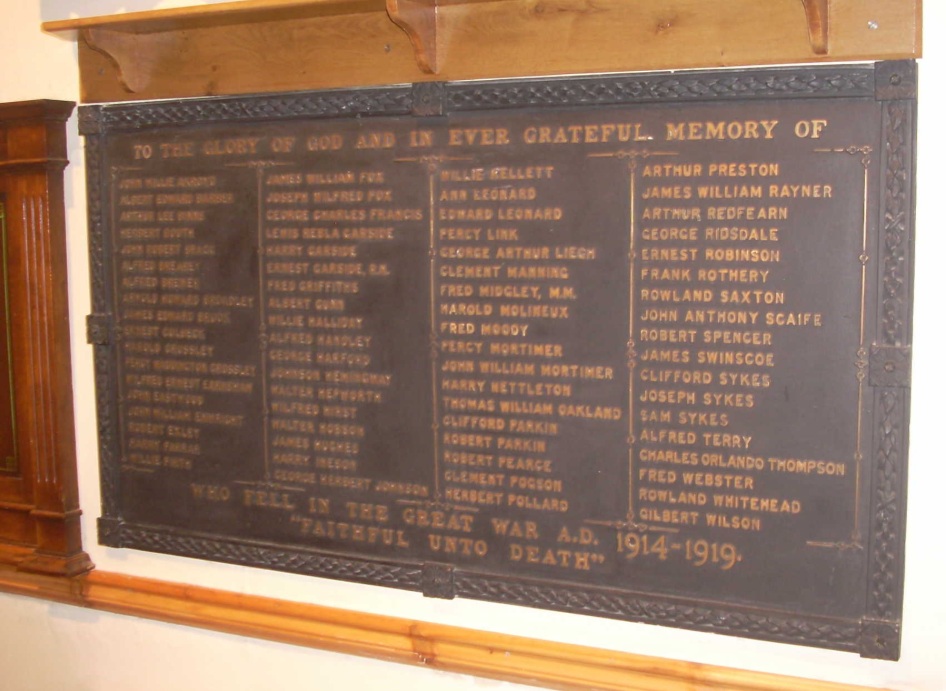
Aside from the Roll of Honour in the Minster, both Ann and Edward are featured in a plaque in the church of St John the Evangelist in Carlinghow, Batley, Yorkshire.
The Imperial War Museum maintains records of the casualties of war, and Ann’s entry can be found here.
I have more than seventy family members recorded in the Commonwealth War Graves Commission records, across the First and Second World Wars. Family war casualties came from the UK, the USA, Canada, and South Africa. This November 11th I will be keeping Ann uppermost in my thoughts as we remember all those who have died in modern wars.
I started looking into my family tree a short while before my father died in 2009, but didn’t get very far. I think Ancestry.com was around then, but I hadn’t signed up, and anyway I was heading off for my new life in Canada.
Finding myself with more time than I’d anticipated, I picked everything up again a few years later, and this time I did sign up with Ancestry, which opened up more doors than I thought possible. I now have a family tree with over fourteen thousand people listed (not all that I’d call very close relatives, to be fair), and many of them are, or were, situated in places that I didn’t know my family had reached.
Two things set the ball rolling in an unstoppable way. One was Mary, a native of Indiana, contacting me out of the blue, and the other was doing the Ancestry-linked DNA test.
I was, I will admit, perplexed that I appeared to have a relative from the United States. My family, my dad’s side at least, was pure Yorkshire, from Leeds, I thought. Goodness, how wrong I was. Mary pointed out that we had a common ancestor, Joshua Mayne (b. 1761), and everything fell into place from there. With Mary’s help, I was able to discover that one of Joshua’s offspring had left Britain in 1822, bound for New York, and from there had built a formidable Mayne dynasty in the New World. Not only that, another of Joshua’s sons had, in 1849, taken his young family to Durban in South Africa and had set up a similar Mayne dynasty there. To top it all, Mary established that Joshua himself, and his wife Elizabeth Collins, were not from Yorkshire at all, but had arrived in Leeds from Cork, Ireland in 1792.
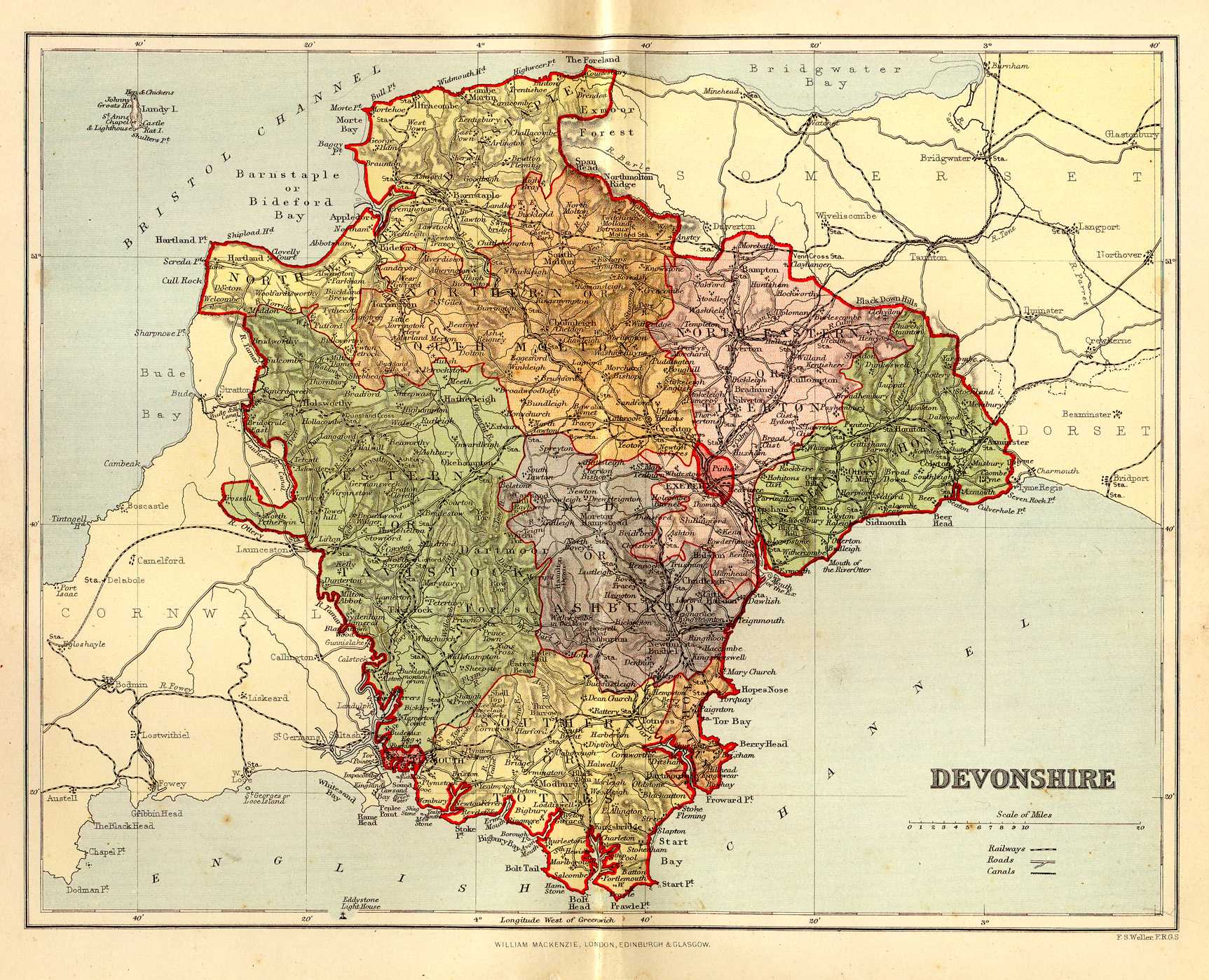
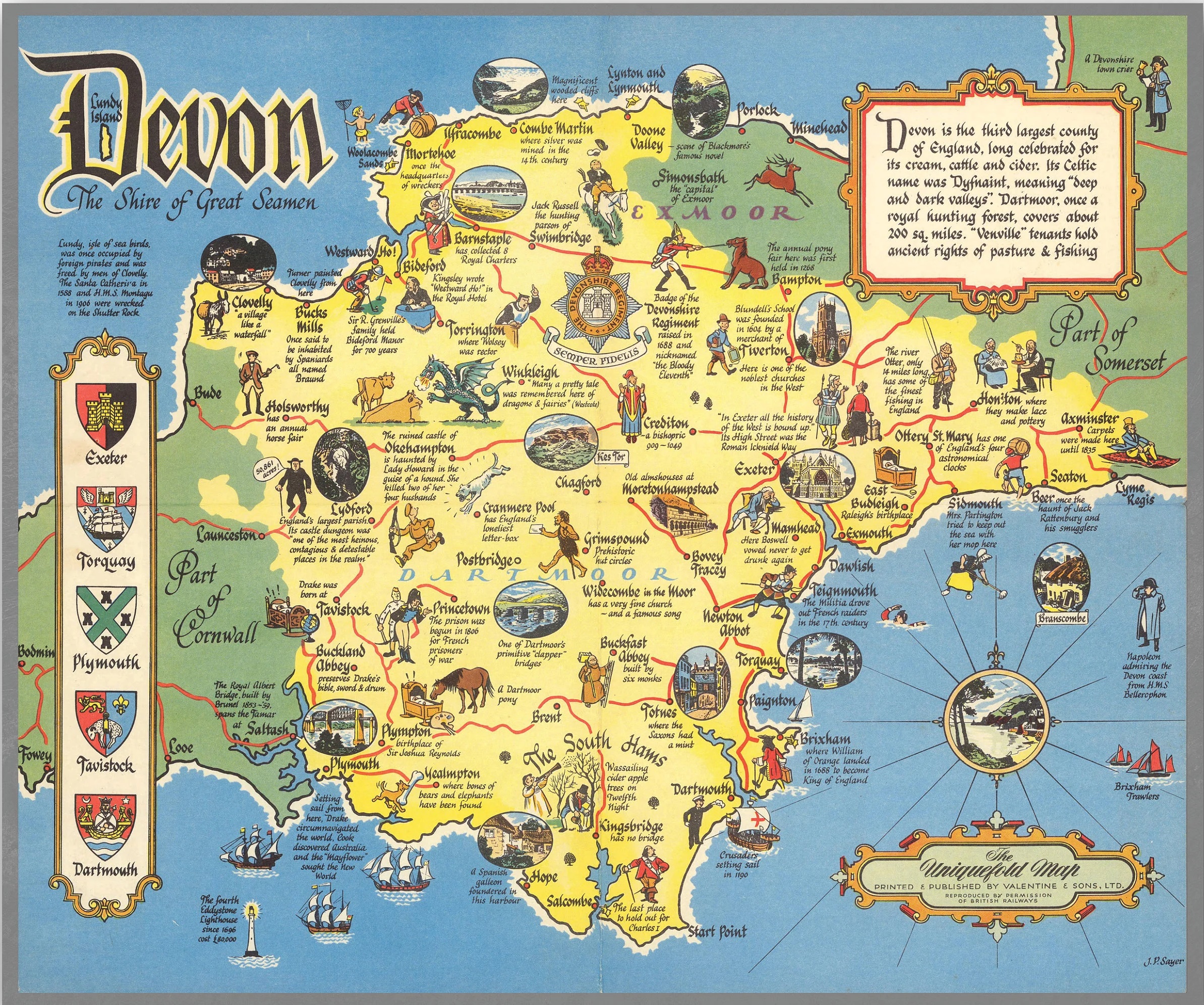
The DNA test came up with equal amounts of potential contacts on my mother’s side of the family, as well as my dad’s, and that was an area I hadn’t addressed up to that point. Building up her side of the tree has shown that we were drawn from agricultural stock in the north of Devon, England, and while many of the family had stayed there and are there to this day, many more had moved away from the land for a new life in Canada and, ultimately, in the United States. Indeed, direct Devon relatives had made it to rural Southern Ontario 150 years before I did.
I haven’t yet found the outer limits of the family tree, either on my dad’s or my mum’s side. I can find very little about my paternal grandmother who’s father arrived in Leeds from Belfast, Ireland, at some point in the early 1880s, although my 24% Irish DNA is in part her legacy to me. Her mother was from Leeds, but her father was from Liverpool, and with a name like Garrett, the chances are that there’s Irish blood from him as well.
On the whole, both sides of my family are from poor stock. Some have done well, though, the South African connection has links to the DeBeers diamond industry. There was some conspicuous DeBeers-related wealth on show in the early twentieth century, with homes in Portman Square and Kensington in London, and even a family burial plot in a Royal Park, the Royal Brompton Cemetery in West London.
My grandfather married into, worked for, and eventually took over, the Pickersgill family business in Leeds in the 1920s. Joe Pickersgill, a very wealthy Turf Accountant, was said to have held the Prince of Wales own betting account in the 1910s and was a millionaire when he died in 1923.
On the American side of the tree, a distant cousin married Mariko Terasaki, the daughter of Hidenari Terasaki and Gwendoline Harold, in 1953. Hidenari was a Japanese diplomat who married Gwen, a Tennessee girl, and worked to avoid Japanese conflict with the USA in the late 1930s. Both were forced to flee to Japan after the Pearl Harbor attack, but Gwen wrote a book about her experiences which was made into the Hollywood movie A Bridge To The Sun. Mariko’s children, those that survive, are prominent peace campaigners, following their grandfather’s lead.
But most of my family tree is comprised of poor people doing poor people’s work, and very much echoing the social structure nineteenth and early twentieth century Britain. Farmers, farm workers, labourers, coal miners, and factory workers, all living in mostly poor conditions but surviving nonetheless. One thing that does jump out is the number of war deaths, at the moment numbering seventy-two. One of the first on my family recorded in the Commonwealth War Graves Commission databases was killed when his ship exploded in the Thames estuary in 1914. One of the latest was a young Canadian naval officer, killed two days after D-Day in 1944 when his ship was sunk in the English Channel.
As I’ve grown the tree, there have been a lot of fascinating stories come out about the individuals in it. In future posts here I’ll try to record some of their stories; not about my family necessarily, but the places they lived and the lives they led, which were in large part, entirely typical.
It’s been an education thus far, and I’d like to document as much of it as I can.
We have just visited a few more graves belonging to relatives I never knew I had, this time in London, Ontario.
When I started up this Ancestry.com thing, I had no idea that any of my ancestors had left England, but that misunderstanding was blown away when a distant cousin from the USA contacted me through Ancestry. She’s from my dad’s side and had been born with the same surname as me, and she opened up a branch of my family tree that I hadn’t found at that point. It turned out that I had an entire dynasty related to me in the USA, and I’m talking hundreds, probably thousands, who all came from one couple arriving in the New York in 1822, from Leeds, in Yorkshire, England.
When I did the Ancestry DNA test, I was matched up with people from my mum’s side of the tree, which I hadn’t really started to research. Curious to see where people fitted, I started to build that side of the family tree and, just like my dad’s side, I found that there were some wanderers.
My mother was born in Torquay, Devon, although I knew that her dad’s side of the family were from Exeter, also in Devon, and her mum’s side were from a small village just outside Torquay called Kingskerswell. My earlier forays into the family tree, when my mother was still alive, hadn’t gone too far and she maintained that the records relating to the Exeter branch of the family were all lost in a fire. When I kicked the family tree thing off again, after her death, I found that she was only partially right about the fire. The whole 1931 Census for England and Wales was lost in a fire, and that included many records relating to my family. But, thankfully, there were many other records that were obtainable, and like my dad’s family tree, the whole thing opened up and hasn’t stopped opening since.
My maternal grandfather was a Stevens, and the Stevens family are solidly Exeter born and bred, despite my grandfather sneaking off to Torquay at some point in the 1920s. My maternal grandmother was a Hill, and the Hills hail from Kingskerswell, and other small places in south Devon. My maternal great-grandfather, though, married into the Bater family, who come from Dolton, in central North Devon. The Baters are, to say the least, a very large family. My maternal great-grandmother, Edith Bater, was one of thirteen children, brought into the world by William and Eliza Bater, and William Bater himself was one of seven children, so you get the idea that there are a lot of Baters related to me in North Devon.
All the Baters, and all of their spouses, were in the business of farming, be that humble labourers or actual landowning farmers, and they all came from an area in north Devon bounded by the Taw and the Torridge rivers. At some point around 1850, one of William Bater’s brothers, George, left Devon and made his way to Toronto, Ontario, Canada. At about the same time, two of William Bater’s uncles, George and Richard Cudmore, also from Dolton, made their way to Toronto, and onward to Clinton Township in Huron County, on the eastern shore of Lake Huron. That seemed to spark a trend because while none of William Bater’s thirteen children moved to Canada, four of his grandchildren did, and they all arrived in the city of Guelph in Ontario, albeit fifty or sixty years after the original Bater and Cudmore incursions into Ontario. George and Richard Cudmore stayed in farming, but George Bater worked in a paper mill in Toronto, and the later arrivals all went into manual labour in the cities of Guelph, Cambridge and London, Ontario.
The Cudmore families expanded and moved on, mostly into the United States. Some pushed westwards into North Dakota to establish farms on the American Prairies, and Alice Cudmore, wife of Richard Cudmore and native of Dolton, eventually made her way to one of her son’s farm in North Dakota after Richard died, and she ended her days there. She’s buried in Hannah ND, quite close to the Canadian Border and the Province of Manitoba, where some of my dad’s family had ended up, homesteading on the Canadian Prairies.
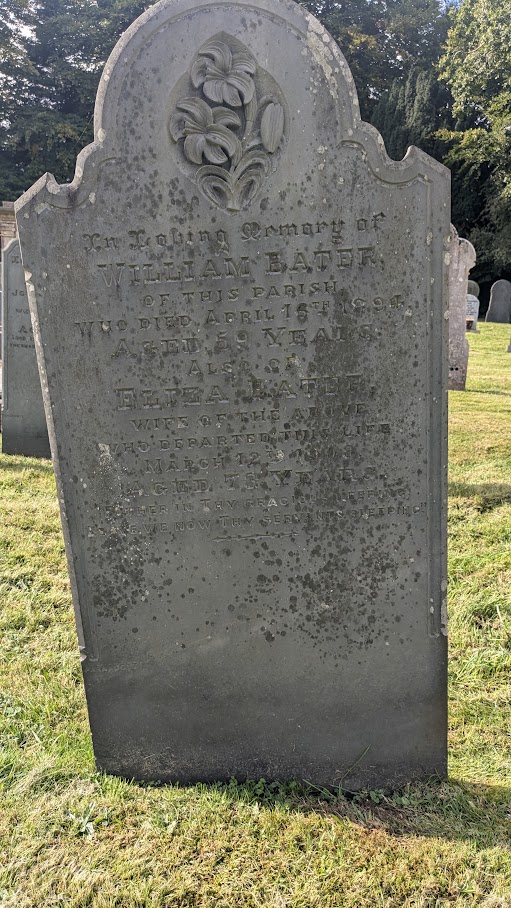
All of that family history is detailed here so that I can link the visits we have made to the graves of some of the people who travelled to the New World from rural North Devon. To start, though, in 2023 we visited the church of St. Edmund in Dolton, Devon, and saw the graves of my 3 x great grandparents William and Eliza Bater, at the time not really understanding just how pivotal they were in the migration to Canada.
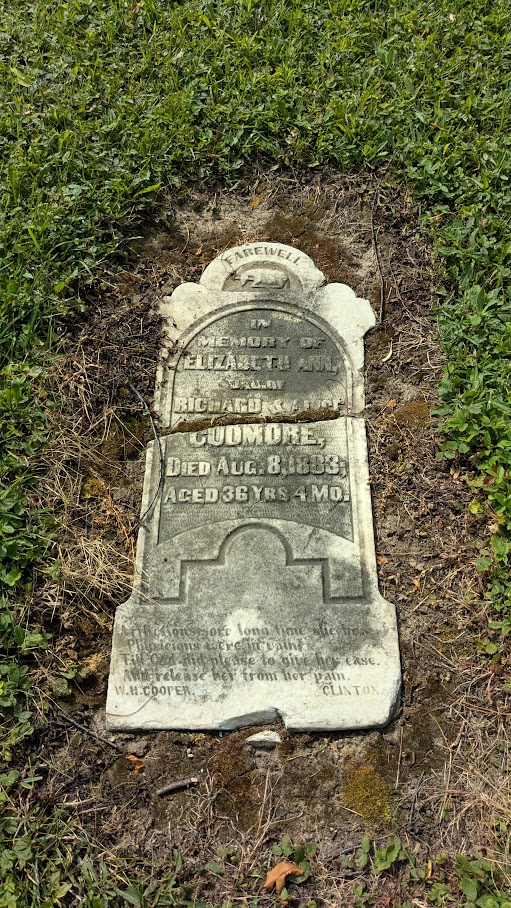
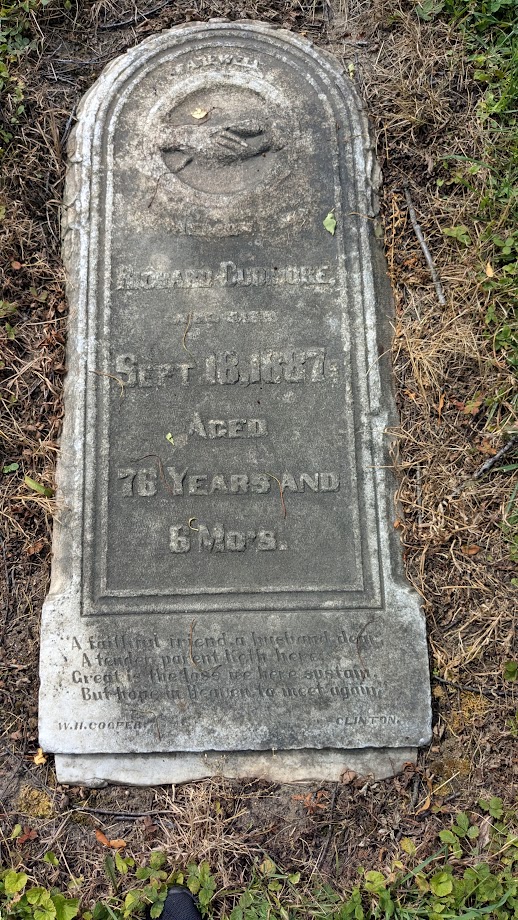
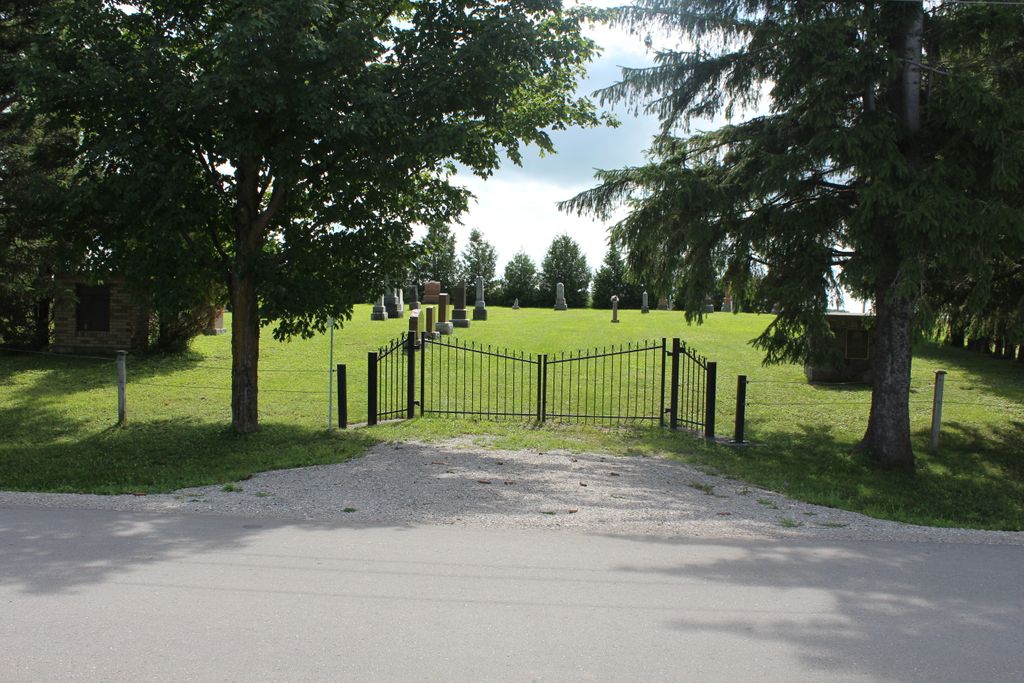
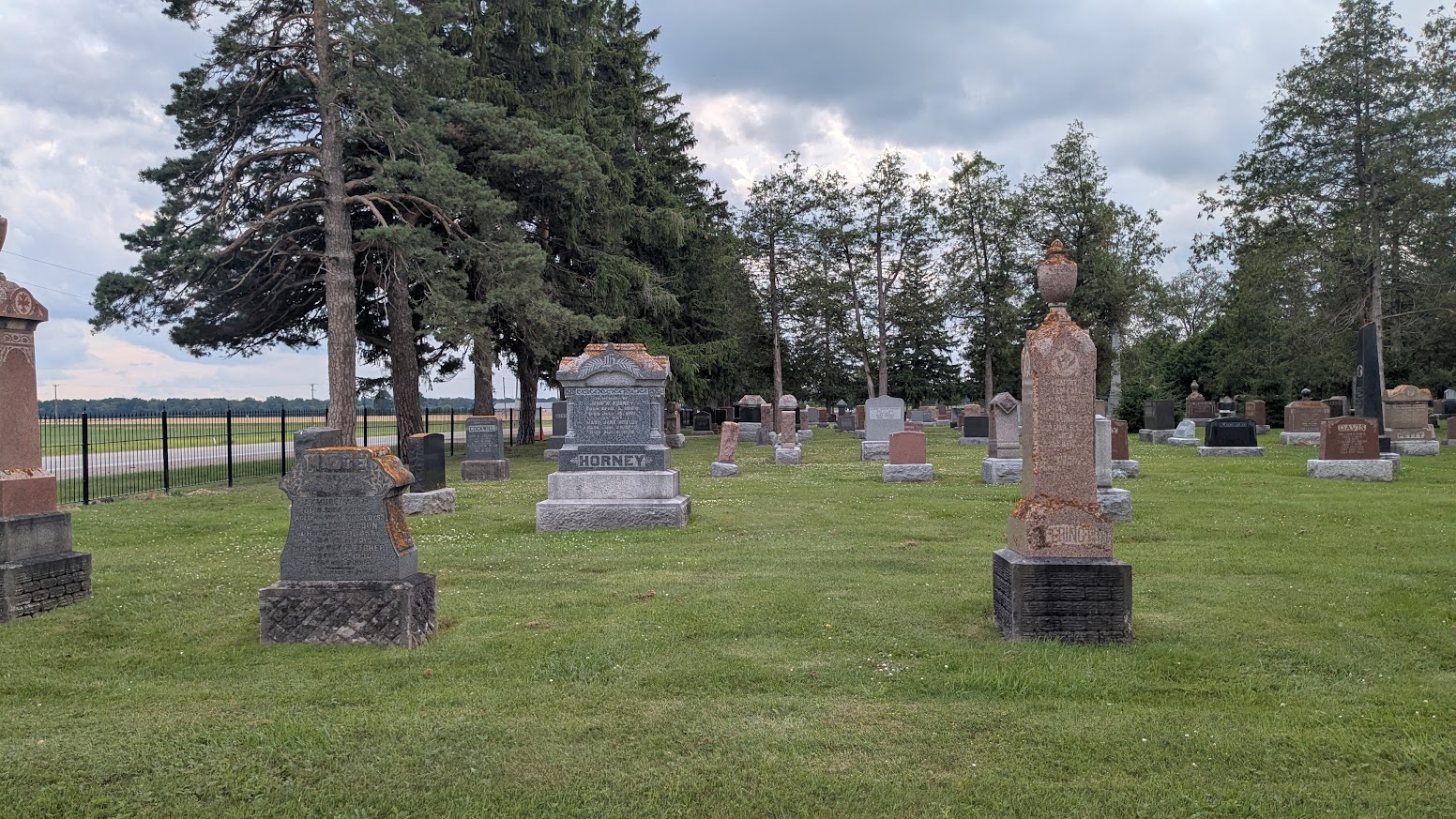
In early 2025, we drove up to Huron County*, Ontario, and visited the graves of Richard Cudmore, and his family members, who had stayed there farming the newly reclaimed land. They lived in log cabins, they cleared the trees, and set up the townships that still exist today. It was quite humbling to visit a tiny roadside cemetery in rural Ontario and find the graves of my family, people who’d travelled out from England to establish themselves on that new farmland.
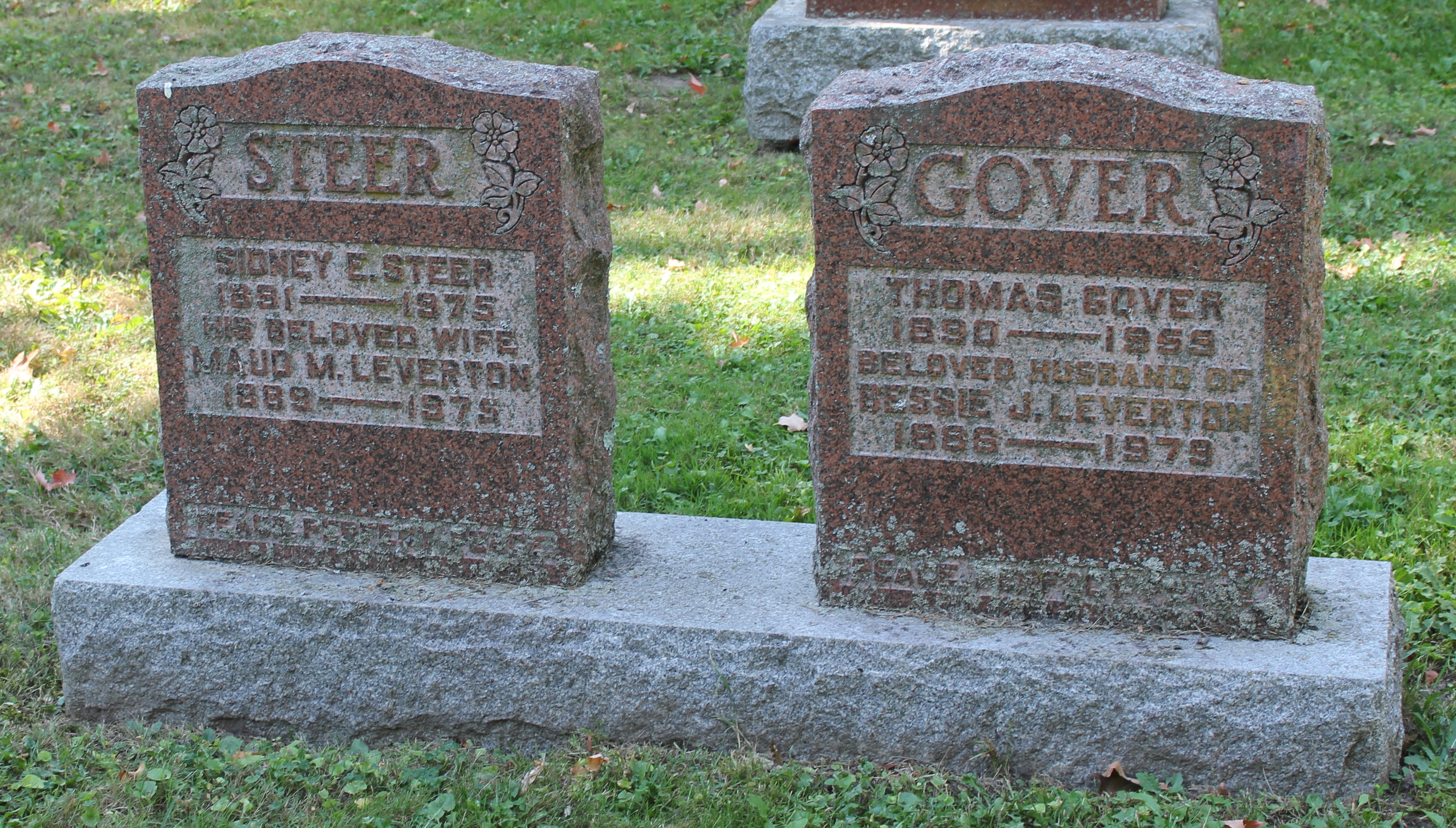
Then just this last week, we went to London, Ontario, to visit some of the graves of the newer immigrants to Canada. The Steer and the Ebsworthy families arrived in Canada from North Devon just before the First World War and established themselves as factory workers, at least initially. Again, it was quite humbling to know that the graves held a little piece of North Devon, and were related, as all the immigrants I’ve mentioned here, to my 3 x great grandfather, William Bater of Dolton.
There were many other arrivals from North Devon into Canada, and not just from the Bater family. The Cater family from Kingskerswell, linked by marriage to my grandmother Lilian Hill, are represented in Newfoundland. John Cater arrived in St. John’s around 1850 and took a job as a shipping agent. He married a local girl, Anne Murphy (most likely with Irish roots, like so many people in Newfoundland), and founded a dynasty of his own that’s centred in Grand Falls. There is an outpost of the Bater family in Winnipeg, Manitoba, and further south in the United States, in Wisconsin, Michigan, Iowa, Illinois, Minnesota, Missouri and beyond, both Baters and Caters have established themselves.
I have no doubt that there are many people like me, discovering the exodus of their families from the UK to Canada and the United States. I’m fortunate to have followed in their footsteps, albeit unwittingly, and have been able to visit not just grave sites but the towns and villages that they lived in.
I have so much more research to do, and so many more people to discover. Who knows where those spirits of the past will take me?
We acknowledge that the land we stand upon today is the traditional territories of the Anishinaabe, Haudenosaunee, and Neutral peoples and is connected to the Dish with One Spoon wampum, under which multiple nations agreed to care for the land and its resources by the Great Lakes in peace.
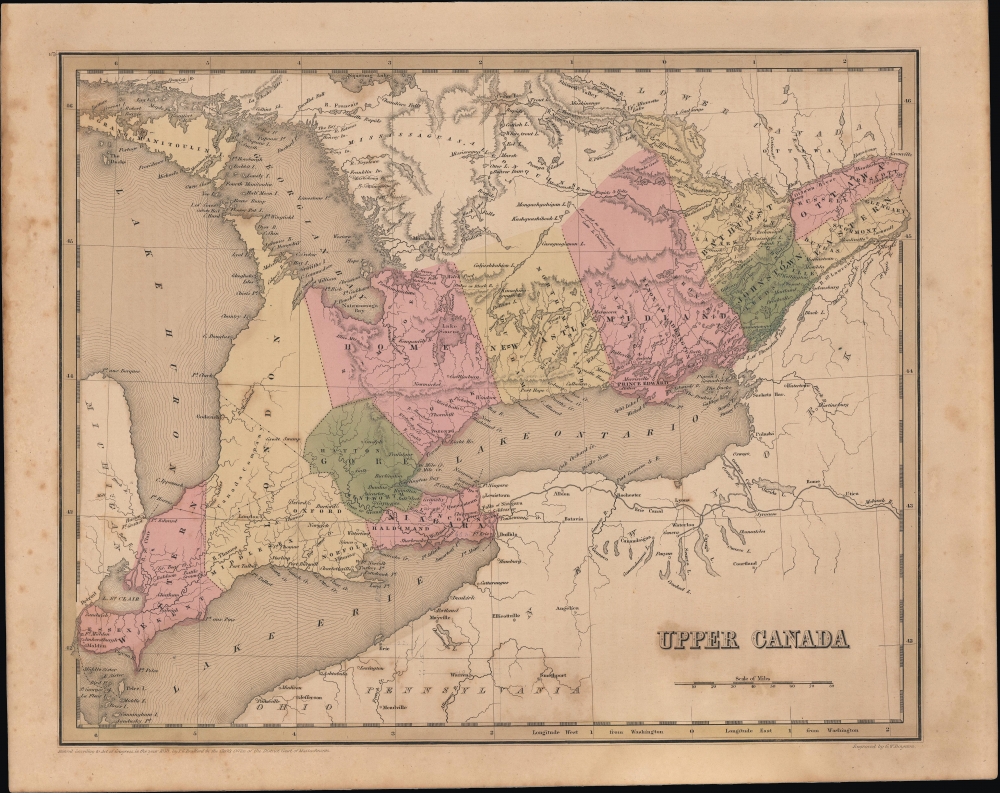
We also acknowledge the Upper Canada Treaties signed in regards to this land, which include Treaty #29 and Treaty #45 ½.
We recognize First Peoples’ continued stewardship of the land and water as well as the historical and ongoing injustices they face in Canada. We accept responsibility as treaty people to renew relationships with First Nation, Métis, and Inuit Peoples through reconciliation, community service, and respect.
We had occasion to visit the lovely town of Blyth, Ontario, in Huron County. It’s about two and half hour’s slow drive from home, and a lovely place to enjoy a play at the annual Blyth Festival. It’s also close to the place where a large group of my relatives, on my mother’s side, had ended up after emigrating from England in the middle of the nineteenth century.
From my family tree research, I had discovered a few graves of those relatives just twenty minutes from Blyth, and this was too good an opportunity to be missed.
At the top of the list was John Richard Cudmore (1811-1887), my great-great-great-granduncle. His sister, Elizabeth Cudmore (1796 – 1873) was my great-great-great-grandmother, and the mother of William Bater (1829-1894), my great-great-grandfather, whose grave we had visited in the churchyard of St Edmund’s, Dolton, when we were in England last year. John Richard, better known simply as Richard, arrived in Canada at some point between 1841 and 1845, and his first Canadian born son, William Horace Cudmore, entered this world while the family were in Tuckersmith Township, now Clinton Township, in 1845.
In the England and Wales Census of 1841, Richard Cudmore is shown as being an agricultural labourer and living in Dolton, Devon. In the Census of Eastern Canada for 1861, Richard is listed as being a farmer and living with his wife Alice and their six children in a single story, log-built house. I can’t verify whether he was farming his own plot of land or working for someone else, but Tuckersmith, like most other rural townships in North America, had been divided up into small parcels of land and it’s likely that he worked one of these. I’ve seen maps of other areas, notably in Kansas and in North Dakota, with the land parcels’ owners named, but the records of Huron County, at least those I’ve found so far, don’t go into that detail.
Richard Cudmore stayed in Tuckersmith for the remainder of his life, and died in 1877. He was buried in Turner’s Cemetery, just south of Vanastra, Ontario, between Clinton and Seaforth, and there he remains. It wasn’t hard to located the cemetery, nor the grave, and it was quite the feeling to be close to one of my relatives, but in a country thousands of miles away from our shared homeland. The cemetery is small, but meticulously maintained (by whom I don’t know), and is fittingly surrounded by the rich, arable farmland that Richard had worked.
Talking of land, I must acknowledge that the area around Tuckersmith is native land and was the subject of Treaty 29, The Huron Tract Purchase, signed by the English Crown and certain Anishinaabe peoples on July 10th, 1827. Full details of the treaty can be read here.
Of course, Richard Cudmore wasn’t the only one of my dead relatives in Turner’s Cemetery. His son John and his daughter Elizabeth are there, as is another daughter, Sarah Alice Crich. There are many members of the Crich family in Turner’s cemetery, as there are on the census listings for the time. It was inevitable that a Cudmore would marry a Crich at some point in Tuckersmith, and of all those Crich family members resting alongside Richard Cudmore, I’m certain that there will be family connections. Indeed, subsequent research has shown up many more family graves in Clinton itself, right up to Keith Ward Jenks, a direct descendent of Richard Cudmore, who died in 1944 when he was aboard a Royal Canadian Navy vessel taking part in the D-Day Landings.
While we were out and about in Huron County, we visited a grave in Harpurhey Cemetery near Seaforth, that of another of Richard Cudmore’s sons, Henry, and his wife Ann. Henry died in 1930 and Ann died in 1945, so their gravestone was significantly newer than those we found in Turner’s Cemetery.
On the way home we called in at the Exeter (Ontario) Cemetery looking for a member of the Crich Family. As it’s quite a large cemetery compared to the country burial sites, and I couldn’t work out the plot numbers, I didn’t find the grave. I’ve since discovered that he’s in his wife’s family plot, the Rowcrofts, so if we go again I know what to look for.
I can only speculate what drove agricultural workers from North Devon to get on a ship and travel to the New World. It may have been a lack of work in England, or it may have been the prospect of being able to own (subject to the treaty of course) some land of their own. My family tree is littered with Baters and Cudmores who travelled from Devon to Canada and to the United States, sometimes landing in one country and ending up in the other, but they were nearly all farmers, or in a trade related to farming.
Following up the descendants of these immigrants, I’ve discovered that after they established themselves, some made their way to other homesteading projects both in Canada and in the USA. Crich family members set up in Saskatchewan, while others went to North Dakota, curiously not too far apart geographically, even if they were in different countries. Indeed, after Richard Cudmore’s death in 1877, his wife Alice went to live with their daughter Ann and her husband John Fitzpatrick, in Park River, North Dakota, and never returned to Tuckersmith Township in Canada.
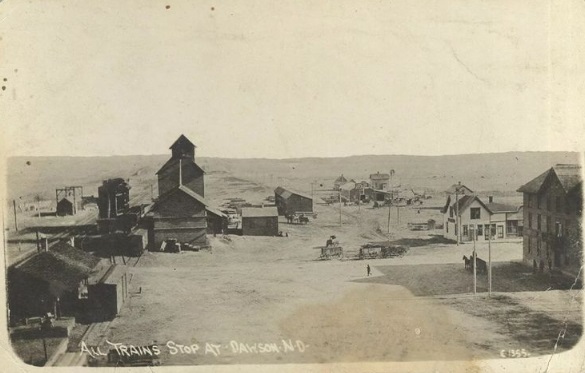
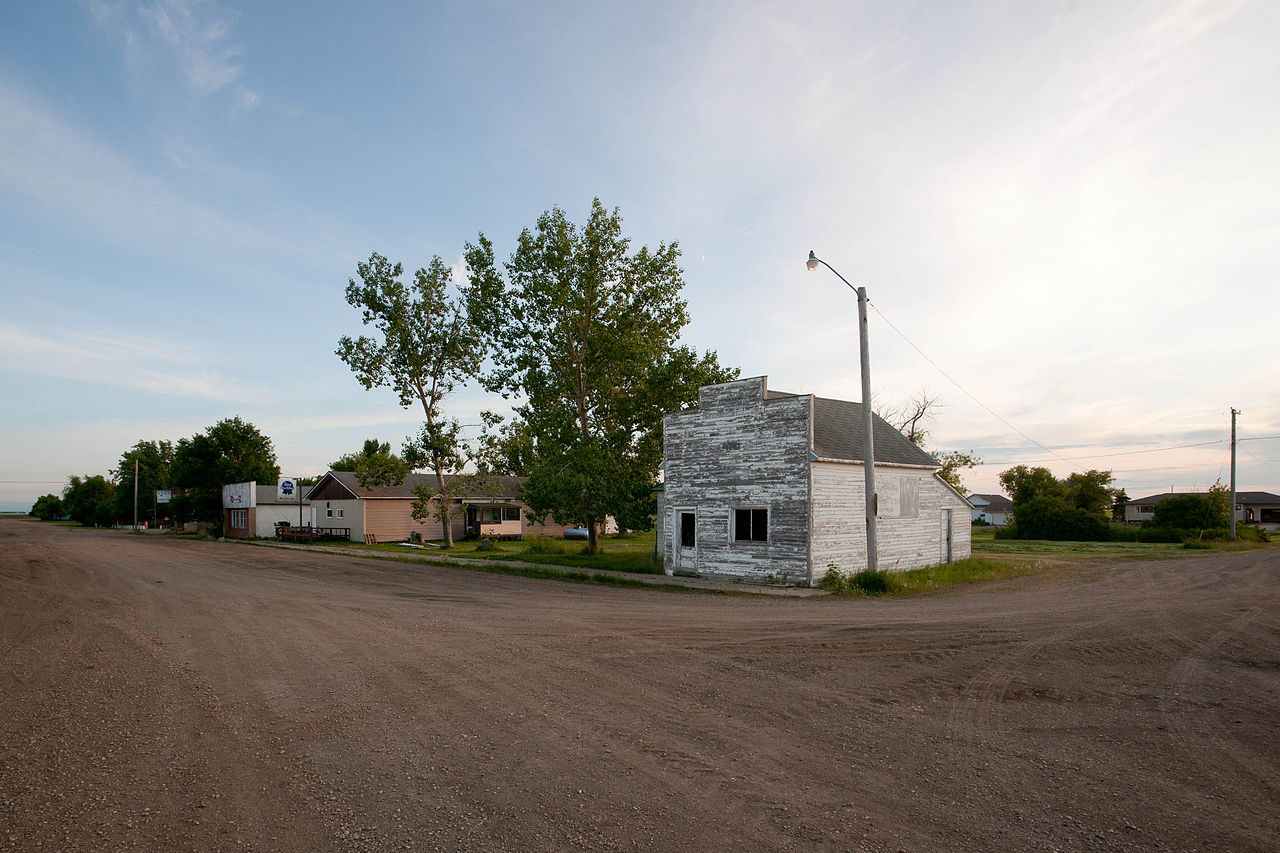
Browsing through Google Maps and Streetview, as I do, I was hugely interested to see the settlements these immigrants made their way to, and what they look like now. One was a town called Wales, North Dakota, which even in it’s heyday was little more than half a dozen grain elevators by the railway track, and Hannah, a little further north, at the end of the railway line, and just a few miles south of the Canadian border. Hannah was very similar to Wales, except that there is a cemetery there and yes, there are some of my family’s graves there. Both Wales and Hannah are little more than ghost towns now, with Wales listed as having a population of ten. However, the land around the towns is still extensively farmed and probably doesn’t look too much different now than it did in the 1920s and 1930s.
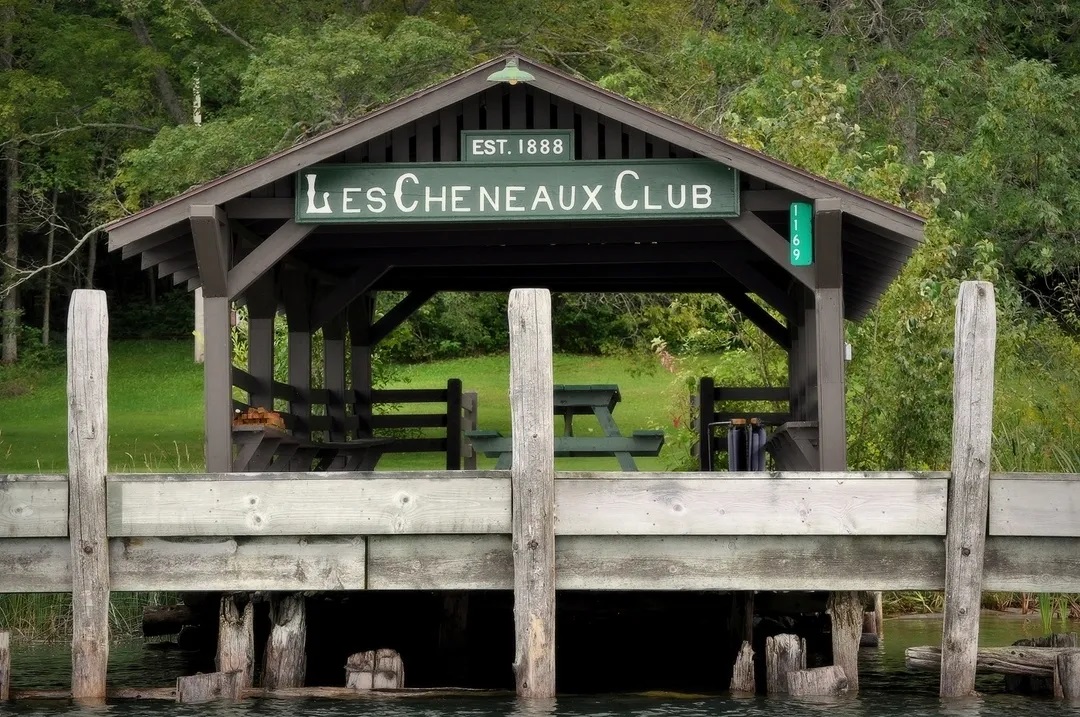
Another branch made their way to Cedarville, Michigan, not too far from Ontario’s Huron County. As some point the family became involved with the Les Cheneaux Club on Marquette Island, which is in the Mackinac Straits and not too far from Mackinac Island. Marquette Island, and specifically the Les Cheneaux Club, was a summer getaway for wealthy Chicagoans when their summers became too hot, and my relatives were caretakers of the Club in summer and winter in the early part of the twentieth century. Indeed, my fourth cousin, once removed, Uldene Ethel LeRoy (nee Rudd), wrote a book called Six on an Island: childhood memories from Lake Huron, which was published in 1956. While searching around for the book, I discovered an undergraduate paper from Grand Valley State University in Grand Rapids, Michigan, written by Uldene’s grandson, Joshua Lycka. It references her book and compares his own memories with hers. The things you find on the Internet!
Both my mother’s and father’s families have extensive connections with emigration to the New World. The Mayne’s led the way, but the Caters and the Cudmores from North Devon, and quite a few of them, followed up a decade or two later, and both branches of the family are now spread far and wide across Canada and the United States. I wonder how much more I will discover as I delve even deeper?
I was born and raised in England, and didn’t immigrate into Canada until I was fifty. As I have discovered, though, I’m not the first of my family to come here, not by a long shot.
On my dad’s side, originally from County Cork in Ireland, we had been generations Leeds, the centre of the industrial heartland of Yorkshire’s West Riding. In the early nineteenth century, a few of the Maynes had left England, one couple to the USA, and two couples to South Africa, but most remained in Leeds. A few generations later there was a small emigration to Alberta, Canada, of more than one couple, and into the twentieth century, Toronto, Ontario, was the destination for a Mayne or two.
But this movement pales into insignificance when compared to my mum’s side of the family, with the Baters and the Caters. Both families are from Devon, in the south west of England. The Caters were from south Devon, south of Dartmoor, and gravitated to the village of Kingskerswell, which lies between Newton Abbot and Torquay. The Caters married into the Hill Family, and the Hills married into the Bater family, but more of that later.
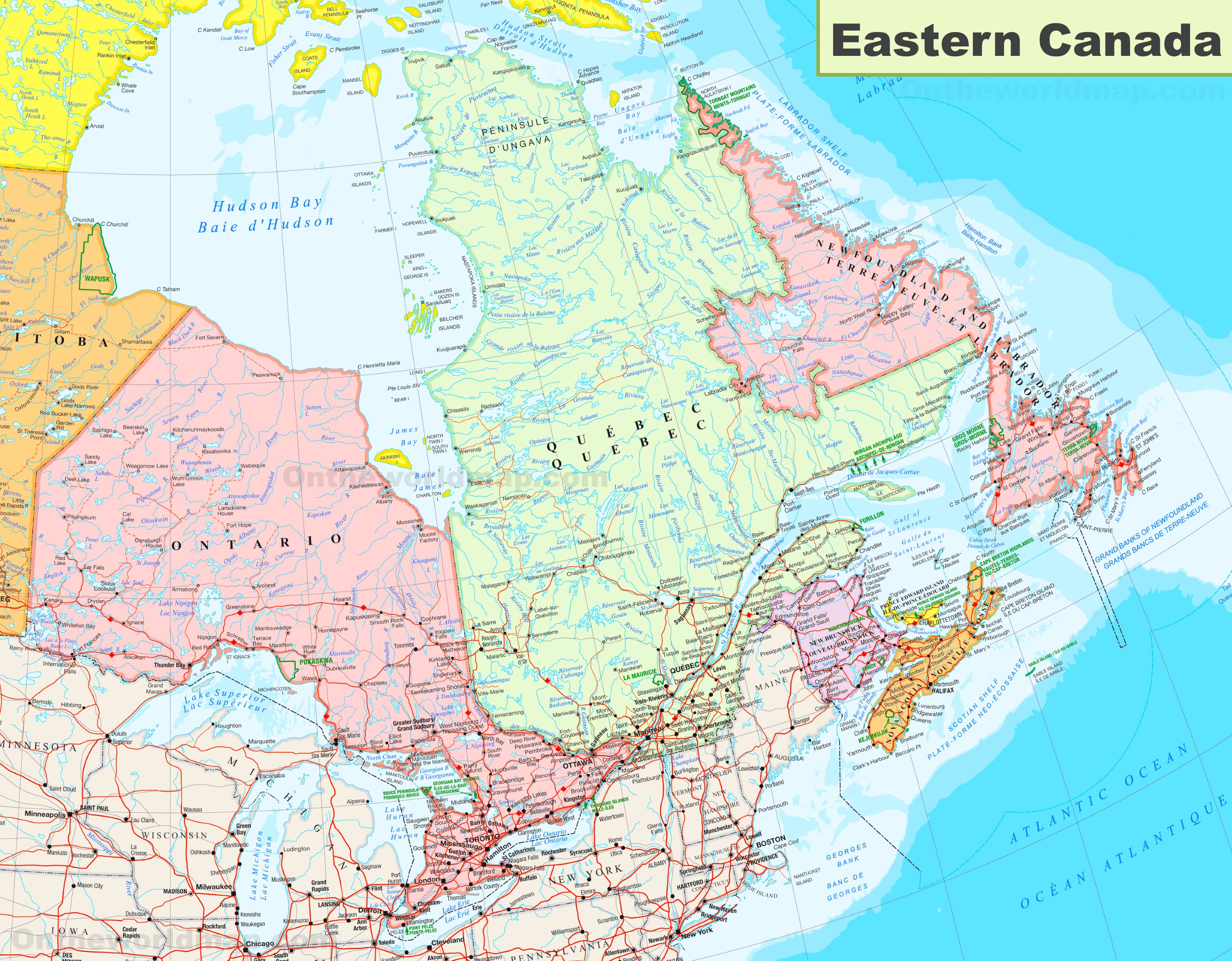
John Cater, born in Kingskerswell, took himself off at some point in the mid 1850s and settled in St John’s, the capital of Newfoundland. He married a local girl, Anne Murphy in 1857, and that started a most extensive dynasty of Caters around that great island. Successive generations lived and died as “Newfies”, but also migrated out into Ontario and into the USA. I’ve recently been in contact with a modern day member of the original John Cater clan, still living in Ontario.
Then there was the Bater family. The Baters come from North Devon, in and around the River Torridge area. To a man, they were all farm workers; some farm owners, some farm workers, but farming was their only profession. In the late nineteenth century there appears to have been a paucity of work for farm labourers, and quite a few of the young men, some with their wives and children, upped sticks and sailed from Appledore in North Devon, to Quebec City in the French-speaking province of Quebec. From there they made their way on the newly laid train network, to Guelph, a community to the west of Toronto. This wasn’t one or two people, it was many, and the period they emigrated stretched from 1870 to 1910. They all seemed to have headed for Guelph, but from there spread out to the farms of Bruce and Middlesex counties, and the industry of Galt, Cambridge and London (Ontario).
Using the number of deaths recorded for family members as a constant for those arriving but never leaving, and that is Caters and Baters, I have 197 in Ontario and 128 in Newfoundland. Of course many have moved on, largely to the USA, but also to other Canadian Provinces. There are many still alive, naturally, and populating modern Canada, but they’re harder to track down.
There was another emigration route from the fields of North Devon, and that was to Peoria in Illinois, USA. It looks like having crossed the Atlantic and arrived at Quebec City, these settlers have embarked on a second vessel (possibly from Toronto, avoiding the St Lawrence River and its shallows), and made the trip through the Great Lakes, Ontario, Huron and Michigan, to Chicago. Then they made their way up the Illinois River to Peoria, and the rich farmlands that were opening up there. Further migration took them down into Kansas and Missouri.
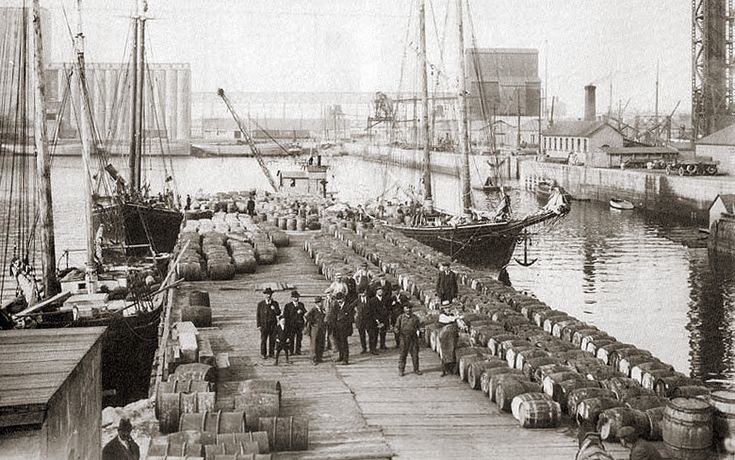
Quebec City Harbour at the end of the nineteenth century
All of this goes to show that I really am a latecomer to the Canadian party. The ease of my move, in a few hours by air, contrasts starkly with the sea voyage undertaken by my ancestors, many of who never made the trip back to England during their lives. These were brave people, setting our for a new life, and pretty much making a success of things, given that I can’t find a Cater or Bater who ever gave up and went back to Devon. I may be a latecomer, but I am in very good company.
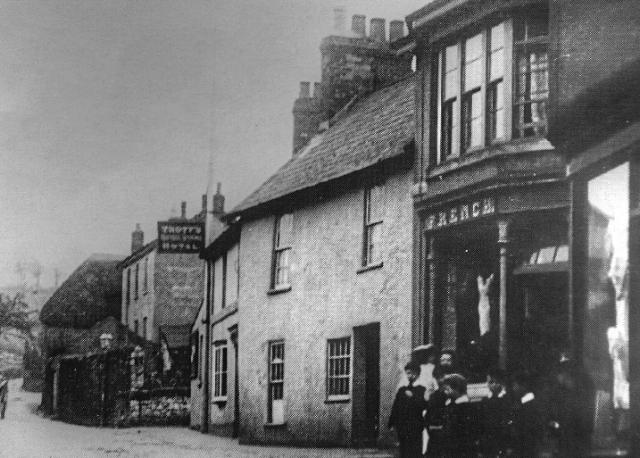
The Seven Stars Inn in Kingskerswell
To finish, the link between the Caters and the Baters was facilitated by the Hill family of Kingskerswell. My maternal grandmother was a Hill, descended from the Caters of Kingskerswell. Her father married a Bater from Dolton, North Devon, and there the link was made. Families, all over the world.
It occurred to me that I hadn’t noted down any details of our trip last August to Fairfield County, Ohio, and the grave of Washington Franklin Mayne. We were in Columbus for the weekend on another matter, but couldn’t pass up the opportunity to visit old WF’s last resting place.
Why? You may well ask.
Washington Franklin Mayne was the third child of Henry Collins Mayne and his wife Anna Robinson, and was born in Loudoun County, Virginia, in 1826. Henry and Anna had arrived in New York from Leeds, in the English county of Yorkshire, in 1822 and made their way to Northern Virginia to set up a farm. Henry’s father, Joshua Mayne, is my great-great-great-Grandfather. Not only was Washington Franklin the third Mayne born on US soil, but he was the last to be born in Virginia as the family moved westwards, to Perry County, Ohio, after his birth.
Not much is known about Washington Franklin as he grew up in the Zanesville Ohio area, but we do know that he studied at Ohio Medical College to become a Doctor and started a practice in the village of Basil, Ohio. As well as being a respected doctor, Washington Franklin acquired a lot of land in Basil and was a well known figure in the area.
The land acquired by Washington Franklin Mayne was on the original lands of the Shawnee, Mingo and Delaware peoples, and their ownership of that land is fully and respectfully acknowledged.
Washington Franklin married Eliza Jane McNeill of Ross County, Ohio, in 1865 and they became the parents of four children while living in Basil.
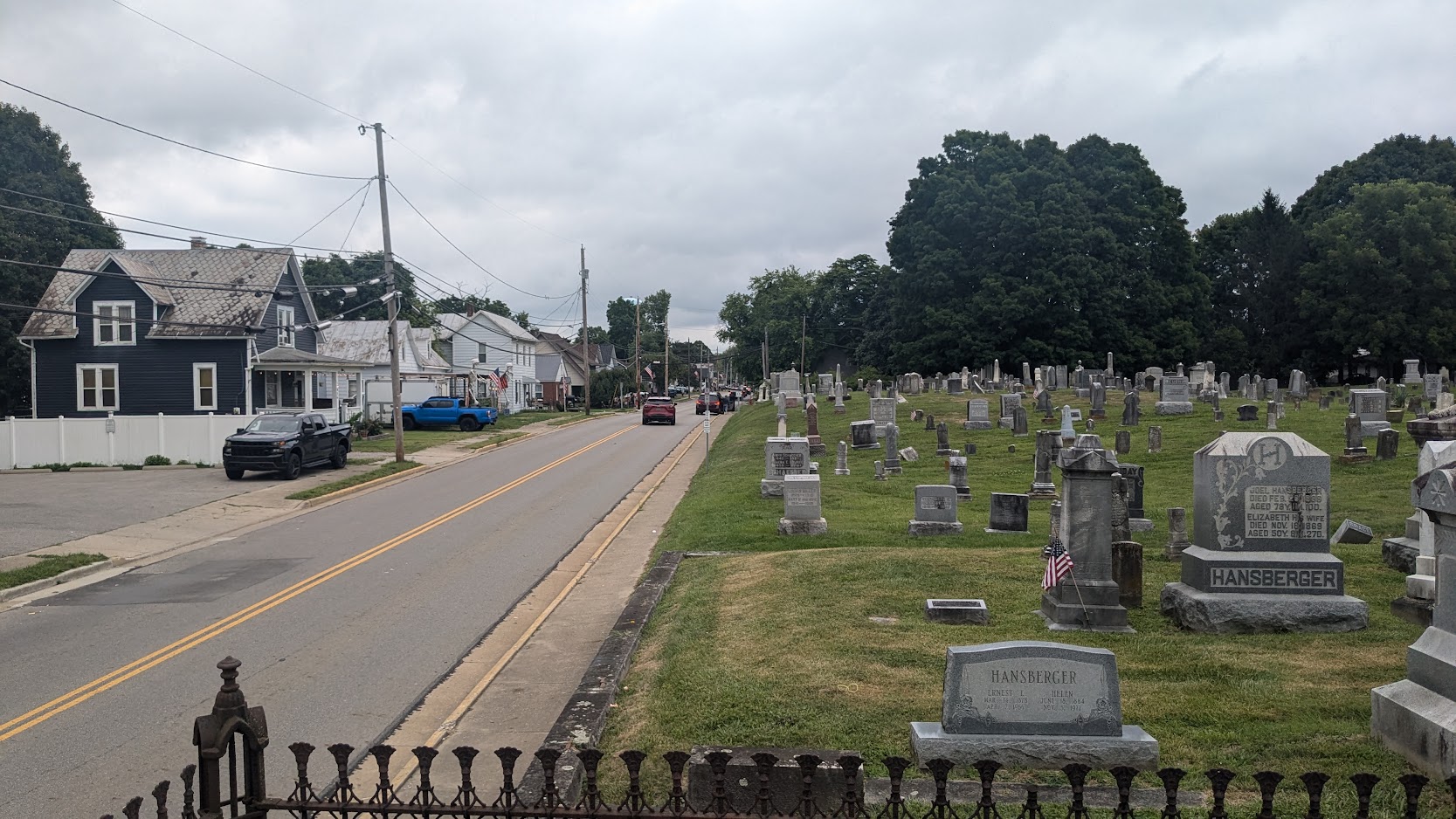
All that is by way of background as to why I would want to visit a small and very pretty little village in rural Ohio. Washington Franklin died in 1884 at the age of 56, and was buried in Basil Cemetery, just yards from the home and doctor’s office he built in the village. Eliza Jane died in 1924 at the home of her daughter Gertrude, in Piqua, Miami County, Ohio. Although buried in Piqua, Eliza’s name is engraved on the handsome stone memorial that marks Washington Franklin’s final resting place.
As we motored south from Columbus, it’s only a 35-minute drive, we both remarked on how similar this part of Ohio was to our part of Ontario; the same crops in the fields, the same buildings on the land. As we arrived in Basil we came across a town parade, an annual event for the people of Baltimore Ohio, the larger town that swallowed up old Basil. I thought perhaps they were out in my honour, but alas, no. We found Washington Franklin’s gravestone easily, stood and soaked up the atmosphere, and I felt really quite humble to be there at the place were one of the founders of the Mayne’s American dynasty had built his life, and the lives of his family.
Washington Franklin and his siblings were the start of a vast family network covering a good portion of the USA, from Indiana to Tennessee, to Kansas and to Colorado, and many places in between. There are many more graves for me to visit, particularly in Indiana, but for now the is trip to see old WF’s grave and the village he made his mark in will have to do.
We’re leaving the kids at home and heading off on our holidays. Two weeks (and a bit) in England, on a long planned but late executed return to my roots. It was supposed to be a sixtieth birthday excursion, but we’re five years late. No matter.
The plan is to spend a week in Yorkshire, among the bones of my long-dead relatives, then to unwind in the great metropolis that is London, for a week. It turns out that I shall again be among the bones of my long-dead relatives because I have recently discovered a whole branch of the family who made it to London in the mid-nineteenth century, living, working, and dying, in places I know well. Not that we shall dwell too much on past family in either Leeds or London, because there is much more to do than sink into family history.
We will also be making a short stop in Plymouth, home to the living relatives of the good Mrs. Mayne, and will be looking forward to meeting Storm Ciarán, which is currently ravaging the west of the country. Fun, fun, fun.
I’ll use this blog to record the trip, more for my own benefit, and when I get back I might just publish a little more widely. Who knows?
Anyway, the first part of the multi-modal trip is about to begin, a drive up the notorious Highway 401, to the airport in Toronto. I’m wishing myself a happy bon voyage.






 Stevemayne's Blog