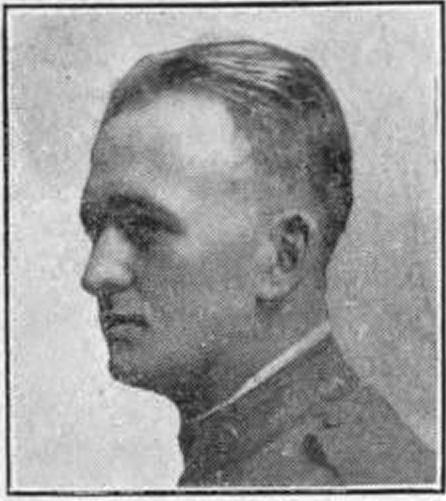
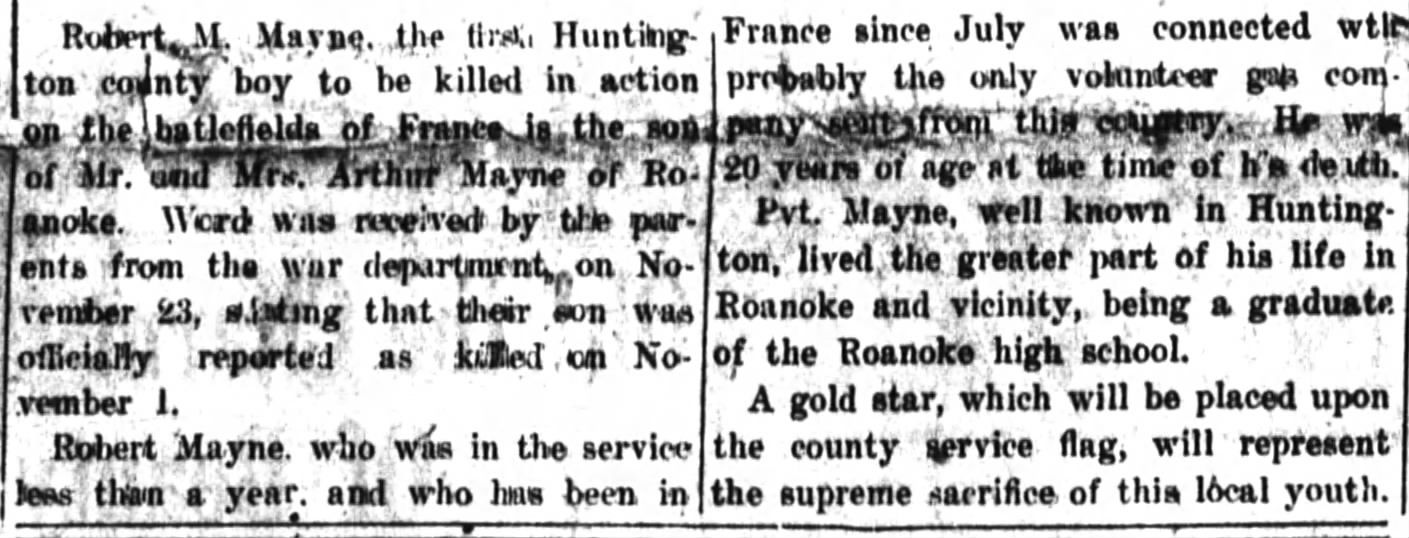
Another Armistice Day entry, and this concerns family member Robert McNeil Mayne, a native of Huntington County, Indiana. Robert was just 21 when he was killed in the US-lead Meuse-Argonne Offensive, late in the First World War. He died on November 1st, 1918, just ten days before the Armistice.
Robert was the only son of Arthur McNeill Mayne and his wife Laura Belle Purviance. He was the great-grandson of Henry Collins Mayne and Anna Robinson, who had left England in 1822 and made their way to New York. Robert and I share a common ancestor in Henry Collins Mayne’s father, Joshua Mayne.
Robert entered service on Feb 18th, 1918 at Fort Wayne and was assigned to Company E, 30th Engineers at Fort Meyer in Virginia. He embarked for France on June 28th, 1918 and was killed at Argonne Forest in Northern France four months later. Robert has the sad distinction of being the first boy from Huntington County to be killed in the Great War. He was buried where he fell.
The Meuse-Argonne Offensive claimed 26,277 American lives, over 28,000 German lives, and an unknown number of French lives, of which Robert was just one. His name is recorded in the Indiana Gold Star Honor Roll 1914-1918.
Like all the other war dead in my family tree, Robert will be in my thoughts on Remembrance Day, November 11th.
I started looking into my family tree a short while before my father died in 2009, but didn’t get very far. I think Ancestry.com was around then, but I hadn’t signed up, and anyway I was heading off for my new life in Canada.
Finding myself with more time than I’d anticipated, I picked everything up again a few years later, and this time I did sign up with Ancestry, which opened up more doors than I thought possible. I now have a family tree with over fourteen thousand people listed (not all that I’d call very close relatives, to be fair), and many of them are, or were, situated in places that I didn’t know my family had reached.
Two things set the ball rolling in an unstoppable way. One was Mary, a native of Indiana, contacting me out of the blue, and the other was doing the Ancestry-linked DNA test.
I was, I will admit, perplexed that I appeared to have a relative from the United States. My family, my dad’s side at least, was pure Yorkshire, from Leeds, I thought. Goodness, how wrong I was. Mary pointed out that we had a common ancestor, Joshua Mayne (b. 1761), and everything fell into place from there. With Mary’s help, I was able to discover that one of Joshua’s offspring had left Britain in 1822, bound for New York, and from there had built a formidable Mayne dynasty in the New World. Not only that, another of Joshua’s sons had, in 1849, taken his young family to Durban in South Africa and had set up a similar Mayne dynasty there. To top it all, Mary established that Joshua himself, and his wife Elizabeth Collins, were not from Yorkshire at all, but had arrived in Leeds from Cork, Ireland in 1792.
The DNA test came up with equal amounts of potential contacts on my mother’s side of the family, as well as my dad’s, and that was an area I hadn’t addressed up to that point. Building up her side of the tree has shown that we were drawn from agricultural stock in the north of Devon, England, and while many of the family had stayed there and are there to this day, many more had moved away from the land for a new life in Canada and, ultimately, in the United States. Indeed, direct Devon relatives had made it to rural Southern Ontario 150 years before I did.
I haven’t yet found the outer limits of the family tree, either on my dad’s or my mum’s side. I can find very little about my paternal grandmother who’s father arrived in Leeds from Belfast, Ireland, at some point in the early 1880s, although my 24% Irish DNA is in part her legacy to me. Her mother was from Leeds, but her father was from Liverpool, and with a name like Garrett, the chances are that there’s Irish blood from him as well.
On the whole, both sides of my family are from poor stock. Some have done well, though, the South African connection has links to the DeBeers diamond industry. There was some conspicuous DeBeers-related wealth on show in the early twentieth century, with homes in Portman Square and Kensington in London, and even a family burial plot in a Royal Park, the Royal Brompton Cemetery in West London.
My grandfather married into, worked for, and eventually took over, the Pickersgill family business in Leeds in the 1920s. Joe Pickersgill, a very wealthy Turf Accountant, was said to have held the Prince of Wales own betting account in the 1910s and was a millionaire when he died in 1923.
On the American side of the tree, a distant cousin married Mariko Terasaki, the daughter of Hidenari Terasaki and Gwendoline Harold, in 1953. Hidenari was a Japanese diplomat who married Gwen, a Tennessee girl, and worked to avoid Japanese conflict with the USA in the late 1930s. Both were forced to flee to Japan after the Pearl Harbor attack, but Gwen wrote a book about her experiences which was made into the Hollywood movie A Bridge To The Sun. Mariko’s children, those that survive, are prominent peace campaigners, following their grandfather’s lead.
But most of my family tree is comprised of poor people doing poor people’s work, and very much echoing the social structure nineteenth and early twentieth century Britain. Farmers, farm workers, labourers, coal miners, and factory workers, all living in mostly poor conditions but surviving nonetheless. One thing that does jump out is the number of war deaths, at the moment numbering seventy-two. One of the first on my family recorded in the Commonwealth War Graves Commission databases was killed when his ship exploded in the Thames estuary in 1914. One of the latest was a young Canadian naval officer, killed two days after D-Day in 1944 when his ship was sunk in the English Channel.
As I’ve grown the tree, there have been a lot of fascinating stories come out about the individuals in it. In future posts here I’ll try to record some of their stories; not about my family necessarily, but the places they lived and the lives they led, which were in large part, entirely typical.
It’s been an education thus far, and I’d like to document as much of it as I can.
I was born and raised in England, and didn’t immigrate into Canada until I was fifty. As I have discovered, though, I’m not the first of my family to come here, not by a long shot.
On my dad’s side, originally from County Cork in Ireland, we had been generations Leeds, the centre of the industrial heartland of Yorkshire’s West Riding. In the early nineteenth century, a few of the Maynes had left England, one couple to the USA, and two couples to South Africa, but most remained in Leeds. A few generations later there was a small emigration to Alberta, Canada, of more than one couple, and into the twentieth century, Toronto, Ontario, was the destination for a Mayne or two.
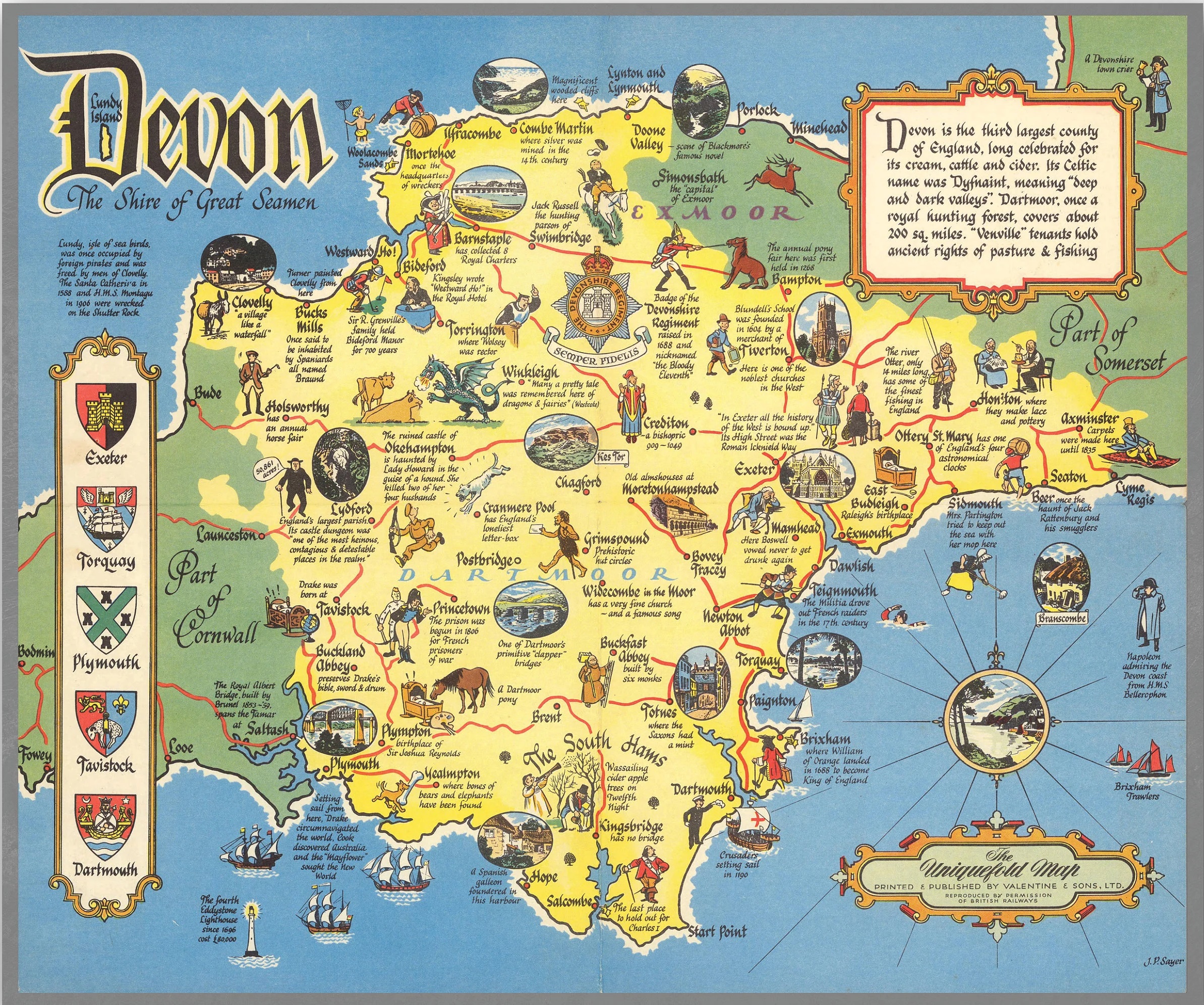
But this movement pales into insignificance when compared to my mum’s side of the family, with the Baters and the Caters. Both families are from Devon, in the south west of England. The Caters were from south Devon, south of Dartmoor, and gravitated to the village of Kingskerswell, which lies between Newton Abbot and Torquay. The Caters married into the Hill Family, and the Hills married into the Bater family, but more of that later.
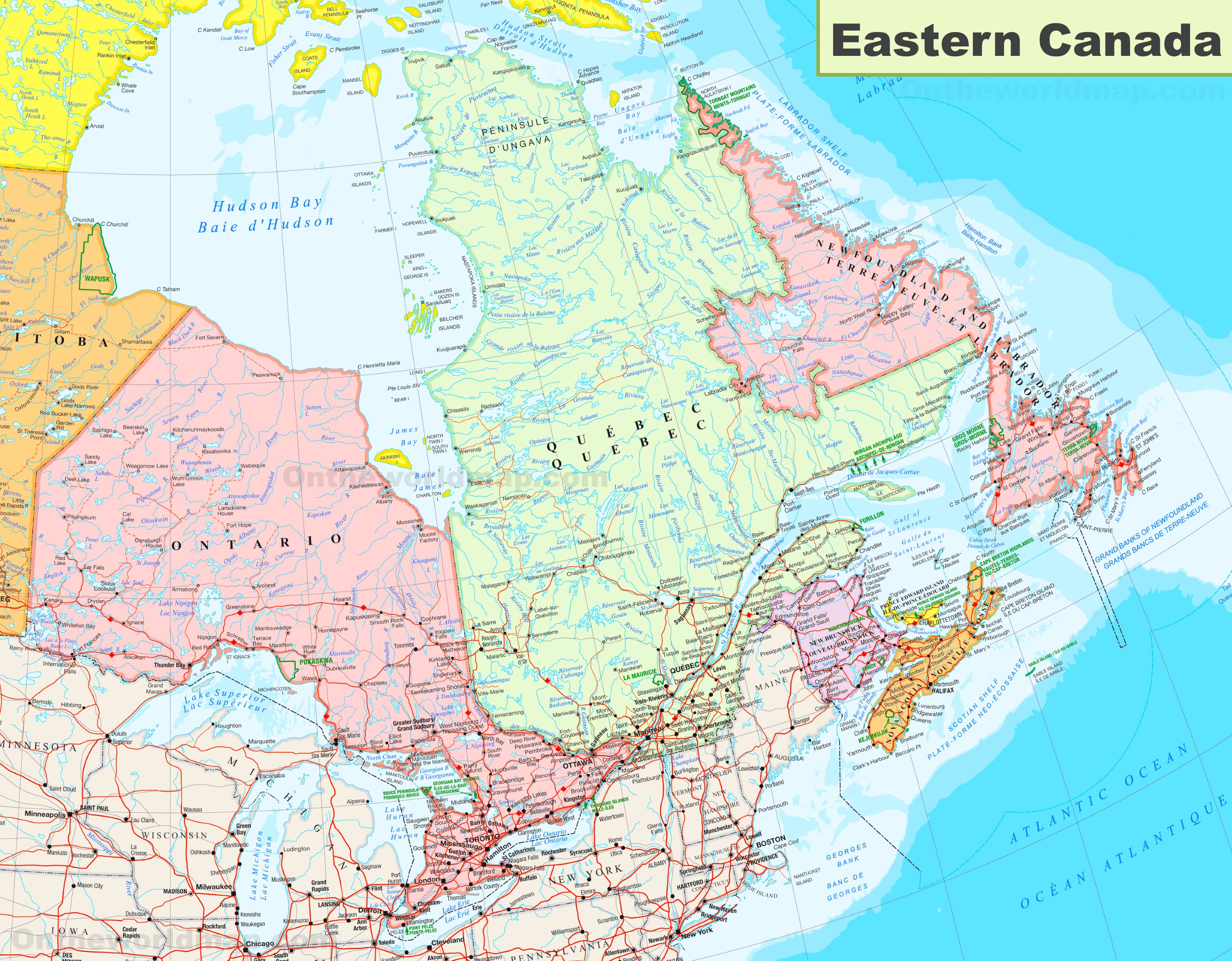
John Cater, born in Kingskerswell, took himself off at some point in the mid 1850s and settled in St John’s, the capital of Newfoundland. He married a local girl, Anne Murphy in 1857, and that started a most extensive dynasty of Caters around that great island. Successive generations lived and died as “Newfies”, but also migrated out into Ontario and into the USA. I’ve recently been in contact with a modern day member of the original John Cater clan, still living in Ontario.
Then there was the Bater family. The Baters come from North Devon, in and around the River Torridge area. To a man, they were all farm workers; some farm owners, some farm workers, but farming was their only profession. In the late nineteenth century there appears to have been a paucity of work for farm labourers, and quite a few of the young men, some with their wives and children, upped sticks and sailed from Appledore in North Devon, to Quebec City in the French-speaking province of Quebec. From there they made their way on the newly laid train network, to Guelph, a community to the west of Toronto. This wasn’t one or two people, it was many, and the period they emigrated stretched from 1870 to 1910. They all seemed to have headed for Guelph, but from there spread out to the farms of Bruce and Middlesex counties, and the industry of Galt, Cambridge and London (Ontario).
Using the number of deaths recorded for family members as a constant for those arriving but never leaving, and that is Caters and Baters, I have 197 in Ontario and 128 in Newfoundland. Of course many have moved on, largely to the USA, but also to other Canadian Provinces. There are many still alive, naturally, and populating modern Canada, but they’re harder to track down.
There was another emigration route from the fields of North Devon, and that was to Peoria in Illinois, USA. It looks like having crossed the Atlantic and arrived at Quebec City, these settlers have embarked on a second vessel (possibly from Toronto, avoiding the St Lawrence River and its shallows), and made the trip through the Great Lakes, Ontario, Huron and Michigan, to Chicago. Then they made their way up the Illinois River to Peoria, and the rich farmlands that were opening up there. Further migration took them down into Kansas and Missouri.
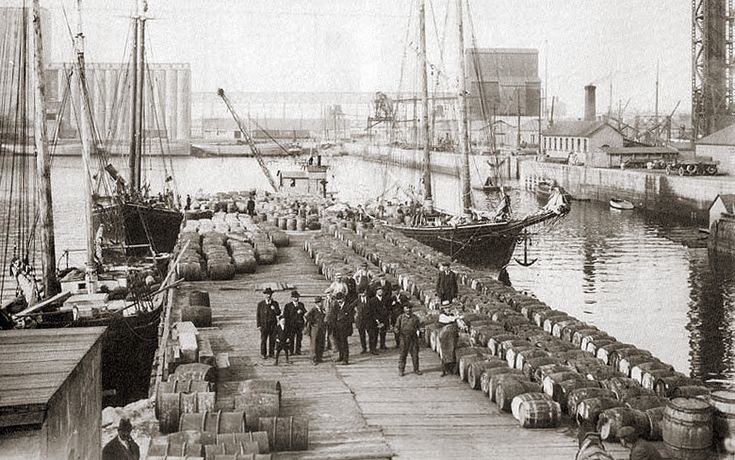
Quebec City Harbour at the end of the nineteenth century
All of this goes to show that I really am a latecomer to the Canadian party. The ease of my move, in a few hours by air, contrasts starkly with the sea voyage undertaken by my ancestors, many of who never made the trip back to England during their lives. These were brave people, setting our for a new life, and pretty much making a success of things, given that I can’t find a Cater or Bater who ever gave up and went back to Devon. I may be a latecomer, but I am in very good company.
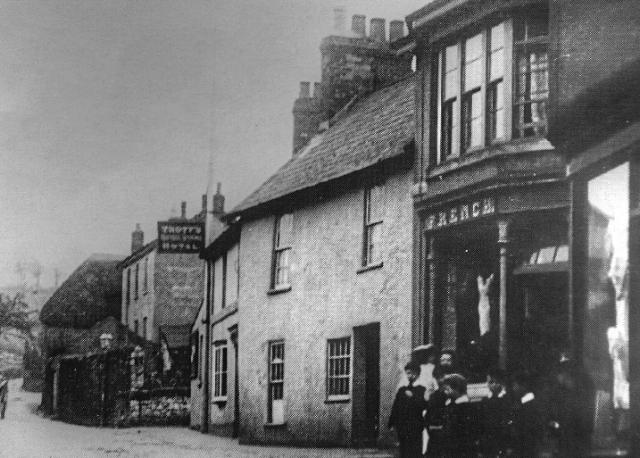
The Seven Stars Inn in Kingskerswell
To finish, the link between the Caters and the Baters was facilitated by the Hill family of Kingskerswell. My maternal grandmother was a Hill, descended from the Caters of Kingskerswell. Her father married a Bater from Dolton, North Devon, and there the link was made. Families, all over the world.
My family tree, or at least my knowledge of it, continues to grow.
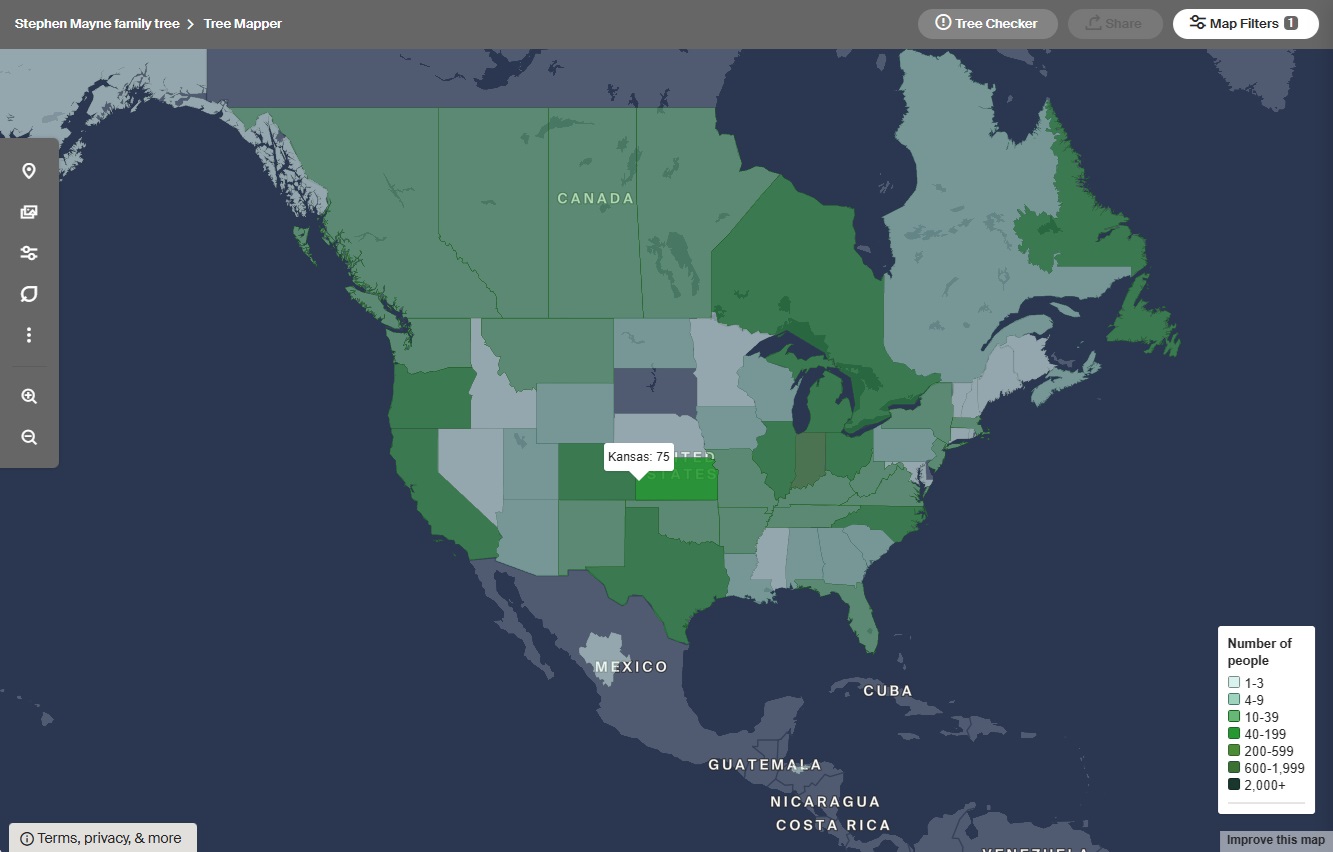
But I’ll start with the headline. Before I started this family tree thing, I wasn’t aware of any of my relatives having lived their lives outside the United Kingdom. Now I know that my relatives lived in Australia, South Africa, Canada, and above everywhere else, the United States of America. Across my mother’s and my father’s sides of the family, we have had relatives die (that’s the measure I use because quite a few returned to England) in forty-eight of the fifty States of the USA. Only Hawaii and South Dakota don’t hold my family’s DNA. I haven’t done a count up, but I’m sure it’s a few thousand or so.
My dad’s side has a sizeable dynasty in the US, centred in Ohio and Indiana, but spread across continental America. Sizeable groups lived and died in Washington State and Oregon, Kansas and Colorado, and down into Texas. Much of the wider spread is Twentieth Century mobility, with sixty-six deaths in California, and thirty-six in Florida leading the way, but the roots have stayed in the Midwest. It started with one couple arriving in New York in 1822, but has been supplemented by relatives arriving in Chicago, Illinois from Ontario, and Montana from Alberta.
Now I find a whole other group of British escapees from my mum’s side of the tree settled in the Peoria, Illinois, area. It seems that they moved rural North Devon and sailed to Montreal in Canada. From there, they caught another ship that sailed down the St Lawrence River, through Lakes Ontario, Huron and Michigan to Chicago, then down the Illinois River to Peoria. They swapped their Devon farms for new land in the Midwest, and established themselves and their communities in the middle of the Nineteenth Century.
Let’s not forget those who stayed in Canada and set themselves up in Newfoundland, Ontario, and Alberta; not as many as in the USA, but still more than I had reckoned on.
I saw a photograph of a bumper sticker today, coined after the recent 2024 US election, that said “This Country Was Built On Immigration”. My family have certainly played their part in that construction.

 Stevemayne's Blog